Thursday, June 29, 2017

The Money (((Masters)))


The Money Masters: How International Bankers Gained Control of America

This documentary is outstanding, overall. I only wish that more would have been said in the WWII segment concerning the successful economic reforms which took place under Adolf Hitler. I am naturally aware that this is an unpopular subject in the mainstream and in the minds of normies who have been lobotomize all their lives. 

But by failing to adequately explore the issue of National Socialist Germany’s debt-free national revival, as well as the foundation of its stable currency against the gold standard, the primary causes of WWII are sure to remain misunderstood. 

Until Hitler’s economic revolution is understood, the establishment’s artificial excuses for that terrible war will continue to be used against us. I trust critical thinkers to review the information available here and elsewhere and make up their own minds. 

-----------------------------------------------------------------------

THE MONEY MASTERS is a 3 1/2 hour non-fiction, historical documentary that traces the origins of the political power structure. The modern political power structure has its roots in the hidden manipulation and accumulation of gold and other forms of money. The development of fractional reserve banking practices in the 17th century brought to a cunning sophistication the secret techniques initially used by goldsmiths fraudulently to accumulate wealth. 

With the formation of the privately-owned Bank of England in 1694, the yoke of economic slavery to a privately-owned “central” bank was first forced upon the backs of an entire nation, not removed but only made heavier with the passing of the three centuries to our day. Nation after nation has fallen prey to this cabal of international central bankers.

The success of the central banking scheme developed into a far-reaching plan described by President Clinton’s mentor, Georgetown Professor Carroll Quigley: 

"to create a world system of financial control in private hands able to dominate the political system of each country and the economy of the world as a whole. This system was to be controlled in a feudalist fashion by the central banks of the world acting in concert, by secret agreements arrived at in frequent meetings and conferences. 

The apex of the system was to be the Bank for International Settlements in Basel, Switzerland, a private bank owned and controlled by the world’s central banks which were themselves private corporations. Each central bank sought to dominate its government by its ability to control Treasury loans, to manipulate foreign exchanges, to influence the levels of economic activity in the country, and to influence cooperative politicians by subsequent economic rewards in the business world.”

Several short-lived attempts to impose the central banking scheme on the United States were defeated by the patriotic efforts of Presidents Madison, Jefferson, Jackson, Van Buren and Lincoln. But with the passage of the Federal Reserve Act of 1913, America was firmly lashed to the same yoke, so that a small number of very rich men have been able to lay upon the masses a yoke little better than slavery itself. 

That yoke inevitably grows heavier with ever-compounding interest, and totals over $20 trillion of debt owed by the American people today ($80,000 per American) ultimately to these bankers. This vast accumulation of wealth concentrates immense power and despotic economic domination in the hands of the few central bankers:

"who are able to govern credit and its allotment, for this reason supplying, so to speak, the life-blood to the entire economic body, and grasping, as it were, in their hands the very soul of the economy so that no one dare breathe against their will.”

Segments: 

•The Problem

•The Money Changers

•Roman Empire

•The Goldsmiths of Medieval England

•Tally Sticks 

•The Bank of England

•The Rise of the Rothschilds

•The American Revolution

•The Bank of North America 

•The Constitutional Convention 

•First Bank of the U.S.

•Napoleon’s Rise to Power

•Death of the First Bank of the U.S. / War of 1812

•Waterloo

•Second Bank of the U.S.

•Andrew Jackson

•Abe Lincoln and the Civil War

•The Return of the Gold Standard

•Free Silver

•J.P. Morgan / 1907 Crash; Jekyll Island

•Fed Act of 1913

•J.P. Morgan / WWI 

•Roaring 20s / Great Depression

•FDR / WWII / Fort Knox

•World Central Bank

Conclusions:

“Let me issue and control a nation’s money and I care not who writes the laws.” - Mayer Amschel Rothschild (1744-1812), founder of the House of Rothschild.

"When a government is dependent upon bankers for money, they and not the leaders of the government control the situation, since the hand that gives is above the hand that takes… Money has no motherland; financiers are without patriotism and without decency; their sole object is gain.” – Napoleon Bonaparte, Emperor of France, 1815

"If the American people ever allow private banks to control the issue of their currency, first by inflation, then by deflation, the banks…will deprive the people of all property until their children wake-up homeless on the continent their fathers conquered… The issuing power should be taken from the banks and restored to the people, to whom it properly belongs.” – Thomas Jefferson in the debate over the Re-charter of the Bank Bill (1809)

“I believe that banking institutions are more dangerous to our liberties than standing armies.” – Thomas Jefferson

“…The modern theory of the perpetuation of debt has drenched the earth with blood, and crushed its inhabitants under burdens ever accumulating.” - Thomas Jefferson

“History records that the money changers have used every form of abuse, intrigue, deceit, and violent means possible to maintain their control over governments by controlling money and its issuance.” - James Madison

“The few who understand the system will either be so interested in its profits or be so dependent upon its favours that there will be no opposition from that class, while on the other hand, the great body of people, mentally incapable of comprehending the tremendous advantage that capital derives from the system, will bear its burdens without complaint, and perhaps without even suspecting that the system is inimical to their interests.” - The Rothschild brothers of London writing to associates in New York, 1863.

“The Government should create, issue, and circulate all the currency and credits needed to satisfy the spending power of the Government and the buying power of consumers. By the adoption of these principles, the taxpayers will be saved immense sums of interest. Money will cease to be master and become the servant of humanity.” - Abraham Lincoln

“The death of Lincoln was a disaster… There was no man in the United States great enough to wear his boots and the bankers went anew to grab the riches. I fear that foreign bankers with their craftiness and tortuous tricks will entirely control the exuberant riches of America and use it to systematically corrupt civilization.” - Otto von Bismark (1815-1898), German Chancellor, after the Lincoln assassination

“Issue of currency should be lodged with the government and be protected from domination by Wall Street. We are opposed to…provisions [which] would place our currency and credit system in private hands.” – Theodore Roosevelt

Despite these warnings, Woodrow Wilson signed the 1913 Federal Reserve Act. A few years later he wrote:

“I am a most unhappy man. I have unwittingly ruined my country. A great industrial nation is controlled by its system of credit. Our system of credit is concentrated. The growth of the nation, therefore, and all our activities are in the hands of a few men. We have come to be one of the worst ruled, one of the most completely controlled and dominated Governments in the civilized world no longer a Government by free opinion, no longer a Government by conviction and the vote of the majority, but a Government by the opinion and duress of a small group of dominant men.” - Woodrow Wilson

“I am afraid the ordinary citizen will not like to be told that the banks can and do create money. And they who control the credit of the nation direct the policy of Governments and hold in the hollow of their hand the destiny of the people.” - Reginald McKenna, as Chairman of the Midland Bank, addressing stockholders in 1924.

"It is well enough that people of the nation do not understand our banking and money system, for if they did, I believe there would be a revolution before tomorrow morning.” - Henry Ford, founder of the Ford Motor Company.

“The study of money, above all other fields in economics, is one in which complexity is used to disguise truth or to evade truth, not to reveal it. The process by which banks create money is so simple the mind is repelled. With something so important, a deeper mystery seems only decent.” - John Kenneth Galbraith (1908- ), former professor of economics at Harvard, writing in ‘Money: Whence it came, where it went’ (1975).


Thursday, June 22, 2017

In Defense Of "Losers"

By Aedon Cassiel


Originally, I had planned for this essay to be a response to Jack Donovan’s still relatively recent essay, “Why I Am Not a White Nationalist.” However, I’ve decided that this essay would work better if thought of as an extended discussion of a couple of the topics raised by Donovan’s essay, rather than as another open letter response aimed at Donovan himself. In part, this means it will only address a fraction of the things Donovan actually said.

Beyond the Buddy System

For the most part, the subtext of these arguments was not really “why I disagree with the premises of ethnonationalism” so much as it was “why I don’t personally want to buddy up with everyone who identifies as a White Nationalist.” Since Donovan’s entire political philosophy now appears to be “cracking open a cold one with the boys in the woods,” it makes sense why he would implicitly muddle the distinction in this way between what one’s political philosophy is and who one would like to buddy up with.

I don’t have to be ‘buddied up’ with everyone I want to form political alliances with. Indeed, the inability to form and negotiate political alliances with people who aren’t pals and bros is a kind of weakness. And it is a kind of weakness that will be bred out of the world by evolution, because groups that are capable of this will inevitably dominate groups that can’t. If the United States government were to turn against the Wolves of Vinland and try to wipe it out of existence, how long do you think the Wolves would survive? I think it would be reasonable to bet they wouldn’t last a week. And why is that?

It’s because the United States government is a larger entity than the Wolves. And the United States government is a larger entity than the Wolves because membership in it is based on shared dedication to common principles and goals as well as consent to the hierarchy of an overarching command structure—not whether or not everyone who joins the U.S. government wants to buddy up with each other. The U.S. government’s capacity for domination of fringe groups like the Wolves is, in and of itself, proof that political alliances built out of principle and extended hierarchy rather than “buddying up” will trump isolated, small–tribe “groups of buddies” every time.

In light of this, Donovan should ask himself why he’s in favor of forming groups of “buddy-based” tribes in the first place. Whatever answers he gives for why individuals should network together to form tribal groups will probably end up being the same exact reasons why those very tribal groups should network together to form larger political blocs.

I say this truly—I really do respect the inner core of the anarcho-primitivist instinct. If I had the choice to live in a thoroughly anarcho-primitivist world, I would be tempted to take it.

But in reality, the inevitable course of events is that tribes will either network into political blocs that grow to the scale of governments, or else they will be dominated by whatever other network of tribes manages to do so first. For a historical analysis of this aspect of the relationship between tribal warfare and the formation of ordered civilizations throughout history, Ian Morris’ War! What Is It Good For? Conflict and the Progress of Civilization from Primates to Robots gets my highest possible recommendation. In short, this is the scenario that repeats on an endless cycle all over the world: individuals form into tribes, and these tribes either grow to the scale of governments that eventually rule over the other tribes—or else they end up dominated themselves because some other tribe built itself up to that level first. Like it or not, one’s tribe either “dominates” or grows to become “dominated.”

But as far as Jack Donovan personally goes, there isn’t much left for argument on this point to prove. Either a time will come within Donovan’s lifetime when his tribe needs a more extended network in order to protect itself against outside assaults from activist enemies ethnonationalists share in common—or there won’t. Either ethnonationalists will be organized enough to be able to usefully offer this kind of protection at that time—or they won’t. Either Donovan’s disavowal of the most crude “skinhead” types in the movement will help shift the Leftist bullseye off of his back, even if it doesn’t remove it completely—or it won’t.

Either way you go, these are all inconclusive predictions of the future; this is not a case where we can pontificate and produce “proof.” In the meantime, all any of us are doing is building our own personal projects while discussing them with our often separate, sometimes overlapping followings . . . and all of us, in our own ways, are ultimately trying to prepare for civilization to collapse. Should the collapse set in within our lifetimes, we’ll just have to see who makes it out given however the general situation will have changed by that time.

And on that point, there really isn’t anything left to be said. So this concludes the first point raised by Donovan’s essay that I thought there might be some value in discussing.

What if We Really are “Losers”?

The second point I thought there might be some value in discussing is Donovan’s suggestion that White Nationalism will fail because of White Nationalists. Throughout the essay, Donovan continually refers back to the most tired Left-liberal characterizations of what kinds of people “White Nationalists” supposedly are: men with “‘white pride’ tattooed on [their] chest[s]” who “theatrically claim to be proud of being white because it is usually the only thing they have going for them.” To be fair, this may very well describe Donovan’s personal encounters with self-professed “White Nationalists.” But to speak for myself, I’ve been involved with Counter-Currents for long enough to have accumulated a rather large pool of people I would call “White Nationalists,” and I’m quite certain I have literally never met a single one who had “white pride” tattooed either on their chests or otherwise.

In fact, most “White Nationalists” I know would look down on anyone who has any tattoos at all—Richard Spencer thinks tattoos are degenerate, for example. For this new generation, “white pride” isn’t something “white supremacists” boast about, it’s just what regular old milquetoast conservatives who read outlets like Breitbart or The Blaze try to ironically (and ineffectually) throw back in the face of liberals when the topic of black or Mexican pride comes up. The average “White Nationalists” of the younger generations today are likely educated enough to be familiar with findings from the field of biosocial criminology showing that genes do indeed have an influence on the propensity to criminal behavior, probably turned in the direction that led them towards ethnonationalism after liberal researcher Robert Putnam finally published his results showing the negative impacts of diversity brought by immigration on community trust, hate drugs and porn and promiscuity, desperately want to build wholesome families, and are genuinely afraid to reveal their views to their peers.

The nature of the “movement” (such as it is) is changing rapidly, and part of the issue here may simply be that Jack Donovan has relatively more contact with the older breed of “White Nationalists” that most people in the new generation only know from cheesy stereotypes.
Either way, this finally brings me to the second point I want to discuss.

If White Nationalists were losers, just what would that prove?

Let’s grant it just for the sake of the argument: let’s assume 100% of people who identify as “White Nationalists” are “losers” in a broad sense.

Well, one could make a similar argument about welfare. According to your definition, you could say that most or all people who rely on welfare to survive are “losers,” in the sense that they would literally “lose” without welfare because they can’t stand on their own feet (or else they wouldn’t be on it in the first place). But what would liberals think about an argument that said that welfarism is dumb because people on welfare are “losers”? Certainly they would recognize it as a non sequitur: so maybe they are “losers”—does that mean we should let them starve in the streets? “Not so fast,” they’d respond.

Let’s step back for a moment.

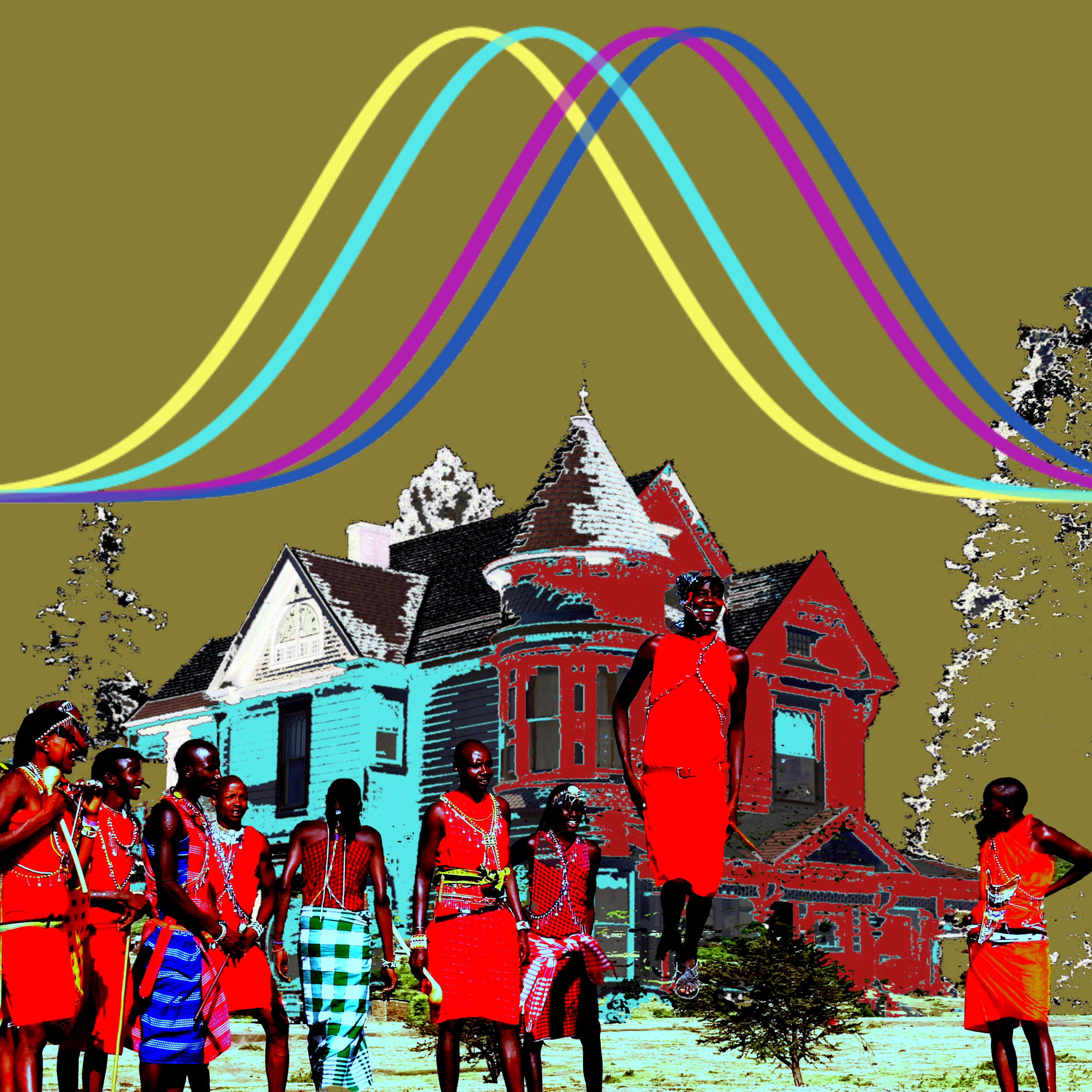
Within any given race, all traits are distributed along bell curves.

On the one hand, this means it will always be true that keeping groups with different bell curves separate will lead to more social cohesion than mixing them willy nilly—as is validated by the literature on diversity and social cohesion that began with the previously mentioned research from liberal Robert Putnam.

On the other hand, it also entails that there will always be a minority of outliers in any given group who actually are more similar to the average member of a different group than they are to the average member of their own.

These minorities will always exist. But because of—you know—the very meaning of the word “average,” it follows that they will also always be in the minority. So even if not all admixture leads directly to reduced social cohesion, a totally segregated society would still always be more cohesive than a totally integrated society.

Now, suppose you live in an area like Palo Alto, California. The average rent in Palo Alto is almost $2,800 for a single bedroom apartment, and these expenses keep out anyone who can’t afford to pay. As it turns out, one’s IQ predicts one’s future wealth better than one’s wealth predicts one’s future IQ scores. This means if there are some groups with low average IQs and low wealth, then someone who lives in Palo Alto will have experiences almost exclusively with the outliers from that group—the few that are unlike most of the rest of them. A similar point would go for a black man whose only experiences with white men are in underground rap battle scenes: such an environment would inherently select for white men who are more extroverted, aggressive, and impulsive than the white male average; and this particular black man could end up as a result with an inaccurate idea of what most white men are really like as a result.

In other words, smart and successful whites who dismiss the “racism” of lower IQ whites who decry the negative effects of diversity because those whites aren’t as smart or successful as others might be rather like the tallest man in the room mocking everyone around him for drowning while the room they’re in begins to flood, dismissing them because he thinks they’re too short to have a valid opinion. It turns out that actually experiencing diversity also predicts one’s holding a negative view of it. Evidence like this suggests that it is much more often those who haven’t experienced as much diversity who imagine that its effects on a community are better than they really are, than it is those who haven’t lived around large members of other races who expect they would find the experience to be less enjoyable than they really would.

And IQ helps predict one’s experiences with diversity. When more successful whites enter diverse areas, they inevitably end up “gentrifying” them. And guess what happens when middle and upper class regions full of successful whites grow increasingly diverse? “White flight”. This deserves repetition for emphasis: do more successful, higher IQ whites stay or go when regions grow more diverse? As a matter of fact, they go. As regions grow more diverse, very large numbers of those whites who can leave in fact do. Thus, more successful whites never have to think about the idea of ethnonationalism, for exactly the same reason they never have to think about food stamps and other forms of welfare.

While it is absurd that this simultaneous condemnation of “gentrification” and “white flight” leaves successful whites damned if they do and damned if they don’t, whether they stay or they go (in other words, if they do just about anything other than give all their money away to blacks as one Baltimore professor insists or else just plain drop dead), there is truth to the fact that both these phenomena imply forms of “privilege”: successful whites rarely, if ever, have to experience any form of “diversity” that doesn’t entail skimming the cream of the crop off of outside groups while staying safely sequestered away from the rest. Less successful whites aren’t so lucky—as successful whites move away, they get left behind. Thus, it is actually less successful whites who end up acquainted with what multiculturalism actually is like, in the real world, for most people, most of the time. Should they be forced to live in increasingly stratified communities because someone thinks they aren’t intelligent enough to be worth caring about?

Are they really just too dumb to deserve cohesive communities to live in?