Tuesday, March 31, 2020

The Plowman In The Library

 By Fullmoon Ancestry

Hans Holbein the Younger, The Plowman from Dance of Death, 1524-26.


I’ve spent the last 21 days in quarantine. To be honest, staying inside these last three weeks has been relatively easy for me. After all, I spent most of my time in college by myself reading books in the university library. Looking back at my experience in college, I think my real education came not from the lectures or assigned readings, but from the books I decided to read on my own out of interest and curiosity. One such book was a prose version of Piers Plowman, the 14th-century poem attributed to William Langland. In many ways, the themes of this poem reflect both my times in college and the last three weeks spent inside my home during the ongoing COVID-19 pandemic.

When I was a teenager, I didn’t want to go to college. I didn’t really enjoy high school, but that was mostly because my high school seemed like a daycare for non-whites who would have otherwise been out in public committing crimes. And while I enjoyed writing stories and playing heavy metal music as a teenager, I may not have been mature or committed enough to go to a music school or a writing program. If I had any career plan as a teen, I remember wanting to become a car salesman after high school as it seemed interesting and I thought I would be good at it.

Naturally, my mom wanted the best for me, so she insisted that I go to college. She even helped me apply for scholarships and supported me for the four years it took to get a bachelor’s degree. I didn’t know what field I wanted to major in or study, so I just picked History as that seemed the most appealing to me. At the time, I thought that it didn’t matter what major I selected. I just thought that having any college degree would get me a fancy job after graduation.

The bright side was that I was able to find a state university where the student population was overwhelmingly white. Of course, being a metalhead and the son of a police officer who was well-versed on the differences in racial crime-statistics, I quickly realized that I didn’t have much in common with the typical, liberal-minded college student. I also started to become aware of the anti-white propaganda in many of the required courses, particularly the mandatory sociology, anthropology, and introductory history courses.

As much as I disliked high school, I now appreciate the fact that my high-school teachers were too busy disciplining the non-white students to spread much of the anti-white propaganda that is now part of the public educational curriculum. Looking back, my first two years of college were a mix of classes that talked about white privilege, white colonialism, and systemic racism. I also started to notice that most of the professors of these required courses were of a certain ethnic background. Not surprisingly, it was these certain professors that pushed the anti-white propaganda the most. I was very naïve during my first year, as I always tried to present crime statistics and historical nuance to the diatribes the professors spewed against European history, culture, and people.

It was my sociology professor in my freshman year that really gave me a rude awakening. After countering the professor’s claims that European settlers knowingly engaged in biological warfare by giving infected blankets to Native Americans, she told me after class that if I continued to question her “authority and knowledge” that I would be kicked out of the class and given a failing grade. From then on, I kept my mouth shut and wrote exactly what I was expected to write in all my essays and exams.

This is why for the longest time I have looked back in anger and resentment on my college experience. None of my teachers ever taught or encouraged me to think for myself or to think critically. The only critical thinking they encouraged was against “dead, racist white men.” They only wanted me to remember their theories and regurgitate them (preferably verbatim) on the following writing assignments or exams.

Yes, I know what you’re probably thinking. I shouldn’t have chosen a liberal arts major because that is simply how undergraduate, survey classes are set up and structured. Or perhaps you might be thinking, “if you didn’t like college, why didn’t you just leave?” To that, I would say that at the time, everyone like my mom and myself assumed that getting a college degree, even a bachelor’s, would allow any person to get a decent job. So for four years, in order to get a good job after college, I kept my mouth shut, my head down, and wrote and said everything my professor expected of me. Even if it meant repeating a lot of anti-white propaganda.

You can buy Greg Hood’s Waking Up From the American Dream here.

Without any friends I could socialize or share my true thoughts and beliefs with, I spent most of my time in the library. Once I was finished with my assignments and studying, I decided that I would make the most of my college library and see if there were any books that I might find interesting. That’s when I started reading various works of European literature available in the library that were published by Penguin Classics.

Before changing their design a few years ago, Penguin Classics were color-coded on the spines of each book: purple being the works of Greek and Roman antiquity, yellow for the literature of the Middle Ages, and red for the works of the renaissance. What originally caught my eye were all the Icelandic Sagas, which were all coded in yellow. As I reached for Njal’s Saga, a book that was next to it fell to the ground. As I picked up the book and glanced at the cover it quickly caught my interest, so I sat down and started reading it. The book was Piers Plowman.

Piers Plowman is an epic poem written in the late 14th century by an obscure English cleric who historians believe to be William Langland. The poem is a mix of Christian allegory and social satire, which discusses the meaning of life in relation to fate and destiny. The main character and narrator, Will, represents the common man and the “will” of the human spirit. The story occurs in eight dreams. In each of the dreams, Will searches for three characters that will teach him how to live an ideal Christian life. These three characters are Dowel (do well), Dobet (do better), and Dobest (do best). In each of the dreams, Will often interacts with a plowman by the name of Piers, who is often at the center of events and represents different themes in each dream, from salvation and sacrifice to patience and penitence. While it is unknown whether the poem has an official ending or conclusion, the final dream has Will on a pilgrimage to find Piers the Plowman, only to run into the personifications of old age, pestilence, and death.

I always had a hard time understanding philosophy books and perhaps that is the reason that Piers Plowman made such an impact on me. It seems that many philosophers try to define what things the three allegorical characters in Piers Plowmanrepresent: namely, how to consistently do good, strive to be better, and remain motivated to be the best. I’ve often asked myself: did my years in college make me a person who does well, strives to be better, and has the motivation to be the best I can be?

During my college years, I read almost every work of European literature that I could find in the university library: ancient historians like Herodotus and Procopius, Scandinavian biographies like the Saga of King Hrolf Kraki, and other epic poems like the Song of Roland. I enjoyed immersing myself in the great works of our history, our culture, and our people. In this regard, I made a commitment to read a certain amount of pages each day, try to read a little more and a little faster each day, while having the overall goal of reading all the classic works of European literature that caught my interest. So while we can debate whether college made me a more skilled person or not, I will say that having the time and access to reading so many great works of Western literature is something that has definitely enriched my life for the better.

I wouldn’t say that I am against education, but I will say that college is not for everyone and should not be for everyone. Higher education was designed for a small elite of each society who would both appreciate the education process while also having the aptitude to utilize and apply what they learned to better their societies. In our modern times, colleges have become an over-bloated industrial complex that cares more about racial quotas and creating debt than maintaining educational standards. And even though I hated the anti-white propaganda that was preached in my college days, my younger friends tell me that their current classes and professors are far worse. After hearing their horror stories, I think I got off easy.

As I have spent the last three weeks in quarantine, I have often been reminded of the many nights I spent reading books alone in the library during my college years. Of all the books I read, Piers Plowman is the book I’ve thought about the most. It was written during a period of plagues and revolts. During these uncertain times, it reminds me that if I can find inspiration in reading about a plowman in the library, we can find hope in the most unexpected places and things. I strive each day to be a positive influence in the Dissident Right, and improve the work I do as a nationalist while staying motivated in helping our people embrace white identity politics.

You don’t need a fancy degree to see that the future belongs to us. But my mom putting me through college definitely didn’t hurt.

The Purgative Fantasy

        By William De Vere

Albertus Pictor, Death Playing Chess, 1480-90.


There is something sinister in the springtime this year. Rather than a serving as a yearly reminder of rebirth and natural beauty, the blooming trees and emergent grasses wear the face of some ancient enemy, awoken from its long slumber. The spreading pestilence makes one long for the dormancy and stasis of winter.

This atmosphere of dread has infected every dimension of our lives. One encounters it in the endless news coverage, the overheard conversations and suspicious glances of coworkers and passersby, the twinge of fear every time someone coughs in our presence. Whether or not this panic is an overreaction is something only time can tell, but the extreme response is certainly without precedent in recent memory.

While no one seems to believe that this plague will bring about the literal end of mankind, the recent confluence of economic and natural disaster does seem to have pushed people into a more apocalyptic frame of mind — if the recent return of a 32-year-old song to the chart is any indication.

There could be some benefits to this. Wars, plagues, and other social upheavals can lead people to rethink their priorities, and perhaps eliminate some of the dross from their lives. A renewed sense of our own mortality (providentially, perhaps, arising during the penitential season of Lent) might motivate us to focus on our families, our people, our mission, and our own souls rather than the ephemera that occupy so much of our lives. On the other hand, some people are just as likely to embrace an attitude of nihilistic hedonism. This appears to be the sentiment motivating certain populations who have refused to suspend their debauchery in the face of a public health crisis.

Michael Wolgemut, Dance of Death, 1493.

Likewise, on a sociopolitical level, the quarantines have temporarily led to cleaner air and water, a reduction in frivolous consumption, curtailed immigration, more family time, and fewer visible instances of social degeneracy. The dominion of employers, bankers, and landlords over our lives has likewise been temporary abrogated. Of course, it is entirely possible, indeed likely, that after this blows over people will go on living exactly as they were before, even if it is within a radically changed political and economic climate. There is simply no way to know at this point.

Whatever the case, this unexpected resurgence of apocalyptic mood does lead one to reflect on the deeper reasons for mankind’s perennial obsession with the collapse of civilization. From The Walking Dead all the way back to ancient Babylon, humans have displayed a morbid curiosity about the end of their terrestrial empire. What forms does this take among the political Right, and might any of them be put to productive use?


The Purgative Fantasy

This morbid curiosity about the end of mankind might be attributed, in part, to a subconscious fascination with and longing for death, not just individual but on a mass scale — akin to Freud’s “death instinct” or Thanatos. Longing for the silence and stillness of the deserted battlefield, the abandoned town, the ruined city, the atomic crater. This is both a retreat from the complexities and impurities of human life as well as an expression of misanthropic disgust for the perceived viciousness and pettiness of our species.

Verdun, 1916

This instinct takes many forms, and has been ably explained by Arthur Schopenhauer, Emile Cioran, and Rust Cohle. One of the most prominent expressions nowadays is the “human extinction movement” and “anti-natalism,” which has significant overlap with certain schools of radical environmentalism. One of the most thoroughgoing theorists in this line of thought was the Norwegian mountaineer and philosopher Peter Wessel Zapffe. He theorized, in “The Last Messiah” (1933), that mankind is a unique product of evolution whose abilities and desires exceed its niche, and is therefore doomed to be destructive and unhappy:

“Whatever happened? A breach in the very unity of life, a biological paradox, an abomination, an absurdity, an exaggeration of disastrous nature. Life had overshot its target, blowing itself apart. A species had been armed too heavily — by spirit made almighty without, but equally a menace to its own well-being.”

His solution went to the root of the problem: “Be infertile and let the earth be silent after ye.” With mankind’s disappearance, the world might be cleansed of this blot on its stark beauty.

Dresden, 1945

A rather different perspective, more in line with the values of the Right, was promoted by the French “esoteric Hitlerist” and political propagandist Savitri Devi. She also welcomed the prospect of cataclysm and human extinction, but unlike the typically nihilistic and left-leaning anti-natalist, Savitri very strongly upheld the value of life and certain life-forms: the aristocrats of the natural world, whether they be lions, tigers, majestic oak trees, or Aryan man. Faced with a future where the triumph of the Allied powers and the overpopulation of the globe would lead to the extinction of these higher types, Savitri contemplated to the end of the present cycle with eager anticipation: “A world without man is, and by far, preferable to a world in which no human élite will rule anymore. The roaring of the lion will again be heard everywhere, in the middle of the night, under a sky resplendent with moonlight or dark and full of stars.”

Savitri appeared to hold some hope that the end of the Kali Yuga would usher in another Golden Age where cosmic order would be restored. But whether this happened or not, she seemed to view mass extinction as the just outcome for a world that had abandoned all higher values and actively oppressed its noblest forms of life.

French Hydrogen Bomb test, Licorne, 1970.

I confess that in my younger years I sympathized with this mindset, born out of a sense that humankind is a kind of cosmic aberration, alien to the rest of earthly life, destroyer of both itself and the natural world. For some years this made me question the morality of parenthood. To bring more life into this thresher, this self-made hell where humans are, as Schopenhauer once wrote, “both the tormented souls and the devils tormenting them,” seemed a supremely selfish and unconscionable act. In time my priorities changed, but there is still a vague nihilism, a fundamental question mark, that lurks at the foundation of my worldview. No amount of stoicism, Catholicism, amor fati, Anglo-American pride, or fatherhood has ever been able to entirely dispel it. Moreover, I have never been among those who could simply dismiss such a view as “immature,” the late night blathering of chain-smoking undergraduates.

However, while there is an iron logic at the heart of this purgative fantasy, for most it will be an inadequate spur to action. For one, such a purgation is likely to be an act of God, and something that is beyond mankind’s power to control. Moreover, this view is unremittingly nihilistic. It is a creed that cannot be lived or sincerely lauded, since the only way to live in authentic accordance with it would be suicide (preceded, potentially, by mass murder). It is incompatible with the desire to preserve one’s culture, one’s people, or one’s ancestral line. Finally, it is also profoundly inhumane. It is indiscriminate in its misanthropy, and in whatever form it applauds the destruction of good and evil alike, the innocent and the noble along with the wicked. Nor is it simply a matter of snapping one’s fingers and ending human existence, like some kind of Infinity Gauntlet; horror and misery would rule the earth as people and animals suffered brutal and prolonged deaths.

I admit that I used to dream of some magical means by which to purge the earth of some of its excess humanity, purify it, restore balance to nature. As I grew older I realized there is no such magic. Only bullets, fire, famine. And plague.

“Burial of Plague Victims,” miniature from The Chronicles of Gilles li Muisis, 1272–1352.


The Great Reset

In addition to this general longing for human extinction, there is another motivation for applauding the end of civilization as we know it. This is the “accelerationist” response, which is sometimes expressed on the extremes of both Left and Right. The belief, simply put, is that “worse is better” and that the collapse of the current system will hasten the achievement of the group’s goals. On the radical environmental Left, this is the collapse of the industrial state and a massive reduction in human population; on the libertarian Right, this is the downfall of the managerial state and return to a natural state of tribalism; on the socialist Left, this is the overcoming of capitalism and ushering in a communist utopia; on the White Nationalist Right, it is the end of the current dysfunctional multiethnic liberal state and the institution of the ethnostate; etc.

Whatever one’s preferred outcome, the logic of this belief is predicated upon the assumption that the changes brought about by worsening social conditions will, by creating disruptions and exposing the hollowness of the contemporary system, necessarily be for the better. However, this is by no means guaranteed. For the socialist, the collapse of the neoliberal order may appear to be a positive under any circumstances; but even the establishment of the dictatorship of the proletariat will not usher in an age of freedom from necessity, but an iron dictatorship in which certain pigs are more equal than others. The odds of our ambitious communists actually becoming commissars are quite slim.

Fresco in the former Abbey of Saint-André-de-Lavaudieu, France, depicting the plague personified as a woman, ca. 14th century.

Similarly, for the rightist libertarian or anarcho-primitivist, the chances of social collapse returning us to a “state of nature” or resurgent tribalism is equally unlikely. If this is a slow-motion crisis, as a pandemic naturally would be, we should expect to see a significant strengthening of the security state, martial law, and increasingly draconian restrictions on behavior, association, and speech (as is already happening throughout the world). The fact that the Left holds power over practically every country in the West means that, despite our hopes to the contrary, it is entirely possible that their narrative and goals will remain paramount throughout this process. They will use any crisis as an opportunity to strengthen their stranglehold on speech and association in the name of public safety, to suspend political processes in the name of stability, to arrange more payoffs for their client class in the name of economic recovery and relief, and use their devilish sophistry to somehow blame this crisis on white Christian patriarchs and structural racism. Thus we could end up with a stronger Leftist regime in which even more checks on its power have been removed. It does not have to happen this way, but the changing demographics throughout the West are cause for pessimism.

Moreover, it is unlikely that this collapse would happen at the same time all over the globe. The weakening of America will simply open us up to domination by more vigorous powers, less hindered by Western compunctions concerning human rights and political correctness, and less schizophrenic in their political goals. From what they’re telling us, China is already experiencing a lullin the virus after two months of effective action against it. Given that they kept this under wraps for months in order to avoid compromising their economic position, it is difficult to believe that this mass infection of the West was not a part of their plan, or at least an unexpected silver lining. Our weakness is their strength, and in the long run might put us at their mercy. Despite the Right’s fondness for authoritarianism, China is not our friend and their domination over the West would be a tragedy of immense proportions.

And even if the collapse of global civilization were to occur overnight, this would not return us to an era of wholesome tribalism and rugged individualism. It would, rather, institute a reign of totally brutal anarchism, in which ragtag bands of survivors would be governed by psychopathic warlords and live by theft, rapine, and cannibalism. And while this outcome might be lauded by the Conan the Barbarian Right, it is again quite unlikely that its acolytes would end up being the Negan or Governor in that scenario; and it would doubtless be a far worse situation for the women, children, and lesser men. People who are actually the flower of their race — those motivated by nobility, honor, chivalry; men of genius and soul; beautiful women and innocent children — these would all be utterly stamped out in such a world.

Peter Bruegel the Elder, The Triumph of Death, 1652.

Both black-pilled nihilism and accelerationism therefore appear to be insufficient responses to contemporary crises, whether pandemics or other potentially catastrophic events.


Apocalypse Viewed from the Right

The significance of these observations for the contemporary Rightist or reactionary is that, as many have noted, there is absolutely no guarantee that things will go our way. The purgative fantasy is just that: a fantasy, beyond acts of God that exceed the human power for destruction; and it is in no way desirable from the perspective of social, cultural, environmental, or racial preservation. Likewise, many groups who place their hopes in the “reset” or acceleration are likely to be disappointed by the outcome.

Given that this crisis is, in and of itself, unlikely to usher in a return of monarchism, ethnic homogeneity, or an American Renaissance, what is the most reasonable response for Men of the Right?

The only reasonable reaction is, on a personal level, to preserve our ancestral values and ensure that these are transmitted to our children, and to adopt a less decadent style of living — more Spartan, more austere, more frugal, more self-sufficient. Culturally, it is important to preserve our memory, our art, music, and history, and most significantly our people. Politically it is absolutely vital that we promote our explanation for this crisis — the only true explanation — that it is a crisis of globalism and neoliberal economics. We must vigorously and publicly confront the lies that have been and will be promulgated on this point, using whatever outlets are available to us.

You can buy Savitri Devi’s The Lightning and the Sunhere.

We might hope, with Ra’s al-Ghul, that these periodic disasters will have a purgative effect, but it is vital that we do all that is within our power to oppose the other likely outcome: a doubling down on the tyranny of the New World Order.

Our inclination towards despair is one of the greatest obstacles to action on behalf of our people, our country, and our God. It infects this movement, as it does all genuinely counter-cultural movements, and no one is immune to it. For my part, over the last few weeks current events have propelled me into a state of morbid brooding, no doubt exacerbated by the perpetual rains and overcast skies in my part of the country.

But on the first day of spring, I awoke to a cold but sunny morning, frost on the ground, trees and daffodils and pansies in bloom. I took my children to a nearby forest, where we were totally alone beneath the ancient boughs, and the serenity of the scene combined with my young children’s innocent wonder at all that we saw helped, for a time, dispel such despair from my mind. It was a reminder that there is a beauty and order in this world that transcends us, and that our highest duty is to preserve it, for ourselves and those that come after us.

Despite the great influence of the perennial philosophy and Traditionalist School on my thought, I cannot claim to have any certainty regarding traditional teachings concerning cosmic cycles and the Kali Yuga. Nevertheless, I leave you with this passage from Rene Guenon, which is instructive for anyone who feels themselves to be living in a time of decay, trouble, and strife.

“The world of disorder and error will be destroyed, and by the purifying and regenerative power of Agni all things will be reestablished and restored in the wholeness of their original state, the end of the present cycle being also the beginning of the future cycle. Those who know that it must be so cannot, even at the heart of the worst confusion, lose their immutable serenity. However irksome it be to live in an epoch of trouble and almost general obscurity, they cannot be affected by it deep in themselves, and it is here that we find the strength of the true elite. Undoubtedly, if the darkness should continue to spread more and more, this elite could, even in the East, become reduced to a very small number. But it is enough that some preserve integrally the true knowledge to be ready, when the ages are completed, to save all that can still be saved from the present world and become the seed of the future world.”

Saturday, March 28, 2020

Melting Crackpot: E. Michael Jones On Sam Francis

                           By Robert Hampton


The Catholic writer E. Michael Jones is currently one of the most popular thinkers on the Dissident Right, owing to disaffected nationalists turning to Catholicism in the wake of Charlottesville. In their desperate search for a based Catholic thinker, these young right-wingers settled upon Jones. Jones’s many tirades against Jews and willingness to associate with the Dissident Right make him an appealing figure to aspiring Catholic reactionaries.

But many of his ideas are silly and wrong. Identitarians should stop seeing him as a serious thinker. Jones himself makes this case better than anyone in a December essay on Sam Francis and the “Triple Melting Pot.” Jones infamously delivered the keynote address at a 2005 memorial event for Francis. Instead of honoring the late paleoconservative, Jones decided to criticize Francis and rant about the Jews. The December essay is intended to defend the speech and reaffirm one of Jones’ many silly ideas. The self-appointed Church doctor argues Americans are not divided by race. We are instead divided by religion, and faith defines our ethnic differences. He criticizes Francis — who he refers to as “Sam” to convey the impression they were friends — for failing to grasp this dynamic.

The essay on Francis exposes many of Jones’s unserious arguments and claims. He insists religious identity defends you from leftist attacks and elaborates on his odd Triple Melting Pot claim.

Jones expresses how amazing it was for him to participate in a Shi’a march in Dearborn, Michigan. Jones contrasts this march with Charlottesville and says it proves “religious identity is the only bulwark against the identity politics of the Great Satan”:

The Arbaeen March in Dearborn in which thousands of Shi’a Muslims marched unhindered to Henry Ford Park shouting “Long Live Hussein” is one example of what I’m talking about. If Antifa had showed up at this rally, they would have had to field thousands of demonstrators to contest the Muslims’ right to assemble. We’re dealing with hypotheticals here, but judging from the size and composition of the crowd, Antifa would not have come out unscathed from this encounter.

Why on Earth would Antifa protest a Muslim gathering? Antifa wants more Muslims and encourages them to defiantly express their culture. If anything, Antifa would cheer on the march. You might as well say the Right should don pink pussy hats because no Antifa tried to stop the Women’s March. There are no similarities between a minority religious festival and a political demonstration in support of white identity.

Jones points to Antifa not disrupting SSPX processions in Post Falls, Idaho as further proof the Left cowers when faced with religious identity. He also touts how the Bishop of South Bend ignored a request to condemn him. Jones cites this as proof the Catholic Church will defend intellectual heretics and implies God will protect him from Antifa:

[U]nlike “conservatism” or “whiteness” or any other confected identity, Catholicism confers an identity through baptism which cannot be taken away from its members by the self-appointed popes who, as recipients of oligarchic money, police the precincts of identity politics. Sam Francis was excommunicated from the synagogue known as conservatism by William F. Buckley, who with the help of Jewish money, had had himself named pope of that sect. The fact that the same thing didn’t happen to me at the hands of [left-wing reporter] Dexter van Zile is proof of my contention that the Catholic faith is a category which exists in the mind of God. As such, it cannot be contradicted by men. It guarantees protection from the predations of Satan and his synagogue on earth that no other identity can provide.

Humble is the man who thinks God stands between him and cancel culture.

In reality, the Catholic Church has a long history of condemning Catholic nationalists. Pope Pius XI formally condemned the Catholic nationalist Action Francaise in the 1920s and excommunicated its leading members. Many church leaders today denounce Matteo Salvini and other European nationalists who dare say no to more immigration.

This reasoning also ignores that Jones is a fringe figure on the Catholic intellectual right. First Things isn’t going to publish or defend Jones. Many writers condemn his anti-Semitism as un-Christian. Most reactionary Catholic writers stress their philo-Semitism to a comical degree. Leading integralist Sohrab Ahmari wrote a whole article about how much he loves Jews.

Jones is not representative of the broader Catholic Right. One bishop ignoring a random journalist’s request does not indicate much.

Leftists react more violently to white identity than to religious identity because they see the former as a serious threat. They do not feel threatened by Catholic traditionalists living in far-away rural America. There would be violent demonstrations against religious processions if the Left felt religious identity threatened the power structure. But Religious identity does not challenge the powers that be. Elites certainly don’t like conservative Christians, yet they realize that people embrace such faiths in response to a loss of power. Smart leftists realize religious identity can at times be a safety valve, the original opiate of the masses before the Sackler family came along.

Evangelical Christianity became more popular after the Civil War and had a revival after the civil rights revolution. White Southerners turned to God to cope with their subjugation. Similarly, young nationalists disenchanted with the failures of the alt-right turn to traditional Catholicism as a coping mechanism. Many of them, but not all, feel it’s better to retreat to religion than to try to change the world.

Jones supports this development. He does not care about demographics or preserving European identity; it’s all a distraction from furthering the Catholic faith. Jones argues white identity is a trap and identitarians “play into the hands of their largely Jewish oppressors.” The real solution is to hope the Church turns everything around.

Jones’s contention that America is divided between three ethnic groups makes no sense in contemporary America. The Triple Melting Pot theory comes from Will Herberg’s 1954 book, Protestant, Catholic, Jew. Herberg asserted these three categories separate Americans and define who they are: “Unless one is either a Protestant, or a Catholic, or a Jew, one is a ‘nothing’; to be a ‘something,’ to have a name, one must identify oneself to oneself, and be identified by others, as belonging to one or another of the three great religious communities in which the American people are divided.”

This is nonsense and no longer applicable to modern America. Even in Herberg’s day, it was silly. It assumes white Protestant segregationists and black Protestants were in the same ethnic group. Jones counters this by saying blacks were mere tools of Jews during integration. The civil rights revolution was actually an ethnic battle!

You can buy Greg Hood’s Waking Up From the American Dream here.

The gist of my talk at the Sam Francis memorial was that the culture wars are simply not understandable in racial terms. The different sides in the culture wars may have used race as a pretext, but the identity of the antagonists was ethnic, not racial in the sense commonly portrayed in the media. In applying the ethnic calculus to this period of history, we discover that the blacks, even if they were the most visible player in the civil rights phase of the culture wars of the ‘60s, were ultimately the pawn of other groups, which were just as white as the groups they attacked.

Jones, by the way, believes integration was anti-Catholic ethnic cleansing engineered by Protestants and Jews. According to this thesis, blacks were also victims of this scheme.

Jones dismisses a more reasonable ethnic paradigm of black, Jew, and white Gentile because Jews are the only group who proudly celebrate their identity. The others don’t see themselves as white or black, apparently.

The Triple Melting Pot is anachronistic in modern America. Ethnic enclaves are, for the most part, a thing of the past. Most whites grow up in mixed religious communities and interfaith marriage is at an all-time high. Jones claims that people stay with their faith most of their life. In reality, most American Christians change denominationsthroughout their lives. The only people who insist on the fundamental differences between Catholics and Protestants are LARPy Catholic intellectuals and hardcore evangelicals. Most whites today don’t see any real differences in the faiths, and they don’t base their identity around religion. Many whites are secular and rarely attend. The parish is no longer at the center of American life.

Ever since the first settlers encountered the Indians, race has shaped American life. Whites were always likely to take the side of their fellow whites against non-whites. The chief differences in early America were white, red, and black. America was founded by Protestants who saw their faith as a foundational component to America, but white Catholics were always included within the body politic. One of the signers of the Declaration of Independence was the Catholic Charles Carroll.

The animosity between Catholics and Protestants primarily erupted with mass Catholic immigration in the mid-19th century and was a major factor in American life for the next 100 years. However, the election of John F. Kennedy in 1960 and the disappearance of ethnic enclaves has largely put this animosity to pasture. White Catholics and Protestants are not divided by separate communities or cultures. Religious differences don’t matter to the vast majority of Americans.

America also has a plethora of other religions now thanks to mass immigration. Jones notes this, but insists we have to stick to the Triple Melting Pot for unknown reasons. Trust the random Herberg book!

The essay veers awkwardly from one argument to the next, but the overall purpose is to insult Francis. He castigates the paleocon as a materialist who failed to understand logos. Jones also hilariously claims that Francis conjured up “revolutionary fantasies based on phantasms of the mind which had only a tenuous connection to reality.” This comes from a man who believes the sun revolves around the Earth.

If the cheap shots weren’t enough, Jones makes sure to celebrate his insulting speech at Francis’s memorial as a heroic fusillade against philo-Semitic racists. At the 2005 memorial in Francis’s honor, Jones decided to ignore remembering the deceased writer. Instead, he ranted about the stupidity of race realism and how bad Jews are. Francis’s family and friends were rightfully appalled by this lack of decorum.

In Jones’s telling, he was a brave Cassandra warning the evil racists of the perils in their thinking. The evil racists — who are also cowards! — couldn’t face his bold truth-telling at an event to honor a dead friend, not Jones’s narcissism. Jones self-righteously says his warnings went unheard and this led to Charlottesville:

Sam Francis, with the help of Paul Gottfried, inspired Richard Spencer to hand out spears to the white boys and point them in the direction of the legal machine gun nest in Charlottesville, where they all got mowed down.

Jones builds his essay around appealing to identitarians. He says the war on whites is real and mass immigration hurts America. But his goal is to tell you these things don’t matter; all that matters is that you join the Catholic Church. It’s clear that Jones wants to subvert the Dissident Right and direct it into his own niche project. His aims have nothing to do with preserving our civilization. Then again, Jones believes race isn’t a real concept. Maybe that should be expected of a thinker who doesn’t even believe in heliocentrism.

There are many great Catholic writers for young nationalists to turn to. De Maistre, Chateaubriand, Bonald, etc. All of these thinkers offer valuable insight into life and faith.

E. Michael Jones only offers insight into his own ego.

Wednesday, March 25, 2020

Feminists Don't Share

By Anton

Typical Feminist


So I’m sitting in my local suburban library doing my writing thing and at a table across the room some old ladies have gathered for “Senior Crafts Hour”. One of the younger librarians appears with a box of paper and glue and scissors. They are going to do collage, or maybe they’re just going to cut things out and glue them to other things. It’s a bit depressing, to be honest, to see these women, in the last decades of their lives, ending up at a table in the back of the public library with safety scissors. But who am I to talk, I’m sitting here watching them.

When she turns sideways, I see that the young Librarian is very pregnant. She’s still here though, on the job. She’s handing out the art supplies when one of the senior women says to her, “Oh! Look at you! What’s your due date?” The Librarian, who looks about thirty, says, “I have a couple more weeks to go.” The old woman smiles and the other ladies continue chattering. They get all the art supplies distributed. The librarian sits down at the table with them to get everyone started on today’s project. When the conversation returns to the librarian’s extreme pregnancy, the same woman asks again: “So what’s your due date?”

The librarian woman answers: “I don’t like to discuss my pregnancy at work. I consider it personal and I like to keep it separate. It’s a decision that I’ve made. I would ask you to respect that.” The woman who asked doesn’t know how to respond to this unexpected rebuke. With great embarrassment she averts her eyes and then looks at the other senior ladies who, being old and wise, change the subject and expertly gloss over the awkwardness. Within seconds everyone is smiling politely again. Except me. I’m sitting there thinking, “Jesus, Librarian Lady, just tell the woman your due date!

Feminists often have an alien quality

The librarian’s rejection of normal social behavior is typical of the disaster caused by empowering women in a dozen contradictory ways. They not only reject normal gender roles, but they also push away the “generational assumptions” that go along with them. In other words don’t just be a bitch to men, be a bitch to everybody. Do your part to make America miserable.

And this poor old woman, the one whose question got batted back in her face, imagine how she feels! She’s just an ordinary suburban lady—in her late sixties, it appeared—all she wants is to share in this fundamental human event. Probably her first pregnancy was the highlight of her life. She probably remembers every detail. For those miraculous nine-months she was the center of attention, everything was focused on her. No time in her life felt so profound. And as she approached that fateful day, what did every person she met say to her? “What’s your due date?” She probably has a deep sentimental attachment to that innocuous question. And now that she’s the one asking it, it must feel bittersweet but also an affirmation of her own life experience.

But here she is, being put in her place by a millennial feminist, another “empowered” female who not only refuses to have a husband like the women of past generations, she refuses to have babies like past generations as well. She will do it her own way, with her characteristic defiance. She will exclude her elders, sow dissent, and humiliate other women for wanting to participate.

Feminists come in many shapes and sizes, but their facial expression remains the same.

Later I tried to think of what would be equivalent for a male. The best thing I came up with was the following: You’re twenty years old. You’re in the military. You’re sitting in an airport or a bus station in uniform (or with a telltale haircut or jacket). Some creaky old guy comes up to you and asks, “What division are you in?” And let’s say you’re tired and you’ve been up all night and you don’t feel like having a conversation with some old guy, which will probably be boring small talk or worse, he’ll launch into some endless story you don’t want to listen to. What do you do? Do you blow him off? Or do you tell him what division you’re in?

You tell him. That’s how healthy societies work. You share. You pass on knowledge, you include each other, you keep inter-generational channels open. You tell the old guy what it’s like to be in the army/navy/marines nowadays, and he tells you what it was like in his day. You get a bit of perspective and perhaps a break from thinking about your own momentary bullshit. He gets a glimpse into the future and a moment to reconnect to an experience that (like pregnancy) probably defined the rest of his life.

I can’t say I have always been generous with old people. I went through my punk phase. The difference was, when I was rude or obnoxious, I felt bad afterward. I knew it was wrong. The pregnant librarian is excluding this woman from her experience because she thinks it’s right. In her case her my-needs-first, feminist brainwashing has overrun her moral instincts, and her natural sense of community.

Side note: When I first got red-pilled, I got involved in the Republican party in my hometown. I ended up walking in a Fourth of July parade with some younger volunteers. I was new to mainstream politics. I didn’t really know how it worked. As we walked the route, one of the volunteers saw an old guy in the crowd with a cap bearing the name of a navy battleship. He hurried over to him, shook his hand and said: “Thank you for your service sir.” The old guy lit up. I watched this and thought: “I gotta try that.” And so I started doing it too. And not just at parades, I did it anywhere it was appropriate. “Thank you for your service.” At first it felt cheesy and fake, but I saw how happy it made the old guys. It does something to you too. It connects you. It makes you part of the whole. It helps create that whole. Which is something we need right now.

Friday, March 13, 2020

Friendship In A Time Of Uncertainty

By Fullmoon Ancestry

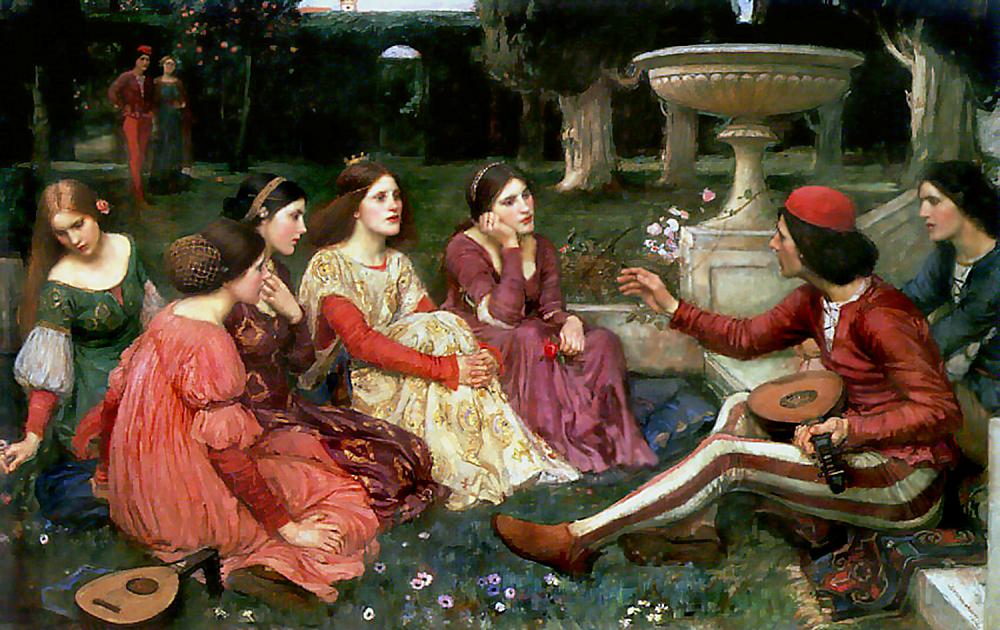
John William Waterhouse, A Tale from The Decameron, 1916.


The Decameron is a novel that is often overshadowed by The Canterbury Talesdespite sharing many similarities. Both were written in the 14th century and have a similar narrative structure of various short stories being told by a group of characters. Both works have also played a crucial role in the evolution of the literature and the vernacular language of their respective countries. Written by Giovanni Boccaccio around 1353, The Decameron tells the story of 10 people (seven women, three men) taking shelter from the Black Death in a villa outside Florence. Over the course of 10 days, each character tells a story related to a chosen topic each day, ranging from comedies and tragedies to philosophical parables and social satire. This leads to 101 stories: 10 stories from each of the 10 characters, with the 101st story being about the developing friendships and relationships between the storytellers.

I have thought a lot about The Decameronthis past week as the numbers of deaths and infections attributed to the novel coronavirus have continued to grow. For the past two months, I have been planning a trip where I would visit friends in eight countries over a two-week period. I first met all these people at various nationalist meetings in 2019, including the three Scandza Forums and the Awakening conference in Finland. I have been very fortunate to have made friends at these events and I have stayed in contact with them over the last several months.

With growing concern over the new coronavirus, and what appears to be a potential worldwide pandemic, I have been seriously debating whether to travel at all these next two weeks. This has been a difficult decision for me. I always try to be a man of my word and feel guilty backing out of plans or promises I make to people. And for the past two months, I’ve been making specific plans with my friends for this two-week period. I have also already paid for most of my flights.

My gut instinct, however, is to postpone my trip until the threat of this virus has died down. I would not want to catch this disease, and I definitely would not want to get any of my friends sick. I would rather err on the side of safety than to take the risk of infecting others, just to not lose money on a purchased flight ticket. I’ve discussed these issues and concerns with all the individuals that I’ve made plans with. To my surprise, most of them have said that I should visit them regardless of the potential risk of contagion. Their most common response to me was “whatever happens, happens!”

Perhaps there is some truth to this viewpoint. Yes, I could easily spend the next two weeks quarantining myself in my room. After all, I have enough fantasy books, video games, and heavy metal albums to keep me hibernating longer than a Japanese hikikomori teenager. But what type of life would I be living? Sometimes, the most memorable moments in life are the times you spend not just by yourself, but with others. By canceling or postponing my trip, I know that I would definitely be missing out on some exciting activities and experiences with my friends.

On a similar note, my friends have often expressed that this virus, or any pandemic for that matter, is something that is ultimately out of our control. So why change my life and plans over something that I have no power over? I definitely agree with them in this regard.

Nevertheless, my conscience keeps warning me about responsibility. While there are things that we can’t control, we can at least take actions and precautions on the information that we have. If I caught an unknown disease while traveling and got others sick without knowing I was contagious, then that is something I have no control over. But if I knew ahead of time about a disease with a high infection rate and still decided to travel, then I feel that I would be negligent and responsible for spreading that disease. This is why I have made the decision to postpone my travel plans and not visit my friends during the next two weeks, despite the guilt of breaking my word and letting my friends down.

My travel plans included meeting with friends in Scandinavia, the UK, the Balkans, and the Baltic. I was planning to go sightseeing with friends in both rural towns and large metropolitan areas. One friend was going to take me to a concert in the Alps. Another friend was going to take me to the Rijksmuseum so that I could finally see Rembrandt’s The Night’s Watch. I was looking forward to trying traditional Balkan food and then traveling to the Baltic to take part in two Independence Day celebrations.

It would have been an amazing journey with unforgettable experiences. But the reality is that I don’t think I would have truly enjoyed the trip with the ongoing sickness panic. Even if I didn’t get sick or get stuck being quarantined on a flight, the constant fear and worrying would have impacted the trip and the time with my friends.

If friendships are the building blocks of communities, then it is only natural for these communities to require the strongest friendships. Like all relationships between people, maintaining friendships isn’t easy. It takes patience, effort, and social skills. I always try to reach out to my contacts and colleagues on a regular basis, whether it be a text message, email, or a weekly chat on Skype or FaceTime.  I also try to let them know when I’ll be in their area and always try to plan an event for us or invite them out for dinner and drinks. It seems simple, but trust me, it takes work. Even with the best efforts and intentions, sometimes events have to be delayed or canceled. Sometimes friends drift apart.

Both The Canterbury Tales and The Decameron focus on a group of people who talk about life, death and all the various experiences in between. While I’m glad I read Chaucer’s classic, I definitely prefer The Decameron. I find its stories more enjoyable and the themes discussed more relevant and memorable. One of those themes is friendship; particularly how friendships endure in times of hardship and uncertainty.

I’ll be re-reading The Decameron over the next two weeks during the time that I would have been traveling and visiting my friends. I’m sure it will remind me of the current outbreak and spread of the new coronavirus. Yet it will also remind me of my friends. While I would much rather be sharing stories and drinks with them, I encouraged all my friends to simply hold off on our plans until it is safer to travel internationally. I will continue to stay in touch with them, just as I will continue attending nationalist events. Diseases and outbreaks come and go. People live and die. Yet our ideas and goals carry on through the events, friendships, and communities that we are building today. Whether it be Erkenbrand, the Scandza Forum, or the Awakening conference, I look forward to seeing you at the next event.

Until then, be sure to stock up on food, water, zinc, and face masks. Just in case.