Sunday, July 23, 2017

The Meaning Of Dunkirk

By Savitri Devi


Editor’s Note:

The following text is excerpted from chapter 14 of Savitri Devi’s The Lightning and the Sun. The title is editorial.–Greg Johnson

Not only had Adolf Hitler done all he possibly could to avoid war, but he did everything he possibly could to stop it. Again and again—first, in October 1939, immediately after the victorious end of the Polish campaign; then, on the 22nd of June 1940, immediately after the truce with defeated France—he held out his hand to England; not the hand of a supplicant, still less that of a man afraid, but that of a far-sighted and generous victor whose whole life was centred around a creative idea, whose programme was a constructive programme, and who had no quarrel with the misled blood-brothers of his own people, nay, who saw in them, despite their hatred of his name, his future friends and collaborators.

And nearly a month before his second peace offer to England, the Führer had already given the Nordic sister-nation a tangible sign of his generosity—nay, of his friendship, in spite of all, in the midst of the bitterest struggle—and such an extraordinary one that history writers have not hesitated to characterise it as “a wonder.” The Allied armies—the British Expeditionary Corps and a remnant of the French troops—were fleeing towards Dunkirk as fast as they possibly could before the German advance; fleeing from the Germans towards the sea. And the German Commander in Chief, General von Brauchitsch had, on the 23rd of May, given the order to press them in from all sides and take the lot of them prisoners before they had time to embark. It was, from the military point of view—and from the normal political point of view; from the point of view of immediate success—the thing to do. But Adolf Hitler appeared unexpectedly at General von Rundstedt’s Headquarters in Charleville and cancelled the order of attack on Dunkirk. The German armoured divisions—the “A” Heeresgruppe, as well as the “D” Heeresgruppe, which was, under General von Bock, pressing towards Dunkirk from the East—where to slow down their speed and leave ten kilometres between their foremost ranks and the fleeing enemy. These counter-orders, “that held back the German advance for two days, and gave the British time to bring home safe and sound the most valuable section of their army,”[1] are utterly incomprehensible unless one boldly admits that they were dictated by considerations which exceed by far the domain of “politics” no less than that of strategy; considerations not of a statesman but of a seer.

The generals did not know what to think, but they obeyed: orders were orders.

To anyone who, in the name of a pan-Aryan view of things (or merely in the name of “Europe’s” interest) stood—and stands—without reservations, on the side of National Socialist Germany, the tragedy of the situation was—and remains, retrospectively—maddening. The capture or destruction of the whole British Expeditionary Corps at Dunkirk, and the immediate invasion of Great Britain—by parachuted troops, if a proper landing was, on account of the British fleet, impossible—could have, one feels, put an end to the war: crushed rotten, Jew-ridden, West European democracy before the USA had time to save it, and united all Europe under the strong hand of the greatest European of all ages. And that new unity in the spirit of National Socialism would have made Europe the bulwark of higher mankind, not “against Asia,” but against the Dark Forces “in Time” embodied in the latest and lowest form of the old superstition of the “value of every man”: Marxism; against the Dark Forces which are, with the help of the Marxist doctrine, threatening Europe and Asia and the whole world. And the Führer himself destroyed that possibility with one word.

That is, at least, the spontaneous (and superficial) view of the average racially-conscious Aryan, Adolf Hitler’s German or foreign disciple. But that was not Adolf Hitler’s own view. The Führer’s more-than-political and more than strategic intuition reached “far beyond any quickly concluded, timely peace.”[2] It grasped—whether he was himself in a position to exteriorise that vision of things or not—the only real earthly peace that ever was and ever can be: the peace of the coming Golden Age, of the far-gone latest one, and of all successive Golden Ages; the peace of this earth whenever the visible world-order is in full harmony with “the original meaning of things,”[3] i.e., with the invisible and eternal cosmic Order, as it is, in fact, at every great new Beginning and at no other time. That peace excludes such bitterness as is bound to arise as the consequence of the humiliation of a great people. Adolf Hitler did, therefore, all he could to spare England the humiliation of total defeat. The baffling orders he gave on that fatal 23rd of May 1940—the date Germany “began to lose the war”[4]—and the astoundingly generous peace proposals he laid a month later before the English, have no other significance.

Rudolf Hess’ much misunderstood, lonely heroic flight to Scotland as a desperate, self-appointed peace-maker, on the 10th of May 1941, has also no other significance. It was, on Hess’ part, neither the rash action of a man half-insane (as it had to be described, officially, for the sake of convenience, and as Rudolf Hess himself wished it to be described, in case of failure) and still less an attempt at rebellion against the Führer’s policy; an effort to end the war against his will. Quite the contrary! Rudolf Hess undertook his long-planned flight, doubtless without Adolf Hitler’s knowledge, as all the details of the event (and especially Hess’ own last letter to the Führer), clearly show. But he was guided from the start by the unfailing certitude that his was the supreme chance—if any—to bring about, in the teeth of the most adverse circumstances, that which the Führer had, in vain, always wanted, and always striven for: lasting peace with England—the sister-nation, in spite of all the insults of her Jew-ridden government and press; the great Aryan power, in spite of her betrayal of the Aryan Cause—constructive collaboration with England, first step towards the constructive collaboration of all peoples of the best Nordic blood.

Rudolf Hess failed—in the realm of visible facts, at least—as Adolf Hitler himself was destined to fail, and for the very same basic reason: namely because he is, like he, one of those uncompromising idealists and men of action whose intuition of permanent earthly realities exceeds and overshadows the vision even of the most compelling emergency; one of those men, “against Time”—both “Sun” and “Lightning”—who have in their make-up too little “lightning” in proportion to their enormous amount of “sun.” (In fact, of all the Führer’s paladins, none—not even Hermann Göring; not even Goebbels, who was so passionately devoted to him—seems to be so deeply like him as Rudolf Hess.)

England’s answer to Adolf Hitler’s repeated peace proposals was, after a categorical “no,” an intensification of her war effort, and a hardening of her war methods.[5] England’s answer to Rudolf Hess’ supreme appeal to her sense of responsibility before the dead, before the living, and before the yet unborn was . . . a cell in the Tower of London (and, later on, in Nuremberg, and finally in Spandau, to this day) for the daring self-appointed messenger of peace. England’s answer to all the understanding and friendliness that National Socialist Germany had showed her from the very beginning, her answer to Adolf Hitler’s sincere profession of faith in Anglo-German collaboration; her answer to his unheard-of generosity at Dunkirk was . . . war to the finish: hundreds and thousands of bombers—one wave after the other, in tight formations—pouring night after night (and often in the daytime) streams of fire and brimstone over the German towns, and on the other hand—unlimited, enthusiastic aid to Soviet Russia, no sooner had Adolf Hitler declared war on her. England’s answer to the German Führer’s repeated plea for honest pan-European anti-Bolshevistic solidarity rooted in the consciousness of common Aryan blood (or of a high proportion of it at least) resounded in Churchill’s jubilation at the news of the “second front,” thanks to which the German forces were now divided. Churchill—the anti-Communist, but still wilder anti-Nazi—declared: “The cause of Soviet Russia is now the cause of every Englishman.” England’s answer was, in August 1941, the Atlantic Charter—an open alliance with the main tool of Jewry in the USA, President Roosevelt, who (although the USA were not yet at war with Germany) now ordered actual firing at every German ship the Americans met on the high seas. England’s answer was two years later the Yalta and then the Potsdam Agreements between Churchill, Roosevelt, and Stalin: the sinister coalition of the Western plutocracies and of the Marxist Empire—of all the forces “in Time”—against National Socialist Germany; the cold-blooded planning of Germany’s dismemberment and enslavement forever; and the relentless advance of the crusaders of hatred from the East and from the West, until their two hosts of hundreds of thousands, in one of which there were Englishmen, had met and merged into each other over the martyred Land. England’s answer was, through British accusers along with others, the shameful distortion of history in the Nuremberg Trial, the condemnation of the peace-maker Rudolf Hess for “crimes against peace,” and the prolongation of the whole propaganda of infamy against both the National Socialist doctrine and the German Nation, to this day.

Maybe, the Jew-ridden United States of America have, under the Freemason Franklin Roosevelt, played an even greater part than that of England in the preparation, conduct, and gruesome conclusion of the Second World War. But England is the nation to which Adolf Hitler had, over and over again, the most sincerely, the most appealingly held out his hand, in the name of the natural brotherhood of Nordic blood, in the name of the peaceful regeneration of the West. Her crime against him, against his people, against herself and the whole Aryan race, is therefore greater than that of any other of the Allies of 1945. And nothing—absolutely nothing—can ever make good for it.

Notes


[1] Kleist, Auch Du warst dabei. Ein Buch des Ärgernisses und der Hoffnung [You Were There Too: A Book of Scandal and Hope] (Heidelberg: Vowinckel 1952), p. 278 (quoted by Grimm, Warum? Woher? aber Wohin?, pp. 364–65).

[2] Grimm, Warum? Woher? aber Wohin?, p. 367.

[3] Mein Kampf, p. 440.

[4] Grimm, Warum? Woher? aber Wohin?, p. 367.

[5] It is now proved that England began her mass bombing of civilian populations on the 11th of May 1940; see on that point J. M. Spaight’s book Bombing Vindicated (London, Geoffrey Bles, 1944).

Saturday, July 22, 2017

The Market As The Capitalist Demiurge

                        By Thomas Storck


In an article a few years ago in The Economist (12/7/13) about economic bubbles, the writer noted, “Many economists have struggled to accept that bubbles exist, as that is difficult to square with the idea of efficient markets.” That is to say, economists struggle to accept the evidence before their eyes since that is difficult to square with their a priori theoretical construct. Although economists are not the only practitioners of an academic discipline who prefer their models and theories to reality, they are perhaps the worst offenders in that respect. Economists have erected an edifice of enormous sophistication and complexity, which, sad to say, often bears little resemblance to the real world. The chief structural component of this edifice is the market, the quasi-magical process by which all that is out of kilter in the world can be made right. Thus we may refer to it as the capitalist demiurge, the quasi-deity imagined by some Greek philosophers that constructs and orders all things in this world.

“[B]ubbles [are] difficult to square with the idea of efficient markets.” How do we explain such a flight of unreality? Let us look at some of what is said about market efficiency and competition in order to understand how there could be such a departure from evident reality based on a theoretical assumption.

Two centuries ago, Adam Smith proclaimed that, through the workings of the invisible hand, those who pursue their own self-interest in a competitive economy will most effectively promote the public interest. This concept—that the rough-and-tumble of market competition is a potent force for raising output and living standards—is one of the most profound and powerful ideas in history….1

It is not difficult to see that market competition can achieve benefits at times—”Free competition [is] justified and quite useful within certain limits,” Pope Pius XI noted, but it “cannot be an adequate controlling principle in economic affairs.”2 Competition can stimulate manufacturers to seek more efficient ways of working, to lower artificially high prices, to produce better quality products. But it can equally work to lower wages, to deceive consumers with shoddy products, to push industries toward cheap or quick manufacturing processes that injure the environment. It is no magic or infallible method for running an economy or promoting the public interest. The beneficial efficiency that market competition can sometimes produce is in no way a substitute for intelligent concern for the common good, as Pope Pius likewise pointed out, when he criticized

the “individualistic” school, [who] forgetful or ignorant of the social and moral aspects of economic activities, regarded these as completely free and immune from any intervention by public authority, for they would have in the market place and in unregulated competition a principle of self-direction more suitable for guiding them than any created intellect which might intervene.3

Adam Smith’s analysis of human behavior that led him to the concept of the invisible hand was not only based on a small subset of humanity, but more importantly, it was focused on only one aspect of human conduct and ignored equally important features. The desire for gain is not always the chief motive for people’s economic conduct, let alone the only motive. Economies have functioned with widely differing kinds of incentives over the centuries and over the face of the earth. Even among countries with broadly capitalist economies there are notable differences in their understanding of the goods that an economy must respect or seek, and hence notable differences in worker rights, the place of unions, government regulation, consumer protections, and so on.4 But when a society constantly tells its members that their economic activity is and should be based solely on self-interest, is this not likely to narrow our focus and actually create the kind of mentality it assumes?

Smith and his followers fail to understand the key role that the

legal and tax systems of a society have. Corporations, for example, as we understand them today, with their features of limited liability, perpetuity, and freedom to operate anywhere, originated only in the 19th century. They are purely a creation of laws and court decisions, all of which could be changed. If their limited liability, for example, were taken away and their officers and directors made criminally liable for corporate malfeasance, corporate behavior would no doubt change radically and immediately. Human nature would not change, but it would express itself differently because the legal environment had changed.

In addition to culture and the legal system, economic power—who owns what, who controls what—goes a long way toward determining economic outcomes. A rich corporation or even a rich individual has much more potential economic power than any number of poorer workers. This has historically been the reason for labor organization, to create a situation in which the mass of workers had some bargaining equality with those holding economic power. Necessary as unions have been and are, however, distributists generally think that worker ownership by means of cooperatives would be better. A government that desired to promote social peace and health could favor such cooperatives by granting them guaranteed loans and favorable tax treatment. Of course, the believers in the magic of market efficiency might object, saying that such favorable treatment hindered the free operation of markets. But this is based on a misunderstanding—or perhaps on a myth. There is no such thing as a pure market, a market divorced from economic power, divorced from the cultural outlook of the society in which the market functions, and which is not structured by laws of one sort or another. The type of economic thought that was first formulated by Adam Smith presupposes a culture and a legal system of a particular sort, and regards this culture and this legal system as somehow natural to mankind. But in the history of the human race such cultures and such legal systems were rare or non-existent until recent centuries. Medieval Europe, from which our own society is descended, looked upon economic activity as having an essential but subordinate place in social life. As a result, their approach to the economy stressed different goals. They did not think of the amassing of goods as the purpose of life, nor that laws and institutions should be framed so as to facilitate production with no regard to its purpose. Richard Tawney, in his well-known and extremely important book, Religion and the Rise of Capitalism, conveys some idea of the medieval outlook:

Material riches are necessary; they have a secondary importance, since without them men cannot support themselves and help one another; the wise ruler, as St. Thomas said, will consider in founding his State the natural resources of the country. But economic motives are suspect. Because they are powerful appetites, men fear them, but they are not mean enough to applaud them. Like other strong passions, what they need, it is thought, is not a clear field, but repression.  There is no place in medieval theory for economic activity which is not related to a moral end, and to found a science of society upon the assumption that the appetite for economic gain is a constant and measurable force, to be accepted, like other natural forces, as an inevitable and self-evident datum would have appeared to the medieval thinker as hardly less irrational or less immoral than to make the premise of social philosophy the unrestrained operation of such necessary human attributes as pugnacity or the sexual instinct.

And he continues,

At every turn, therefore, there are limits, restrictions, warnings, against allowing economic interests to interfere with serious affairs. It is right for a man to seek such wealth as is necessary for a livelihood in his station. To seek more is not enterprise, but avarice, and avarice is a deadly sin. Trade is legitimate; the different resources of different countries show that it was intended by Providence. But it is a dangerous business. A man must be sure that he carries it on for the public benefit, and that the profits which he takes are no more than the wages of his labor.5

The capitalist order has changed the life of what was once Christendom much more profoundly than most people realize. And it has equally profoundly changed the way most of us, including most Catholics, think about not just economic activity, but about the social order as a whole. But this need not be. We can reframe our thinking. As difficult as this would be, it can be done. G.K. Chesterton said that being a Catholic “is the only thing that frees a man from the degrading slavery of being a child of his age.”6 Just as many Catholics laudably have resisted the notion that sexual pleasure justifies any amount of wrong-doing, up to and including the murder of an unborn child, so we can resist the juggernaut of capitalist thinking and acting. It is hardly possible to withdraw entirely from capitalist-controlled society, but it is always possible to free our thoughts and subject them, not to the pressures of consumer fulfillment, but to the yoke of Jesus Christ the King.

Tuesday, July 18, 2017

Demystification Of The Birth & Funding Of The NSDAP

By Veronica Kuzniar Clark

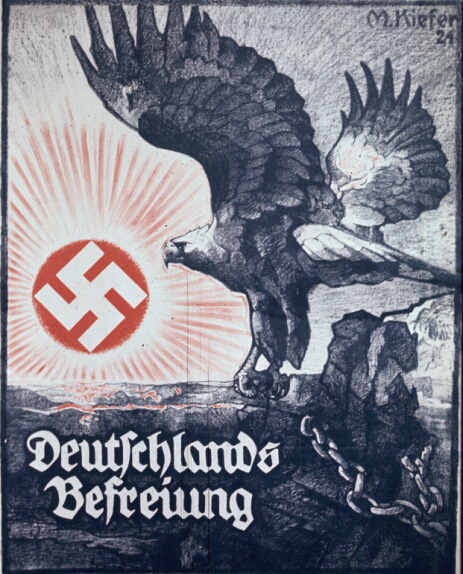
"Germany's Liberation"

Part 2 of 2

Most potential recruits and financial supporters heard about Hitler and the NSDAP via word of mouth. Nothing was as effective as this. When men like Scheubner-Richter, Schacht, Borsig, Kirdorf, and Thyssen recommended the NSDAP and personally endorsed Hitler, wealthy and other upper- and middle-class Germans were willing to seriously consider Hitler and his party. Hitler was invited to speak to heavy industrialists in 1927 by word of mouth in fact. He even wrote a secret pamphlet intended only for this industrial-capitalist audience, which they then passed around to others.

Besides active word of mouth campaigning, the NSDAP also placed posters everywhere they could, promoted speaking engagements and other party activities and viewpoints in their VB, sold various odds and ends to raise small funds (e.g. various items like soap with NSDAP packaging), and sent wealthier members abroad to raise funds from German expats and foreign sympathizers. Kurt Lüdecke excelled at this form of campaigning.

In the very beginning, Hitler and the NSDAP targeted veterans, farmers, workers, young men, noblemen and women, small businessmen and women, and pensioners. These were the social classes who were initially the most receptive, due to the economy and prevailing anti-monarchism, but later on Hitler’s support base included wealthy elites, heavy industrialists, fascist and monarchist foreigners, landed Junkers, veterans’ organizations, the German Army and Navy, and even Montagu Norman.

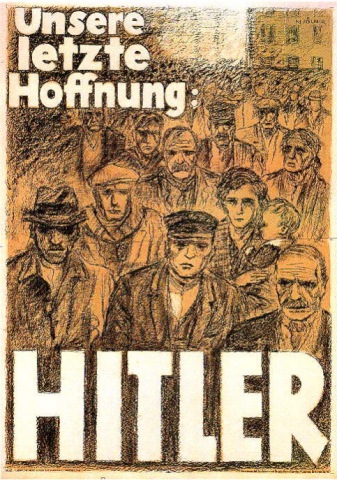
"Our Last Hope"

Norman was a prominent English banker and personal friend of Hjalmar Schacht who, according to both his private secretary Ernest Skinner and Émile Moreau, despised Jews, the French, and Roman Catholics. He unabashedly refused to assist France’s treasury with anything and proved willing and able to arrange financing for the NSDAP by way of his connections to Bruno von Schröder (Schroder Bank), Kurt von Schröder (Stein Bank), and the Bank of England (F. C. Tiarks and M. Norman himself).

Norman had strong sympathy for the Germans which dated back to his days as a student in Dresden, and naturally offered to financially assist and thereby stabilize the new government that his friend Schacht had openly supported since 1931. Since Hitler was hostile to France (he saw the French as foreign enemy number one), friendly to Britain (which he did not feel was a threat), and discriminatory towards Jews, the three things that Norman found favorable, he recommended that Kurt von Schröder extend credit to Hitler’s party, which now controlled the government.

Schacht was Hitler’s de facto lifeline in this respect, a nationalist German banker who had his own designs for German recovery, but who was also personally impressed with Hitler’s speeches and mass appeal, which no other politician possessed.

As for Hitler’s initial support, many farmers were blighted by financial obligations to relentless moneylenders, and most, including landed Junkers, felt threatened by Communist expropriation and insufficient protective agricultural tariffs. The veterans were receptive because they felt betrayed by the ruling class, especially the liberal-democrats of the SPD, and because they had a difficult time finding work. Workers, who were mostly young men, were receptive because they felt they were being exploited by the business class, but primarily because they were the most negatively affected by the inflation and unemployment. Pensioners on fixed incomes were receptive to Hitler’s socialist stance. Noblemen and women were interested in Hitler because he opposed Freemasonry and expropriation of their landed estates, and because he hinted at restoration of the monarchy. Additionally, all of these groups generally opposed Marxist-Communism because they were not interested in a revolutionary bloodbath, but economic and social security as well as justice and prosperity for the German nation.

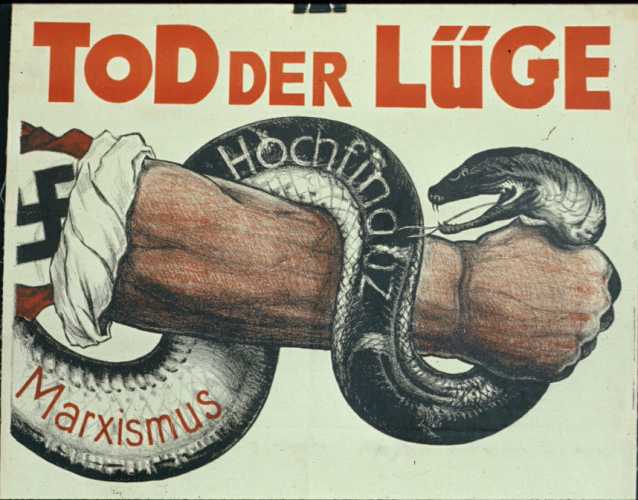
"Death to lies"

Hitler’s main opposition in the formative years came from the Communists, who denounced him as a tool of capitalism and the former nobility; the heavy industrialists, who distrusted his socialism and the SA (they feared the SA was nothing but a Communistic horde); and the left-wing faction within his own party, who questioned Hitler’s financial sources and pro-business stance.

When someone requested to join the NSDAP, one paid one’s initial annual dues and was then given a membership card and asked to perform some service or task for the party. This could be anything from putting up posters before speaking engagements to spreading the word by simply talking about the NSDAP or handing out flyers on street corners and at beer halls. After the Hitler-Strasser break, he or she was asked to swear allegiance to Adolf Hitler.

Vetting was likely performed by those members doing the actual talking and recruiting in the streets, as there was no known formal vetting procedure. As long as a person paid his annual dues and served the party loyally, he or she was trusted. Those who wished to break with the party were actually told to leave by Hitler himself at a rally that took place after the Strasser and Stennes affairs. We’ll revisit this topic later on.

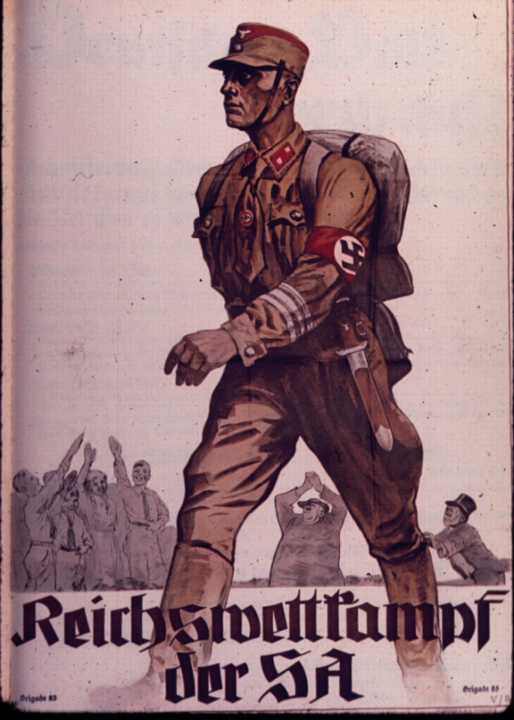
Along these lines, Kurt Lüdecke, Otto Wagener and Ernst Röhm played leading roles in arming, training, and drilling SA men. Their personal fundraising; their secret dealings with the German Army (Reichswehr), which had many prominent sympathizers of the NSDAP and SA; and Lüdecke’s connections to black market Jewish arms dealers proved imperative to building a credible paramilitary threat to the status quo.

The government in Berlin tended to ignore SA violence against Communists because it opposed a Communist takeover. Also, Hitler’s party supported German national unity at all costs, so Hitler and his SA were worth tolerating to prevent Bavarian secession.


Hitler’s real bargaining base was his SA and the masses. Without both, he could afford to be ignored by the elites, government, and industry; however with both he was a true threat, like the Communists.

Lüdecke, Wagener, and Röhm all led, at one point or another, regular drilling and paramilitary basic training at a large hall funded by party members and various supporters. Marching in formation and drills also took place in the forests and countryside when possible, but mostly it occurred in the party’s own rented hall or on a wealthy sympathizer’s private estate. Fortunately for unemployed and poor members, the party paid for everyone’s uniforms.

When SA and SS ranks were introduced, the requirements were loyalty and leadership aptitude. The SS consisted of men handpicked by Hitler himself. Thus, he vetted them personally. As a matter of fact, Hitler usually personally appointed leaders to their positions even in the SA. He recalled Röhm from Bolivia, for instance, to reorganize and lead the SA.

Hitler tended to choose people who he felt would resist falling prey to groupthink. Historians have tended to characterize this as Hitler’s “divide and rule” tendency, but in-depth study of the party’s early development suggests instead that Hitler chose people who would (a) not challenge or question his leadership, and (b) not fall prey to the “yes man” problem. This appointment procedure did two things: it prevented serious intraparty division by subordinating all to Hitler himself, while at the same time supported intraparty challenges, which prevented groupthink. Leaders could disagree and even challenge one another’s authority without destroying the party.


Hitler based promotion solely on performance, not status. This tendency increased later on during the war especially after Hitler established the NSFO (National Socialist Commanding Officer Corps). This NS-high command likely would have replaced the OKW (Armed Forces High Command). Hitler wanted select NSFO officers to undergo a 4- to 18-hour course in political-ideological instruction. He himself appointed the head of the NSFO, Hermann Reinecke, in December 1944.

The NSDAP expanded into cities and states outside of Munich (Bavaria), where it had its Brown House headquarters, by appointing certain members to run party operations and perform party services in their own states, cities, towns, and villages.

The most well-known example of an NSDAP member-cum-leader who acquired almost enough personal power, financial backing and mass following to challenge Hitler himself was Gregor Strasser. Hitler was able to prevent a crisis from developing with his gifts for clever maneuvering and personal appeal, but such risks are inherent to any party that becomes as large as the NSDAP. And they are risks that must be taken if a party wishes to develop and grow.

Talented, committed and qualified speakers and leaders were appointed to run operations in every location possible. But Berlin NSDAP members also traveled around giving speeches and lectures and soliciting financial support. All speaking engagements required admittance fees. Hitler himself was constantly traveling and meeting with workers and elites alike to recruit new members and bolster his finances.

At the end of 1920, the NSDAP had about 3,000 members. Membership then grew from 27,000 in 1925 to 108,000 in 1928. In August 1931 the NSDAP created its own intelligence and security sector. Heinrich Himmler established the SD (Sicherheitsdienst) and Reinhard Heydrich was appointed head of the organization, which was kept separate from the SS (Schutzstaffel). By the time of the Strasser crisis, the SA was some 400,000 members strong and the party itself had grown to 2 million by 1933. In 1932, it was large enough to achieve control of 37% of the Reichstag.

Here are the election results from 1920 to 1933:

 Political Parties in the Reichstag

June 1920 

May 1924

Dec. 1924

May 1928 

Sep. 1930

July 1932

Nov. 1932

Mar. 1933

Communist Party (KPD) 4 62 45 54 77 89 100 81

Social Democratic Party (SPD) 102 100 131 153 143 133 121 120

Catholic Center Party (BVP) 65 81 88 78 87 97 90 93

Nationalist Party (DNVP) 71 95 103 73 41 37 52 52

National Socialist Party (NSDAP)–––12 107 230 196 288

Other Parties 98 92 73 121 122 22 35 23


One can see that the NSDAP lost most of its former 230 seats in July 1932 to the even more radical-revolutionary Communist Party (KPD) in November 1932, not to conservative Catholics or social-democrats. The conservative nationalists (DNVP) only received a boost of 15 seats. These results, contrary to most historiography, do not reflect the demise of the NSDAP, but the masses’ disaffection with any party that was not willing to promise sweeping social and economic change for the majority, even if change meant bloodshed. Hitler and the NSDAP were not viewed as extreme enough, so they lost seats to the KPD!

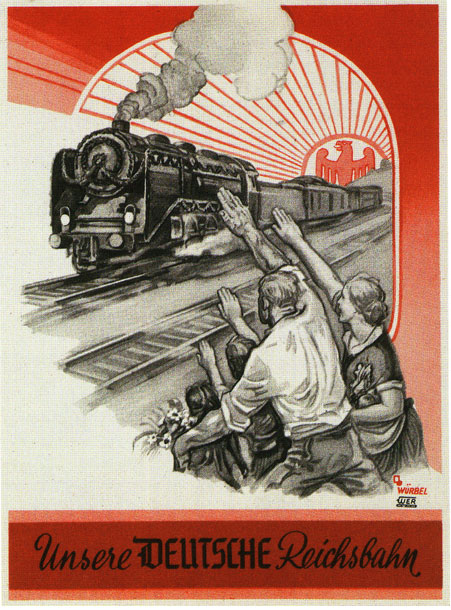
"Our German Railroad"

This alarmed men like Hjalmar Schacht and Franz von Papen so much so that they were finally willing to give Hitler the opportunity to become chancellor. He actually should have received the chancellorship in July 1932 when his party had the most seats in the Reichstag, but industrialists and noblemen surrounding General Schleicher, Franz von Papen, and President Hindenburg opposed his appointment to the chancellorship. So much for James Warburg’s and the Rothschilds’ “magical funding.”

Hitler faced so much resistance at this stage that he, like everyone else, had to resort to blackmail to receive his due appointment. Hitler arranged a private meeting with President Hindenburg’s son Oskar, during which he is suspected to have threatened to expose his father’s role in the repeated taxpayer bailouts of the Junkers’ mismanaged, bankrupted estates. Since blackmail and intrigue had been used to cheat Hitler of his due appointment, he decided that he could also play such a game.

Hindenburg appointed him chancellor shortly thereafter, which most historians claim was at the behest of von Papen. We see that von Papen’s desire to prevent a Communist majority by giving Hitler the chancellorship was only partly why Hindenburg appointed him. Hitler won, but not because he received covert funding. Franz von Papen continued to intrigue against Hitler and urged industrialists to withdraw their financial support of the NSDAP! The goal of this so-called “cabinet of barons” was to give Hitler just enough power to satisfy him personally without actually allowing him to attain a majority strong enough to overthrow the status quo, but just strong enough to prevent a Communist majority.

Given this context of stalemate, the speed of the NSDAP’s growth in just 6 years and its subsequent attainment of absolute power were only possible with an authoritarian leader in a crooked political situation in which blackmail, corruption and political sleight-of-hand was the order of the day. 

                    are united and loyal.””]


What had started as a democratic-style workers’ party with a simple executive committee to which Hitler was appointed in the early 1900s became an authoritarian-style organization with its own uniforms, offices, training facilities, insurance company, sales items, newspaper, propaganda machine, army (the SA), and security service (SS and SD).

 This was nothing short of impressive and most of the credit for its success goes to those leaders and members like Hitler, Hess, Gansser, Eckart, Funk, Schwarz, Feder, Keppler, Himmler, Rosenberg, Goebbels, the Strassers (before 1932), Scheubner-Richter, Hanfstaengl, Lüdecke, Göring, and Röhm, all of whom literally devoted their lives to the party.

NSDAP events took place as often as they could be afforded. The newspaper was of course always available—it was a daily—so the public and members always knew what was going on from day-to-day. Hitler gave speeches and met with important wealthy persons almost non-stop after his release from prison. He was keen enough to purchase vehicles, which were rare in those days. Speedy travel was vital to defeating rival parties like the Communists who still had to walk to their various speaking engagements and meetings.

The NSDAPs doors, so to speak, were always open to receive new recruits. Interested persons either signed up at simple on-site recruitment centers or they mailed their applications to the party’s headquarters in Munich.

The need for bodyguards arose when Hitler started regularly giving speeches. The Communists had caught on to this Adolf Hitler and his NSDAP and therefore sought to intimidate it or shut it down. The SA originally served as the party’s guards, but this role was quickly taken over by the SS (Saal-Schutz), which served as an assembly hall guard as well as Hitler’s personal bodyguard. Himmler started its transformation into an elite paramilitary force, renaming it the Schutzstaffel, in 1929.

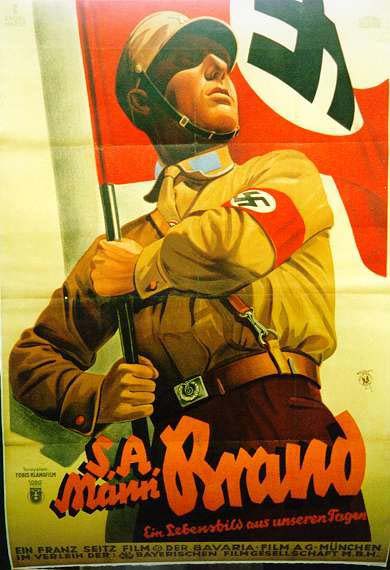
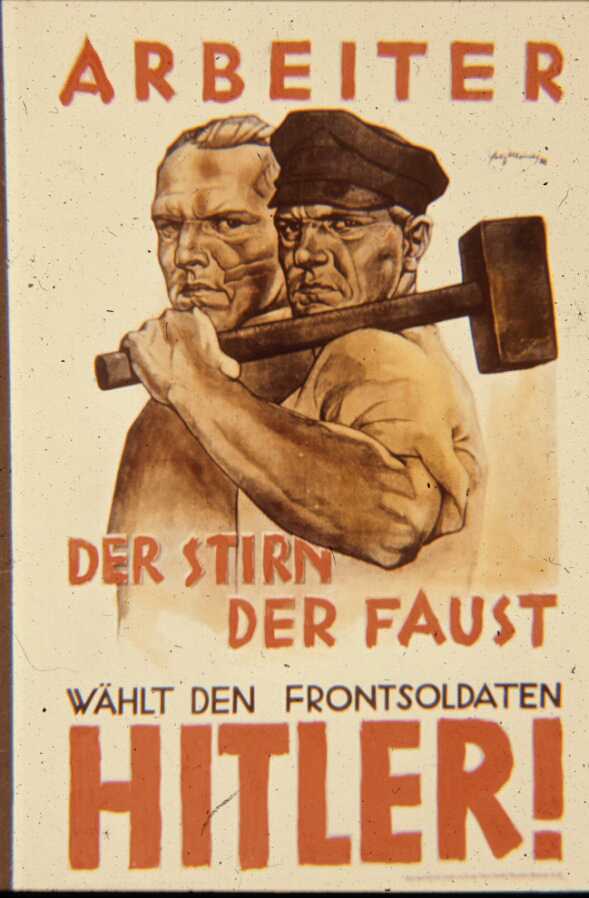
"Workers of head and hand vote for front-soldier Hitler"

This Allgemeine-SS later expanded into the National Socialist Armed Forces (Waffen-SS), which eventually grew so large and powerful that it rivaled the state’s official armed forces. Hitler’s intent was to ‘national socialize’ the state armed forces, which opposed him more and more as the war progressed. The intrastate schism between military and social elites on the one side and NS-populists on the other remained intact even under Hitler’s skillful leadership and absolute power. He only fully realized the extent of this social chasm in July 1944 when several of his generals attempted to murder him with a suitcase bomb. This in fact occurred shortly after Hitler ordered the creation of the NSFO, mentioned earlier.

Most early members of the NSDAP gave an incredible amount of their personal fortune and time to the party. Countless young men defied their conservative parents by joining the NSDAP as their only hope for future employment and social security. Young women were attracted to Hitler personally, but also to NS fanfare and its commitment to uphold family values.

The lifeblood of the party was its youth, and numerous parents had their children join either the Jugenbund der NSDAP or Jungsturm Adolf Hitler, both of which were formed in 1922—the creation of at least one of these youth divisions was announced in the VB. In 1923, the organization had some 1,000 members. The Jugenbund, originally based in Bavaria, expanded into a nationwide organization in 1924 and was subsequently renamed the Grossdeutsche Jugendbewegung.

In 1925, after the NSDAP was reorganized upon Hitler’s release from prison, membership grew to over 5,000. In July 1926, the Grossdeutsche Jugendbewegung was again reorganized by Kurt Gruber, a law student from Saxony, and officially renamed the Hitler Jugend Bund der deutschen Arbeiterjugend, (better known as the Hitler Youth). This organization promoted sports, political education and preparatory paramilitary training for later membership in the SA or SS once a child was old enough. Children were given performance booklets in which their HJ accomplishments were recorded. By 1930, the HJ had enlisted over 25,000 boys over age 14. The Deutsches Jungvolk, a junior branch for boys aged 10 to 14, was also formed. Girls between the ages of 10 and 18 joined a similar organization, the Bund Deutscher Mädel (BDM), or League of German Girls. In 1930, HJ membership was about 25,000. By the end of 1932, shortly before Hitler came to power, membership was 107,956. By the end of 1933, the HJ had 2,300,000 members.

Uniforms were an integral part of the NSDAP from the beginning. This was the result of Hitler’s personal influence on the DAP, which did not have or require uniforms. NSDAP members often met in beer halls or at the party’s headquarters for daily or weekly drill and training, and were expected to put on their uniforms after the drill leader arrived. All drills and training took place in uniform, and all NSDAP members who attended either Hitler’s speeches or major party events were in uniform.

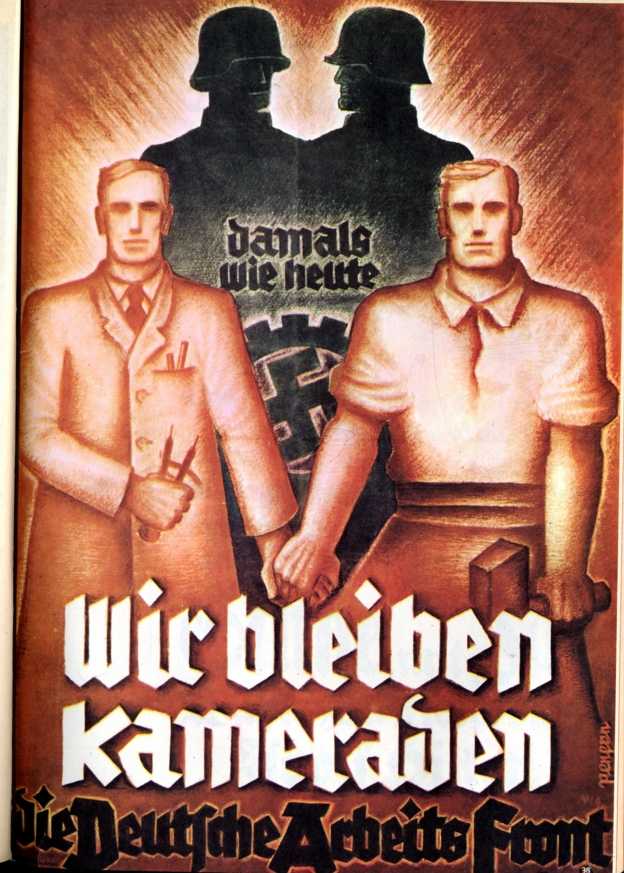
"Then as now, we remain comrades. The German Labor Front"

The SA performed considerable community and charitable work. This included organizing soup kitchens, toy and food drives, home handy work, combating crime, patrolling the streets against Communists and other violent groups, and any other form of service or assistance individual party members were willing and able to provide to community members. Patrolling the streets often led to violent conflict involving injury and death on both sides. As a result, Chancellor Brüning banned the SA, SS and HJ, which all went underground until the ban was lifted after Brüning was ousted. The new Chancellor, Kurt von Schleicher, lifted the ban in exchange for Hitler’s cooperation in forming an anti-Communist coalition government. The SA was then permitted to march under police protection in Communist neighborhoods, because no party in the government at that time was pro-Communist. Even the SPD was forced to back away from a Communist alliance. The Social Democrats realized they had to cooperate with nationalists since they were clearly on the wane and very unpopular with the masses and Junkers. Hitler seized the moment: he ordered his Reichstag members to vote with the Communists against the nationalists and conservatives while he ordered his SA to battle them in the streets.

Sunday, July 16, 2017

Demystification Of The Birth & Funding Of The NSDAP

By Veronica Kuzniar Clark


Part 1 of 2

Editor’s Note:

This essay is a companion to the volume Warwolves of the Iron Cross: The Hyenas of High Finance: The International Relationships of French and American High Finance (Volume 3), a compendium of Third Reich writings on economics by Dr. Heinrich Pudor, with additional material by Veronica Kuzniar Clark, Fred Scherbaum, Wilfried Heink, Luis Muñoz, and Hans Krampe.

What exactly did the NSDAP represent and who were its founding members? Why and how did Adolf Hitler transform the party from an unimpressive proletarian workers’ party to a full-fledged political machine that obtained absolute power in Germany? Perhaps more importantly, how was it funded? We answer these questions in this introduction.

But first, we begin with an examination of the early stages of the NSDAP and its recruiting process. One must understand how this process unfolded if one is to understand the NSDAP’s position on Judaism and Freemasonry as well as the prevailing social and political order of the day. Naturally, we also reveal what some of the other important aspects of its early development were, which necessitates a fair amount of myth-busting about Hitler, including who actually gave him money.

Triumvirate: Leadership, Development, and Unity

Adolf Hitler, contrary to his own self-myths and the myths of others, was never poor—at least, not until he had drained his savings and entitlements gallivanting in Vienna. Many historians have written that Hitler simply lived day-by-day wasting both his money and time, but in so doing they overlook Hitler’s experience and “life education” that later played such an important role in the development and direction of National Socialism as well as the Second World War. The development and direction of both can be traced to Hitler’s experiences during those “lost” years.

Hitler, like so many other young German men and women of his day, fell from middle-class status into that of the “wretched proletariat.” This was something that young Hitler refused to accept. He was deeply embittered by his Vienna experiences, which offered false promises of prosperity and hope for young people with enough willpower and talent. The prevailing dissonance of the time and place in which he grew up inculcated in him a burning desire to change these circumstances, which is precisely what he did after 1933.

Hitler was so resentful of the class-ridden society that was Vienna, and Austria and Europe generally, that one of his key aims throughout both the peace and war years was cultivating a system of merit. One’s birth station was not what mattered. What mattered were one’s talent, loyalty, dependability, and fortitude, notably in the face of adversity and uncertainty.

Hitler was able to overcome most embedded class barriers in two distinct ways:

1.  He recruited both men and women from all social classes and accordingly tailored his speeches and disposition to each, depending on his/her social standing.

2.  He supplanted economic valuation with racial valuation.

Let’s look at the first point. Hitler needed the broadest spectrum of German society he could get, so this meant that he needed to appeal to men, women, young, old, wealthy, poor, unemployed and employed alike. Women were amongst Hitler’s most devoted and fervent supporters in the early years. So were low-wage earners, small businessmen, and foreign nobles, such as White Russian émigrés who wished to see the return of the Russian monarchy.

They provided Hitler with a physical audience, elite and business connections, and monetary support, most of which ended up being granted in the form of IOU credit.

Hitler needed industrialists as much as he needed the workers, elites, and disenfranchised foreigners. Since his goal was to raise the station of all Germans, he had to win them all together, which required a strategy of multi-class appeal. When he met and spoke with counts, duchesses, and other members of the former aristocracy, he addressed them in an appropriate manner. His etiquette, speech, and personal manners proved impeccable in such company.

When he met or spoke with industrialists, such as Fritz Thyssen, he tailored his behavior and manner to match that of the hopes and fears of industrial Germany. At the same time he was careful to scale back his socialistic language in such company, so that the industrialists would not misidentify him as a Marxist-Communist. He had to convince them that he would crush Marxist-Communism and uphold their industrial powerbase in the face of the growing mass of disenchanted, underpaid workers who felt they were being cheated and exploited by German industry.

Whenever things got economically tough, the workers suffered wage and benefit cuts. They blamed the industrialists, but Hitler saw that the industrialists were also suffering: many went bankrupt during the inflation as well as during the Great Depression. The crippling Versailles reparations forced most German industrialists and exporters into an untenable economic position, which in turn harmed German workers. This meant that Hitler had to at least hint at future German rearmament, which was covertly occurring anyway.

On the other hand, Hitler had to promise the workers, his single largest and most important support base in almost every respect in the formative years, that he would not allow the state or industry to exploit them or continue treating them as automatons. We can see that balancing the wants and needs of these three core sectors of class-ridden Germany was far from simple. But Hitler did it, and nearly bloodlessly.

Now to the second point: Hitler had to come up with a unifying ideology for Germanic peoples. This task seems simple in retrospect, because Germany was a homogenous society by today’s standards. However, back then this was not how the German situation was seen. Germany may have been racially homogenous, but class antagonisms were so deep-seated that few if any German elites and nobles were interested in sharing political or social power with lower-class and middle-class Germans.

The Junkers (estates Lords) treated their farmhands (serfs) as second- or third-class citizens and ordered them to pack up and get out if they dared to vote against their landlord employers. Most of the Junkers refused to set aside the feudal lifestyle, which helped fuel growing mass discontent for monarchy and aristocracy. This only served the interests of republicans and Freemasons, both of whom wished to see the end of monarchy for good. We will discuss their motivations later. For now it is enough to say that their motives were far from benevolent.

German class divisions trumped any sort of racial or ethnic solidarity. Not surprisingly, one finds that the desire to unite all Germans as racial comrades was found almost entirely amongst the lower- and middle-classes, and even many middle-class Germans did everything they could to cling to their bourgeois station, even if it meant keeping the lower-classes downtrodden. As one can see, Hitler’s goal was anything but simple.

How, then, did Hitler unite Germans? And how successful was he? Hitler united Germans by invoking an ideological concept similar to Italy’s Romanita, as espoused by Benito Mussolini. Hitler’s concept was Nordicism: the basic, simplified premise of which was that all Germanic peoples were united by their Nordic racial component, and because they were united by this common “race soul” or blood component, why should they fight or be divided?

While such a unifying idea sounds both feasible and reasonable, many resisted nonetheless. The Junkers, former nobility, and many other business elites in Germany saw Hitler as nothing other than a lowly former corporal who had no clout given his petit bourgeois (lower middle-class) upbringing.

Hitler was only partially successful in uniting all Germans as Volksgenossen. His lack of complete success in this regard, an unattainable goal to be sure, later proved to be his undoing. Elites amongst the officer corps did immeasurable damage to Hitler and his war effort, but the story of their treachery and sabotage is beyond the scope of this discussion.

Might Hitler have been more successful had he been more racially inclusive early on? Not necessarily. Mussolini, unlike Hitler, was not racially exclusive at any point and expended a great deal of effort and time attempting to recruit non-Italians to the Italian fascist cause. He was largely unsuccessful, especially in Ethiopia—this in spite of the fact that he had Ethiopians trained as pilots (before the Tuskegee Airmen even came into being) and promised them higher status within a Fascist Italian Empire.

We may deduce from this example that Hitler having merely extended his hand openly in the beginning to non-Germans would not have guaranteed National Socialism’s political or military success. Mussolini did so, and his tolerant hand was rejected. Indeed the U.S. and Britain did not win the Second World War due to non-white conscription, but because they supported and funded the Soviet war machine and were willing to bomb Germany indiscriminately.

This brings us back to our main point, which is that unifying a body of people, regardless of whether it is homogenous or diverse, is no easy task. Hitler was only able to convince the lower- and middle-classes that racial value must supersede economic (class) value. Most of the German elites were never won over to his Nordicism.

So, what does all of this mean? First, it means that a party that wishes to succeed must appeal to women and men both, citizens of all ages, and all social classes. A sensible and serious leader and party cannot afford to leave any group out. Naturally this all depends on the individual nation and citizenry in question, as Hitler’s brand of politics and leadership were formed with a specific time, culture, people, and place in mind. It was not intended for export, but for adaptation in multiple contexts. Hitler’s brand of politics was in fact largely modeled after Mussolini’s as well as the leadership of the Austrian mayor Karl Lueger. Thus copying Hitler’s leadership style or National Socialism is unwarranted and unlikely to be successful.

Second, it means that the masses are more important to a party’s success than the elites, because there are more of the masses. Only the masses have the power to invoke fear in upper-class people by threatening to support violent revolutionary parties and organizations, which are often led and funded by hostile fifth-columnists. The Communist Party (KPD) was the only party besides Hitler’s that evoked genuine fear in the elite classes of Germany.

Hitler and the NSDAP could not be ignored for the very reason that they, besides the Marxist-Communists, had the largest mass following in Germany at the time. Industrialists could not afford to anger or rebuff Hitler and the NSDAP; if they did, then Hitler’s followers would quickly have swelled the ranks of the Communists or perhaps have even overthrown him, as Ernst Röhm and many SA members wished to do.

Hitler’s party was the only non-Communist, nationalist party that offered the lower- and middle-classes a better standing in German society. Given Hitler’s ability to keep the overwhelming majority of his followers in line and loyal meant that he alone could prevent a transitional bloodbath, which is what most of the upper-class Germans feared the most. And this is exactly what he did.

What’s important to bear in mind, however, is that Hitler needed a credible threat to maintain his personal and political leverage over the upper classes and big business. Without the Communists to threaten them via mass upheaval and bloodshed, the industrialists and former nobility had little reason other than patriotism to support Hitler and the NSDAP.

Third, it means that a party needs a viable means to unite a citizenry that has every excuse not to be united. Bavarians wanted to secede from Germany and become an independent state. Big business demanded an end to the Junker estates that squandered numerous government bailouts and demanded trade tariffs that harmed German industry. The Junkers did not care whether the industrialists suffered, so long as their estates were still in their name and they could live a lavish life of luxury at the German taxpayers’ expense.

To mediate such divisiveness, Hitler invoked Nordicism, which called on Germans to recognize and value their blood ties instead of their social standing (based on wealth). This unifying ideology provided Hitler with the necessary means to develop a system of merit: one could rise to the top of National Socialist society regardless of one’s parents’ or personal finances, because one was equal to all other Germans from the racial point-of-view.

Hitler’s German racialism and anti-Semitism were the practical means for achieving classless unity among formerly divided Germans. Hitler used a similar approach later on with the Waffen-SS. He turned an exclusively German idea (the Allgemeine SS) into an international, multiethnic idea by uniting everyone who participated against Jewish-Bolshevism, the enemy of all people.

Initial Member Recruitment

Like any grassroots party, the NSDAP developed organically from amongst a handful of hardcore ideologues, the primary catalyst having been Adolf Hitler. But the NSDAP did not spring up on its own; it instead arose from out of a party that already had a platform, leadership core, and small committed following. This was the German Workers’ Party led by Anton Drexler.

Hitler was actually appointed by the Army to spy on the German Workers’ Party. The Army was interested in two things: locating nationalists for its own designs and rooting out Communists who threatened to turn Germany into a subservient satellite of Moscow. Hitler’s speaking skills and interest in politics led the Army to select him for this covert task. He took a liking to Drexler and many of his ideas, so he finally signed up and was issued a membership card with his name and membership number on it, a tradition that Hitler maintained.

While Hitler began his political career as the propagandist for the Workers’ party, he was quick to identify the party’s main problems: it appealed to too few and had no outreach venue other than speaking engagements, which were often drab. He therefore focused on developing his own talents, which surpassed Drexler’s, and forming his own designs for the Workers’ party; hence the birth of the NSDAP.

Hitler was quick to capitalize on Drexler’s connections to wealthy Thule Society members. He did not join the Thule Society but requested their patronage. They alone significantly enhanced the potential for what was now his party to appeal to upper-class Germans, who, in turn, also helped fund the party. After he quit the Army, Hitler threw himself into the development of the NSDAP with unmatched determination.

While Drexler and his core focused entirely on winning over German workers, Hitler had eyes for larger audiences and outreach. His relationships with White Russian émigrés, wealthy Thule Society members, and especially Gottfried Feder (an economist) and Dietrich Eckart (a philosopher and writer) proved invaluable in his acquisition of the bankrupt Völkischer Beobachter (VB). Feder together with two other early NSDAP members owned 30,000 shares of the VB. Dietrich Eckart was able to obtain a loan for RM 60,000 from the sympathetic General Ritter von Epp to acquire the VB. The rest of the RM 120,000 price tag came from an industrialist named Dr. Gottfried Grandel, who was won over by Hitler’s personal appeal to him. Eckart likely helped out too, along with Dr. Gutberlet (who pledged RM 5,000).

Hitler’s early supporters came from a wide range of classes, nationalities, and ethnic backgrounds. Numerous wealthy White Russian émigrés, who had Thule Society contacts, formed an alliance with the NSDAP and allegedly raised “vast sums of money” for Hitler—i.e. according to an official 1923 file note. There was Henry Ford, who was anti-Jewish and wished to spread his message to receptive nations. Benito Mussolini’s personal agents were known to have established contact with NSDAP members in Germany, likely in order to arrange the transfer of financial gifts from the Duce. The Russian Grand Duchess Victoria, who was pro-monarchy and anti-Bolshevik, gave Hitler money.

Sir Henry Deterding of Royal Dutch Shell Corporation offered Hitler vast amounts of money in 1931, ’32, and ’33 in exchange for a guarantee that he would regain his expropriated oil interests from the Bolsheviks at some future point in time. The amount was likely between 30 and 55 million pounds sterling. Deterding was so pro-German that he ended up marrying a National Socialist woman and even moved to Germany.

Deterding, like many other members of German elites, realized that only an assertive foreign policy could secure Germany’s economic survival in a world in which France and England had a monopoly over one-quarter of the globe and were determined to crush Germany’s global competitiveness. The Germans had tried everything else, including complying with the Versailles reparations, which was de facto theft. This “treaty” was in fact designed with one goal in mind: the permanent crippling of German industrial competition.

Ernst Röhm was a fervent German nationalist who channeled Army funds to the NSDAP via various front organizations. The Thule Society, which was pan-Germanic and nationalist, not only contributed members to the NSDAP but helped it raise a lot of money. The two German jewelers Josef Füss and Herr Gahr supported Hitler. A certain Mr. Pöschl, a small businessman, gave to Hitler early on. Quirin Diestl was another early supporter who gave small funds. Oscar Koerner, a toy shop owner, likewise gave money to the NSDAP. Dr. Friedrich Krohn, a dentist, gave as much as he could. Adolf Müller helped the NSDAP keep the VB going by endlessly extending credit to Hitler. Frau Hoffmann, the widow of a headmaster, contributed regularly. Numerous friends of General Ludendorff, a Thule Society member, provided the NSDAP with funding.

A significant number of prominent foreigners and German nationals living or working in Austria, Britain, Czechoslovakia, Finland, France, Italy, Holland, Hungary, Switzerland, Sweden, and America gave Hitler money, much of it via Winifred Wagner, Kurt Lüdecke, and Hungarian nationalists like Gömbös.

The German Free Corps members gave Hitler money, and so did many Stahlhelm members. Several right-wing German business interests, such as Emil Kirdorf of the covert Ruhrlade group, gave Hitler money, along with many business interests that usually supported Alfred Hugenberg (a man who tried to use Hitler for his own ends). There was also General Ritter von Epp, who helped Dietrich Eckart and the NSDAP purchase the VB; Dr. Emil Gansser, who had connections to wealthy Protestants; Admiral Schröder, a former naval commander; Baron Sebottendorf, who had connections to J. F. Lehmann (a Thule member, financier and publisher for the German Navy) and sympathetic naval officers; Herr Schaffer, who acquired weapons for Hitler’s SA; Kurt Lüdecke, and through him two Jewish arms dealers who were either (1) not privy to who Lüdecke was or (2) had no reason to fear Hitler (this was the early 1920s after all); possibly the Duke of Anhalt and Count Fugger; Ernst Hanfstaengl, a Harvard graduate with numerous American connections and some wealth of his own; the wealthy Frau Quandt, who married Josef Goebbels and who had elite connections; Fritz Thyssen, who later denied that he gave substantial sums to Hitler and Göring, in 1929 and off and on throughout the 1930s, both of whom he liked very much; and so forth.

No Warburgs. No Rothschilds. No Rockefellers. While the Rockefellers indirectly came into Hitler’s financial sphere by way of Standard Oil technical investments, and the Warburgs via I. G. Farben and J. H. Stein later on, neither gave Hitler any financial support before 1933. And neither directly supported or paid Hitler at any point in time. The Sidney Warburg story is pure fabrication.

Fritz Thyssen and some of Hugenberg’s heavy industrial connections, not James Warburg, gave Hitler substantial monetary gifts in 1929 (at least RM 1,250,000) and Deterding and several German coal companies took care of Hitler in the early 1930s.

While Hitler spent a vast amount of these funds on campaigning, he was by no means rolling in untraceable money. All of his funding was carefully accounted for and most of it came from VB advertising; party dues, insurance, and speaking fees; Gregor Strasser’s left-wing faction, which received RM 10,000 per month in 1931; the good will of VB publisher Adolf Müller; and the financial frugality of party treasurer Franz Schwarz, whose meticulous party financial records were destroyed. The Americans interrogated him so brutally that he died in 1946 in Anglo captivity. His records denoting even Hitler’s anonymous donors never turned up anywhere. The American occupiers are suspected of having destroyed them.

As for Goebbels’ remark on 17 January 1932 that the finances of the party “suddenly improved,” this was not exactly true. The truth is that the party’s credit line suddenly improved, and this was thanks to the maneuverings of Franz von Papen and Baron Kurt von Schröder with his syndicate of investors, including a number of prominent heavy industrialists, the Hamburg-America Steamship Line, the Stein Bank of Cologne, Commerz und Privat Bank, the Gelsenkirchen Mine Company, Deutsche Bank, Reichskredit-Gesellschaft Bank, Allianz Insurance, members of the potash industry, the Brabag Coal Company, Deutsches Erdöl, and a number of other brown coal industrialists.

While Hitler tolerated fifth-column banks like M. M. Warburg and the Temple Bank (a special account created for the Temple Society by the Reichsbank to fund Ha’avara emigration), he eventually restricted and regulated their business opportunities and forced them to assist with financing Jewish emigration. Hitler’s goal was to increasingly inhibit and thereby financially squeeze the foreign banks until they were unable to exist any longer and had to relocate outside of Germany—the same policy he employed to encourage Jewish emigration and business closures. One such example was the Germanization (i.e. German takeover) of two Jewish ironworks plants in the Rhön region in 1937.
Saturday, July 15, 2017

In Defense Of Losers, 2

By Spencer Quinn


Aedon Cassiel’s excellent Counter-Currents article “In Defense of Losers” made me think a lot about the nature of dissident political movements in general, and white ethno-nationalism in particular.

One of Cassiel’s points, made in the second half of his article, was that the more intelligent or successful whites—winners, presumably—tend to insulate themselves from the negative effects of racial diversity by being able to afford to live away from most non-whites and by typically encountering only those non-whites who are exceptional for desirable traits on their race’s bell curve. Less intelligent or successful whites—losers, presumably—cannot afford such insulation, and therefore will be more likely to personally observe the negative impacts of racial diversity.

It follows that most whites who are sympathetic to White Nationalism will spring from this latter subset of the white population because, presumably, they would be the most dissatisfied with racial diversity. Hence, any White Nationalist movement will contain a large number of “losers.”

I believe that this makes sense and that there’s quite a bit of truth in it (as there is in the entirety of Cassiel’s article, which I am by no means paraphrasing in toto here). Cassiel also does of a good job of dispelling the White Nationalist loser notion as peddled by our nation’s elites while sticking to the discussion’s original terminology. However, I also believe that with some effort this argument could be taken a little further.

Let me back up first and define the terms “winner” and “loser” before applying these concepts to White Nationalism. As a caveat, I am only offering these definitions as they apply to white men since there are far fewer white women seriously involved in White Nationalism at this time. Also, these definitions are mine alone, and may or may not correspond with the epithets “winner” and “loser” as they are commonly used.

So, defining “winner” is easy; it’s someone who isn’t a loser.

Okay, then, what is a loser?

When I was in high school and college, a “loser” was simply someone who was socially maladapted, a person who had few if any friends and no credible hope for serious attention from the opposite sex. Because such a person earns this distinction in an environment in which no one has to work or fight to survive, I would refer to this person as a “Scholastic Loser.” In a scholastic setting, most people who aspired to be winners avoided losers as much as possible since it was socially backward to be around them. Their loser-ness permeates space like a bad smell. In hindsight, this has all the pettiness of the bureaucratic snobbery and groveling found in Gogol’s or Dostoevsky’s Russia, but that’s just the way it was.

For example, I was neither a winner nor loser in college, but starting out I was certainly much closer to the loser end of the spectrum. Still, with some work over a few years, I was able to eke my way towards the center of the spectrum and enjoy a somewhat respectable social life. One night, as I was planning a trip to a club across town and entertaining not-quite-so-unrealistic hopes of meeting girls from other colleges there, a friend asked if he could tag along. I was crestfallen. This friend occupied the ninety-ninth percentile of loserdom as if it were a decrepit port-a-potty. He was a nice guy and I liked him fine, but he was tedious and annoying and not terribly good looking. But because we were in the same broad social circle and because I just didn’t have the heart to hurt him, I couldn’t say no. I already had the handicap of being a little more than half-loser myself, and with this guy hanging around my neck like an albatross, the night was shot before it could even begin.

In a scholastic milieu, being a winner or loser loosely correlates with attributes such as looks, physical stature, money, wittiness, accomplishment (academic or athletic, usually), and how much beer you can guzzle. But the most important attributes are the ability to attract the opposite sex and the ability to embarrass. The former makes others respect you; the latter makes others fear you. When I was in graduate school years later, I had a snide, hipster colleague who thought he could be rude to me. One cutting, sarcastic dig from me however—in front of a couple pretty girls, no less—and he was happy to see me from then on.

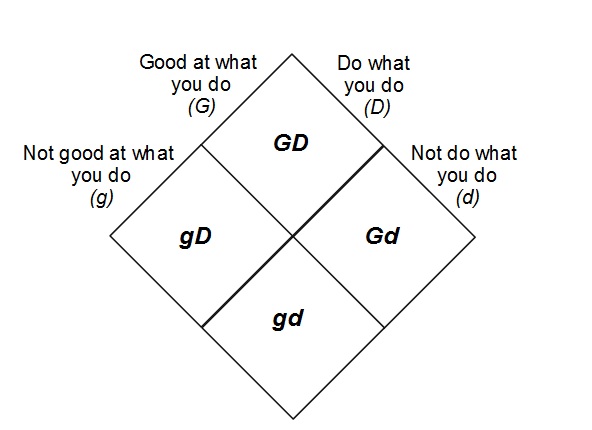
Once you get into the real world, of course, things change and make all this scholastic business seem quite juvenile in retrospect. When you have to struggle for survival and provide for other people, society correctly values different aspects of a man. For a man to be considered an “Adult Winner,” he must A) be good at what he does, and B) do what he does. If he can do one of these things and not the other, then he is part-winner and part-loser. If he can’t do either, then he is all loser. It’s really that simple. If a man can fulfill these two criteria, then in the vast majority of cases, he will be able to at least earn a living, attract the opposite sex, and accomplish a good chunk of what he wants in life. All the rest (looks, height, fitness, wit, intelligence, etc.) matters less, with the caveat that being rich accomplishes A and B in one fell swoop since what a rich man does is “whatever he wants.”

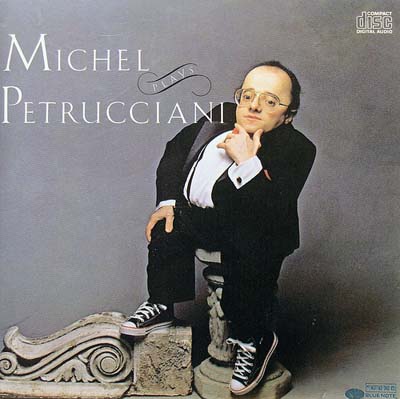
As proof of my Adult Winner-Loser theory, I present exhibit A, one Michel Petrucciani.

This was a fascinating man, born in France in 1962, with an incurable genetic disorder called osteogenesis imperfecta. Osteogenesis imperfecta in its more extreme forms causes short stature, brittle bones, constant pain, and pulminory problems. It is also inheritable, saddling each of its victim’s offspring with varying chances of being afflicted as well. Oh, and it can also kill you young, with victims of certain types of the disease rarely living a normal lifespan (Petrucciani, all three feet of him, made it to 36).

The reason why I bring up Michel Petrucciani is because he was a true winner in my little schema. In spite of horrific adversity, the man was an extremely talented and successful jazz pianist. He released over thirty recordings and was awarded the Légion d’honneur in Paris in 1994. Furthermore, he had girlfriends, even wives. (!) Pretty ones, too. Check out two of them, here and here. One of these ladies even bore him a child who, predictably—and tragically—enough, was afflicted with the same disease as his father.

In a social science sense, Michel Petrucciani is the perfect specimen to test my Adult Winner-Loser theory because he controls for almost every possible independent variable that would attract the opposite sex except for criteria A and B above, which become the dependent variables. Pretty much the only thing he had going for him was that he was extremely good at what he did, and he did what he did. This and this alone explains how this scrunched up little genius got more damnable action than a good chunk of us.

(Yes, Michel Petrucciani was a nice guy, but so was my college friend of the decrepit porta-potty, for all the good it did him.)

I imagine a Punnett Square of the Adult Winner-Loser breakdown would look something like this:

And just like in genetics, a person can have many Punnett Squares describing different things he may be good or bad at, which places winners and losers on a continuum, rather than in a stark black-white dichotomy. Our mainstream elites would have us believe that White Nationalism either consists of Scholastic Losers or Adult Losers of the gd variety. The former never reversed their social backwardness, and latter are no good at what they do and are unemployed besides. And yes, there are people like this among White Nationalists as there are among members of any dissident group.

But what our elites don’t count on are losers of the Gd variety also being attracted to White Nationalism. These are white men who are talented, intelligent, and driven, but who are excluded or hindered from their chosen careers or forced to conform to modern, politically correct standards which clearly disadvantage “pale males” like them. They are made into “losers” through no fault of their own, and from this pool White Nationalism draws some of its best thinkers and leaders. Think Wilmot Robertson resorting to the classic underground publication Instauration or Sam Francis being fired from the Washington Times or Peter Brimelow being let go from National Review or the safe, cushy life Kevin MacDonald could have lived had he simply dropped the Jew thing years ago. A lot of our best people have suffered outright rejection from the mainstream in one way or another or certainly expect to if they ever get doxed. As a result, they have little invested in mainstream society and would care even less if it were to come crashing down. As we all know, having little to lose also encourages risk taking. It makes one dangerous. What comes around, goes around with unjust rejection. Ultimately, the rejected party bites back twice as hard.

Now, I have to be very careful here lest I give the impression that all White Nationalists are losers. They are not; not by a long shot. I’m sure there are many perfectly successful and well-adjusted WD folks who do more than just sympathize with us and read our blogs. As I have stated before, “winners” and “losers” in this instance are not the commonly-used epithets we’re so familiar with but objective jargon established to make a point within this limited context. Most importantly, they are not static, with many losers being transformed into winners once they become White Nationalists and put in the serious effort and sacrifice necessary to make this thing work.

I believe this is something else our mainstream elites did not count on.

Is Jesus A Myth?

By Aedon Cassiel


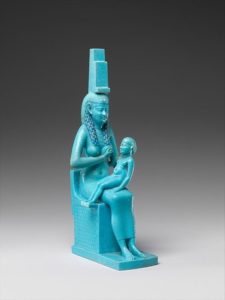
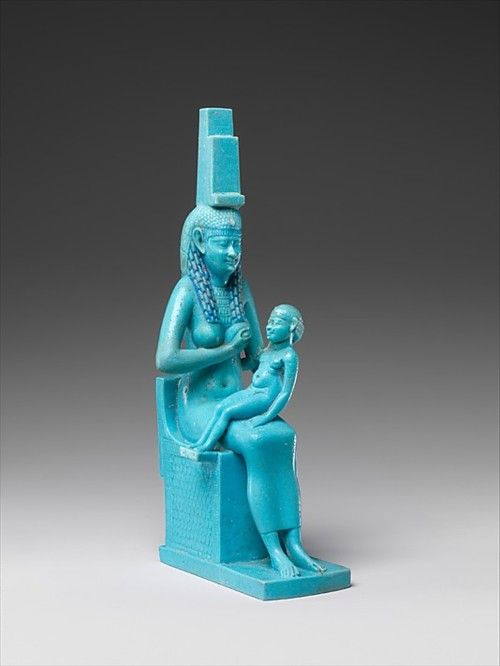
Isis with the infant Horus, faience, Ptolemaic period

I’ve spent most of my time at Counter-Currents focusing on issues that unite us rather than those that divide us. This hasn’t been out of any tepid desire to avoid controversy: I really do think the issues that unite us are far more important than those on which our community is split. Thus, I’ve been hesitant to risk sowing discord over side issues where we need unity more than ever.

But the truth of our side’s take on the issues that unite us—if you ask me—is obvious, and this just doesn’t always lend itself to interesting conversation. As a writer, I can only repeat the obvious for so long before desiring more of a challenge.

So to make it abundantly clear that this argument is posed with no hostility, I’ve decided to collaborate with Christopher Robertson to make this a sort of Bible Week at Counter-Currents. While I publish a discussion of the possibility that Jesus never existed as a historical figure, Robertson will be publishing a sort of Bible study (which he agreed to do by my insistence—I genuinely found it interesting). This way, the overall tone of Counter-Currents won’t be skewed towards either its Christian or non-Christian readers. And I hope that this token of good faith will help defuse any sense of hostility potentially created by this essay. Also note that in the future I’ll be discussing my disagreements with modern “atheists” in just as much detail.

First off, my background . . .

I was raised—initially homeschooled—in a small Southern town, with young-earth creationist parents. For those who don’t know, this is where someone adds up the genealogies listed in the Old Testament from Adam to Jesus and comes to a figure of 4,000 years, adds this to the 2,000 years or so we’ve seen Anno Domini, and concludes that the Universe must be approximately 6,000 years old.

I didn’t even encounter anyone I knew to be non-religious until somewhere around the age of 15.
And then I went on a manic spree, reading everything I could get my hands on—from Richard Elliott Friedman’s Who Wrote the Bible? to the little known part three of Thomas Paine’s The Age of Reason, subtitled Examination of the Prophecies.

My deconversion process was slow and torturous, because my mother was convinced I was on the way to an eternity in hell—a matter that completely superseded all interests I may have had in my earthly life entirely. If focusing on the matter of my eternal soul meant neglecting all other aspects of my education altogether . . . well, even 100 years spent starving and homeless followed by an eternity in Heaven would be better than 100 years spent in luxury followed by an eternity in Hell. It occurred to me that this attitude was entirely compatible with her premises, and that anyone who claimed to hold the worldview that she did without behaving the same way would have to be some kind of hypocrite.

I ended up forced into debates with pastors, forced to read countless works of apologetics, and ultimately spent several years in what amounted to some kind of ad hoc seminary.

In short, I didn’t come to appreciate the idea of mythicism because of some teenage act of rebellion, or juvenile attempt to snub my nose up at Christians and prove my superior intellect; I was sincerely interested in the truth, and curious to analyze all the different possibilities left by the gaps in the historical record. It was also a deeply personal process for me, because at the time, I was also taking the idea that I might be condemning myself to an eternity in Hell because of the conclusions I was arriving at in complete and total, unironic seriousness.

So, what is mythicism?

Mythicism is the thesis that Jesus is a myth, not a historical figure.

The most common objection to mythicism is that it’s impossible to prove a negative: if the mythicist has an arrogant attitude towards people who claim to know that a historical Jesus really existed, don’t they deserve the same amount of arrogance in return for claiming to know that he didn’t?
But this misses the point that a mature version of mythicism should really be aiming to prove: the idea is not supposed to be “hey, here’s why you can’t prooove Jesus was a real historical man! Neener neener!” but something more like this: “We’ve looked at what most religions around 1 AD were like, and what the background beliefs of the population in question were mostly like. Here’s our most plausible account of how Christianity arose in history. As you can see, this account of Christian origins just doesn’t involve a historical founder. We don’t need a historical founder because we have a better account of the origins of Christianity, that explains the facts as we find them, that just doesn’t involve one.”

In other words, the idea is not to ask “Can we prove a man named Jesus existed in history around 1 AD?” but rather: “What is the most plausible account of how the religion we now know as Christianity began?” That account will either involve a historical Jesus, or it won’t.

Now, in this essay, my aim is even more modest than that: I don’t intend to prove within the span of a couple of essays that the mythicist account is the most plausible story of how Christianity arose, but simply that an intelligent and mature mythicist account is possible. I’ll achieve this first by showing why there are enough gaps in the historical record to allow one to question if a historical Jesus really existed, and then by outlining one conceivable origin account that demonstrates what an alternative that doesn’t involve a historical founder might look like.

What is mythicism not?

You may remember a well-circulated, amateurish underground conspiracy “documentary” from about ten years back called Zeitgeist.

This is an excellent demonstration of what mythicism is not. After peddling 9/11 conspiracy theories, the documentary does a lazy job of summarizing bulletpoints of rough similarity between Jesus and the gods of previous religions: supposedly, the sacrificial God born of a virgin only to be crucified and resurrected is a constant motif throughout ancient religion. The documentary makes this claim of Mithra, Horus, and Dionysus, among others. Yet, when comparisons like these are made by amateur mythicists, they almost always reveal a deeply pseudo-intellectual comprehension of the pagan objects of comparison with Jesus.

Mithra, for example, wasn’t born of a virgin; he emerged fully formed as an adult . . . out of a rock. [1, 2] And he was never killed, let alone crucified. [3]

Dionysus was born from Zeus having sex with Semele:

“And Semele, daughter of Kadmos was joined with him [Zeus] in love and bare him a splendid son, joyous Dionysos,–a mortal woman an immortal son. And now they both are gods.”–Hesiod, Theogony. 940 ff (trans. Evelyn-White) (Greek epic 8th or 7th centuries BC)

Then he was torn into pieces by the titans.[4] And the only account in which Dionysus was resurrected and ascended to Heaven afterwards, the Contra Celsum, was written in 248 AD—and therefore could not have inspired the story of Jesus (more likely it was the opposite).
Horus was born when Isis took the form of a bird, “revivified the sexual member of [then-dead] Osiris and became pregnant by him, eventually giving birth to their child . . .” [5]

I can’t imagine any Christian telling the story of how after Mary died, the Holy Spirit resurrected her vagina and impregnated her dead body while in the form of a bird to conceive Jesus.

A mature and reasonable mythicism is not drawn from overly simplistic and lazy comparisons of the story of Jesus with the motifs of other religious figures. But this is the form of “mythicism” that people are most likely to be familiar with. So part of my task is to show that there are indeed forms of mythicism that are far more mature and intelligent than this sort of tripe.

God and the Gaps

Though traditional scholarship places the circulation of the first written Gospel (by almost all accounts of current scholarship, The Gospel of Mark) around 70 AD, it isn’t until around 170 AD that we have any official record of how they acquired their modern names. That was when Irenaeus, a Roman bishop, published Against Heresies, a refutation of various forms of Gnosticism.
In Book 3, Chapter 1, he claims:

Matthew also issued a written Gospel among the Hebrews in their own dialect, while Peter and Paul were preaching at Rome, and laying the foundations of the Church. After their departure, Mark, the disciple and interpreter of Peter, did also hand down to us in writing what had been preached by Peter. Luke also, the companion of Paul, recorded in a book the Gospel preached by him. Afterwards, John, the disciple of the Lord, who also had leaned upon His breast, did himself publish a Gospel during his residence at Ephesus in Asia.

What were Irenaeus’ sources, a full hundred years after the fact? How can we trust him to know the identities of the authors of the Gospels? In fact, even mainstream Christian scholarship tends to doubt the authorship of the Gospels. As Craig Blomberg writes in The Case for Christ, “It’s important to acknowledge that strictly speaking, the gospels are anonymous.” Furthermore, as this essay on Why Scholars Doubt the Traditional Authors of the Gospels notes,

. . . the first church fathers who alluded to or quoted passages from the Gospels, for nearly a century after their composition [that is, until the time of Iranaeus], did so anonymously. Since these sources do not refer to the Gospels by their traditional names, this adds further evidence that the titles bearing those names were not added until a later period (probably in the latter half of the 2nd century CE), after these church fathers were writing.[5] And, if the manuscript titles were added later, and the Gospels themselves were quoted without names, this means that there is no evidence that the Gospels were referred to by their traditional names during the earliest period of their circulation. Instead, the Gospels would have more likely circulated anonymously.

So we should make it very clear that when we refer to “Matthew,” “Mark,” “Luke,” and “John,” this is primarily a matter of convention, and not any real identification of the books’ authors. The proper title for the book I will call “Mark” is “The Gospel According to Mark,” and it obtained that name well over some hundred years after Jesus would have been dead.

As mentioned previously, the first Gospel—very probably Mark—is near–unanimously believed by scholars to have entered circulation around 70 AD. Together, Matthew, Mark, and Luke are known as the “synoptic” gospels (from the Greek σύν; syn, “together” and ὄψις; opsis, “view”), because they copy a great deal of content from one another—content differs between Matthew and Luke, but both contain lines throughout which are copied verbatim, or almost verbatim, from Mark. Thus, the current scholarly consensus is that Mark came first, and some years later Matthew and Luke both separately worked with Mark, as well as a hypothetical document called “Q” collecting the sayings of Jesus, or perhaps some other figure, used to explain lesser amounts identical content contained in Matthew and Luke but not originally appearing in Mark. The second leading theory is that the shared content between Matthew and Luke occurs because Luke copied directly from Matthew (a theory which dispenses with the need to hypothesize about “Q”). The Griesbach hypothesis differs from this consensus by supposing that Matthew was written first, and that Luke used Matthew as a source, while Mark then used both Luke and Matthew.

One problem for these second two theories can be demonstrated with an easy example: Mark contains no story of Jesus’ birth. Matthew and Luke both add birth narratives to the story, and the details of their narratives couldn’t differ more totally. Luke 2:1–7 says:

In those days Caesar Augustus issued a decree that a census should be taken of the entire Roman world. This was the first census that took place while Quirinius was governor of Syria. And everyone went to their own town to register.

So Joseph also went up from the town of Nazareth in Galilee to Judea, to Bethlehem the town of David, because he belonged to the house and line of David. He went there to register with Mary, who was pledged to be married to him and was expecting a child. While they were there, the time came for the baby to be born, and she gave birth to her firstborn, a son. She wrapped him in cloths and placed him in a manger, because there was no guest room available for them.

As it so happens, we know that this census took place in 6 AD.

Yet, when Matthew tells the story in Chapter 2, he claims that: “. . . Jesus was born in Bethlehem in Judea, during the time of King Herod . . .” And as it so happens, we know that Herod the Great died in 4 BC—ten years before Quirinius was appointed Imperial Legate of the province of Roman Syria and conducted his census.

The two Gospels, therefore, place Jesus’ birth a full ten years apart in time.

And they do so with narratives that never once overlap on any of the key important points. Matthew tells a story of King Herod ordering the murder of all newborns in Bethlehem in an attempt to kill the newborn Jesus:

When Herod realized that he had been outwitted by the Magi, he was furious, and he gave orders to kill all the boys in Bethlehem and its vicinity who were two years old and under . . . (2:16)

While it isn’t impossible that such an event could have taken place, the anonymous “Gospel According to Matthew,” written some decades after the events in question, is the sole source for it in all of history. And Luke never mentions it, either.

Matthew then claims that Joseph was warned by an angel to flee Bethlehem because of Herod’s plan, notes that Joseph “got up, took the child and his mother during the night and left for Egypt, where he stayed until the death of Herod” (v.14–15), and then claims that this all happened to fulfill “what the Lord had said through the prophet: “Out of Egypt I called my son”” (v.15).

Now, this verse is more interesting than it appears at a glance. Matthew has the unique trait of searching far and wide to make claims of Jesus having fulfilled Old Testament prophecies. But anyone who isn’t committed to taking an apologetic approach from the outset, I think, will find these claims not only unconvincing, but downright disconfirming of its author’s reliability.
This particular prophecy, for example, comes from Hosea 11:1.

Now, here is what Hosea 11:1–2 says:

When Israel was a child, I loved him,
and out of Egypt I called my son.
But the more they were called,
the more they went away from me.
They sacrificed to the Baals
and they burned incense to images.

Not only is it clear that v.1 is a historical reference to the nation of Israel, and not a prophecy about the coming of a future prophet or son of God, but it is abundantly clear that v.2 could not apply to Jesus—certainly no Christian would want it to, because it would have Jesus rebelling against God making sacrifices to the gods of foreign religions.

The discrepancies don’t end there. While Matthew has the family of Jesus fleeing to Egypt until Herod’s death (2:15, 2:21–23), Luke has them staying in Nazareth the entire time from the very beginning, going away to Jerusalem every year without fail (2:41 – “Every year Jesus’ parents went to Jerusalem for the Festival of the Passover”) and staying alone for three days in the Temple of Jerusalem (2:46–47 – He was “. . . sitting among the teachers, listening to them and asking them questions. Everyone who heard him was amazed at his understanding and his answers.”) Surely this would have caught King Herod’s eye! But according to Luke’s account, Jesus wasn’t born until King Herod was already ten years dead. Luke’s story has Joseph and Mary start in Nazareth, then journey to Bethlehem and back again, while Matthew’s has the family start in Bethlehem, then flee to Egypt, then find a new home in Nazareth. There literally isn’t a single point of overlap between their two accounts. It’s hard to see how to explain this, except by concluding that they were both separately filling in gaps left in Mark’s story.

See A Synoptic Gospels Primer: Parallel Texts in Matthew, Mark & Luke for an overview of the various approaches to this issue, and see here for further discussion of the existence of the hypothetical document known as “Q.”

The Gospel of John, meanwhile, is not believed to have entered circulation until at least 90 AD—and likely not even until after 100 AD.

So, how good are the Gospels as records of the life of a historical Jesus?

Less scholarly apologists who address themselves to popular audiences would like us to believe that what we have in the Gospels are four independent but corroborating, eyewitness accounts of the life of the historical Jesus. But even according to mature Christian scholarship, this very probably isn’t the case.

Instead, what we appear to have is one anonymously written work that appeared at a bare minimum almost four whole decades after the hypothetical date at which Jesus’ death would have taken place, two that copied extensively from it, and one that was most likely not written for still yet at least a few more decades. Generally speaking, this reduces the evidence represented by the Gospels down more or less to the evidence represented by Mark: whether or not the Gospels represent strong evidence for a historical Jesus, in other words, basically depends on whether or not the Gospel According to Mark does.

I’ll discuss this further in the next entry, and then discuss the one set of Christian documents we have which precede the dating of the Gospel According to Mark: the letters of Paul.

Notes


1. Mithraic Studies: Proceedings of the First International Congress of Mithraic Studies (1975), p. 173.

2. Encyclopedia of Religion and Ethics, vol. 8 (1994), p. 757.

3.  Richard Gordon, Image and Value in the Greco-Roman World (Aldershot: Variorum, 1996), p. 96

4. Paus. viii. 37. § 3; Diod. iii. 62; Phurnut. N. D. 28.

5. Richard Wilkinson, Complete Gods and Goddesses of Ancient Egypt (2003), p. 146.