Saturday, August 5, 2017

What Really Is Behind The 40-Hour Week: Slavery

    
Posted by Lukas Magnuson

One of the most common pieces of knowledge and essentially guarantees in life is the idea of a full time job. Full-time jobs often have varying definitions with some being full-time if it is 35 hours a week and others that require 40 hours of work per week. The question that many do not seem to ask is why is it 40 hours a week? Who decided that insurance coverage is only available unless someone has a job that requires at least 40 hours a week? This question and the issue of a 40 hour work week is studied and comes out with quite a fascinating perception to the entire idea of 40 hour work weeks.

Studying 40 Hour Work Weeks

In this reading, they use the term economic slaves to describe the wages as they indicate that economic slavery is best defined as people who rely on wages to maintain their life to the best of their abilities. This has probably perceived as obvious that people need to work to make money, however as time as passed there has been an increased sense of false security that the government and the mass media gives out. They tend to say that people have economic freedom in the 21st century. However, this is technically not true. People are essentially forced to have to take on a 40-hour job that does not pay enough. This doesn't even include the fact that many jobs require people to work overtime, which still is not enough to pay off the bills and many other necessities to live the "American Dream" and enjoy life.

People are essentially working 50-60 hour jobs and are forced to, due to the fact that they are pressured and heavily judged by employees and employers if they do not take on the task of extra work past their hours. Sure it pays more, however there is less leisure time and this technically lowers the amount of economic freedom someone truly has. The average salary in the United States is in the low number of about 22,000, but often have bills for the bare essentials that people leave them with no spare money of their own. This essentially is slavery in that there is not really an accomplishment and breaking even after working hard all week is not really productive. The stress still exists and no one but the companies feel better, but the employees definitely doesn't.

The issue of economic slavery also is prevalent, through trying to better one's life through something like college. Colleges leave students on average with about $20,000 worth of college loans. These often are unsubsidized, which means that interest constantly accrues interest every single year. This increases for several years and the more money stacked in loans the more interest that accrues. These payments can take a decade to pay off, which really puts the term economic freedom into question. Where is the freedom if all millennials are constantly working just to avoid prison or bankruptcy? This is simply legalized slavery. The only people who do not suffer are the elite and select few.

This has lead to the need to increase the hourly wages, however people have continued to fight it. This is a very hard issue to conquer.

The 40-Hour Work Week Turns You In An Economic Zombie

by Lukas Magnuson

How the forty hour week is an essential tool for capitalist control.

Economic slavery, also known as wage slavery, refers to a complete dependence on wages accrued from labor in order to survive. Naturally, this state applies to most people that live on this planet. In the developed world, wage slavery has effectively sculpted society and individual habits. The majority of people who are employed work for approximately forty hours a week. In those forty hours, they often submit to fairly dehumanizing conditions. They are told what to wear, when to leave and when to arrive, what to eat and even when they are allowed to go to the toilet. Why are the vast majority of people in the developed world so happy to meekly submit to this frankly ludicrous state of affairs?

Surprisingly enough, the forty hour work week was actually a hard-won concession on the part of trade union movements. In the dawning days of the Industrial Revolution in the United Kingdom, it was considered to be normal to work for between ten and sixteen hours a day. When exhausted workers began to protest they demanded a more reasonable settlement on working hours from their employers. The factory bosses conceded to a forty hour week, which has now been replicated throughout most of the developed world.

From the stance of a global capitalist, the forty hour week is essential to maintain equilibrium and control. While it does not exhaust and outrage ordinary citizens to the extent that they will rebel against the state of the world, it did leave them exhausted and occupied enough that they will not be capable of fulfilling any kind of meaningful collection in the spare time.

The forty hour week has also proved to be the nourishing force behind consumerism, particularly when it comes to over-indulgent spending. As workers have very little free time to themselves, they are suggestible to spending vast amounts of money on the entertainment and conveniences they consume in the hours spare that they have a week. The result of this is a perpetuation of debt and inflation, in addition to restricting how much time an individual can feasibly spend on more worthy and potentially revolutionary activities rather than mindless entertainment.

Friday, August 4, 2017

Review: How the Jews Defeated Hitler: Exploding the Myth of Passivity in the Face of Nazism

             Posted by Andrew Joyce, Ph.D.


At the close of my review of the late David Cesarani’s Final Solution: The Fate of the Jews, 1933–1949, I remarked that “the Holocaust,” as a cultural concept, had performed one of the greatest vanishing acts in history — the disappearance of the Jews as active participants during World War II.[1] Faced with an almost blanket portrayal of Jewish victimhood and passivity during the period, I commented: “Examining the thousands upon thousands of histories of World War II, one would get the impression that there was not only one war, but also only one aggressor. Quite how and why “the Jews” leave the historical stage as belligerents in 1939, when the preceding six years had witnessed them engaging in international propaganda wars, political maneuvering, and targeted assassinations in several European countries, has been surprisingly overlooked.” Benjamin Ginsberg’s relatively short but efficient work, How the Jews Defeated Hitler (2013, First Paperback 2016), may be considered a significant exception to this overwhelming omission, offering an argument that Jews played “a major role in the defeat of Nazi Germany.”[2]

In the introduction to his text, Ginsberg, a Professor of Political Science at Johns Hopkins University, outlines the structure of his argument along with his definition of Jewish resistance to the advance of National Socialism in Europe. Ginsberg’s definition of Jewish resistance is important because it differs significantly, in terms of its discursive parameters, from those generally employed in Holocaust historiography and its offshoots. For those interested in a more detailed exploration of the issue of Jewish resistance during World War II, as a subject of historiographical debate, The Holocaust in History by Michael R. Marrus (Penguin, 1989) and Histories of the Holocaust by Dan Stone (Oxford University Press, 2010) are perhaps the best and most succinct introductions to the most pertinent themes. However, in brief, historiographical argument prior to the 2010s was limited to two strands of thought, each biased and deeply flawed. The first strand of ‘resistance’ historiography was the negation of the idea of Jewish resistance. This involved lachrymose assertions that Jews offered no opposition to an unprovoked and irrational German hostility, and were led to sensationalized forms of mass murder like ‘lambs to the slaughter.’ A prime example within this strand is Martin Gilbert’s The Holocaust: The Jewish Tragedy (Harper Collins, 1986), and is also strongly associated with Raul Hilberg’s assessment that “the reaction pattern of the Jews is characterised by almost complete lack of resistance.” This first strand of argument was particularly popular in the diaspora, and in the United States and Great Britain in particular. The Holocaust developed as a cultural trope in these countries in tandem with the development of this lachrymose strand of historiography.

The idea of totally passive victimhood was, however, less popular among Israeli academics and hardline Zionists more generally. In the eyes of these Jews, the Jewish experience during World War II had fortified and proven prewar arguments on behalf of a Jewish national home, and it was almost a matter of national pride that some emphasis be placed on explicitly Jewish efforts to fight against National Socialist Germany. In this context, histories began to emerge from Israel in the 1960s glamorizing Jewish partisan warfare, or events such as the Warsaw Uprising. The second strand to Jewish resistance historiography of course retained the idea that Jews, ultimately, were victims, in the sense that they were victims of an unprovoked and irrational German hostility. However, the difference was that this strand denied total passivity in the face of such hostility, and made strenuous efforts to emphasize armed Jewish participation in European national resistance movements, and in partisan warfare. It represented, for lack of a better term, an idea of ‘muscular victimhood.’[3]

Both of these strands suffered from severe methodological and theoretical failings in that both discussed Jewish resistance only within the sphere of armed, guerilla, partisan action. Even the briefest of glances through Jewish history would illuminate the fact that, at least since the sack of Jerusalem by Titus in AD 70, Jews have pursued their social and political goals via means significantly more abstract than armed conflict. Indeed, the century prior to World War II witnessed the development of modern Jewish politics, with features involving the consolidation of media power, the strengthening of transnational political networks, the development of international Jewish mutual aid networks (particularly following the Damascus Affair in 1840), and the ascent of the Jews into Western governments and the professions. It should therefore be regarded as remarkable that discussions of Jewish opposition to National Socialism should have neglected these international and incredibly influential spheres of influence as potential or actual avenues for resistance. Ginsberg’s unique contribution is to take the mainstream discussion of Jewish resistance into these neglected areas. Across four chapters, Ginsberg explores Jewish activism in the United States, the Soviet Union, in the field of counterintelligence, and in partisan warfare, and argues that Jewish actions in all spheres were crucial to the defeat of National Socialist Germany.

Ginsberg’s chapter on the Soviet Union is particularly interesting. For centuries Jews have lacked the conventional means of defense available to a threatened nation, and in the 1930s Jews were a group of around 18 million people scattered across the globe. To combat such strategic deficiencies however, Jews could rely upon centuries of experience in more abstract forms of defensive diplomacy, and in the 1930s this involved “working for, with, and through states and political leaders who shared their hostility toward Nazi Germany.”[4]Ginsberg explains that by the 1930s Jews exerted a remarkable level of influence in Soviet government and society. Jews were crucial to the founding of the Social Democratic Party in the 1890s, and the Jewish Socialist Bund played a major role in the unsuccessful 1905 revolution. In the period leading up to the 1917 revolution, Jews were instrumental in the leadership of both the Bolshevik and Menshevik parties. It was therefore quite predictable that after the revolution, “among the first official acts of the victorious Bolsheviks was outlawing pogroms and anti-Semitic movements.”[5]

Jews came to play major roles in the Communist Party and the Soviet state, taking key roles in areas such as “foreign affairs, propaganda, finance, administration, and industrial production.”[6] Half of Lenin’s first Politburo were Jewish, and during the early decades of Communist rule Jews were “especially prominent” in the security services. For example, the Jewish pharmacist Genrikh Yagoda was head of the secret police during the 1930s, and specialized in preparing poisons for his agents to use in liquidating Stalin’s opponents. Ginsberg adds that “other high-ranking Jewish secret police officers included M.T. Gay, who headed the special department that conducted mass arrests during the “Great Terror” of the 1930s, and A.A. Slutsky and Boris Berman, who were in charge of Soviet terror and espionage abroad.

Quickly rising as an elite in Soviet society, Jews enjoyed privileged access to the professions and influential political and cultural positions. “Though making up less than 2 percent of the overall populace, between 1929 and 1939, Jews constituted 11 percent of the students in Soviet universities. This included 17 percent of all university students in Moscow, 19 percent in Leningrad, 24 percent in Kharkov, and 35.6 percent in Kiev.”[7] Ginsberg adds that “Jews had become the backbone of the Soviet bureaucracy and constituted a large percentage of the nation’s physicians, dentists, pharmacists, and other professionals, as well as nearly 20 percent of the scientists and university professors in such major cities as Moscow and Leningrad.”[8] The USSR’s most influential journalist, Mikhail Koltsov, was Jewish, while the Soviet Union’s official radio announcer, Yuri Levitan, was also a Jew. Other culturally influential Jews were Semyon Lozovsky, chief Soviet press spokesman, Ilya Ehrenberg, the leading publicist for anti-German sentiment, and Vasily Grossman, the Soviet army’s most influential war correspondent. The Soviet film industry was also dominated by the Jews Sergei Eisenstein, Mikhail Romm, Mark Donskoy, Leonid Lukov and Yuli Reisman. Thus, while Jews ostensibly had no nation of their own, Ginsberg remarks that they “had a good deal of influence within the new Soviet state.”[9]

Jews used this influence to combat a very strong threat from National Socialist Germany. During the first weeks of the German attack, the Wehrmacht destroyed more than 17,000 Soviet aircraft, 20,000 tanks, and 100,000 heavy guns and mortars. As many as 5 million Soviet troops had been killed or captured or were missing in action. Jews had an obvious interest in fighting against such odds, and flooded the army’s influential positions in order to push a fanatical resistance effort. Ginsberg remarks that it was commonly remarked by troops (and repeated by Alexander Solzhenitsyn) that no Jews were to be found on the front lines.[10] Ginsberg himself concedes that Jews “sought whatever refuge they could find and preferred rear-echelon assignments.”[11] However, Jews were over-represented at officer level, and remarkably comprised more than 10 percent of the army’s political officers — essentially the enforcers of government doctrine. Ethnic nepotism resulted in such a high number of medals being spuriously awarded to under-represented Jewish front line troops that in 1943 the Soviet regime was forced to try to reduce the number (and avoid aggravating non-Jewish combatants) by issuing a statement reading: “Medals for distinguished conduct are to be awarded to men of all nations, but within limits with regard to the Jews.”

Aside from warfare, Jews were essentially slave-masters overseeing the vast sphere of Soviet war production. The millions of Russians working ceaselessly in munitions factories came under the control of Boris Vannikov, deputy people’s commissar for armaments, while mass population movements of workers were orchestrated by the commissar for transport, Lazar Kaganovich. Those workers tasked with building more and more factories were under the control of the Director of the Commissariat for Construction, the Jew Semyon Ginsburg. Steel production (Semyon Reznikov), aviation (Solomon Sendler), naval construction (Grigory Kaplun), the chemical industry (Leon Loshkin), and the fields of electricity, heavy industry, and fuel, were under Jewish authority. The vast Russian workforce was essentially under Jewish control, and put to use in defense of Jewish interests. Meanwhile, the German workforce was operating on only one shift, continuing to produce consumer goods. Children went to school and women stayed at home. In the Soviet Union, the factories of the Jews operated every minute of every day, two million women were drafted into the military, and children were forced into the systems of production. A worker had to show up for work 66 hours per week, with only one day off per month.[12]

As well as possessing a vast and captive workforce for war production, Jews also engaged in intensive popular mobilization efforts. This was necessary because many of the USSR’s citizens “hated the regime,” which had uprooted, dispossessed, and starved to death millions of peasants. Ginsberg demonstrates that Jews dominated the machinery of both popular coercion and persuasion, effectively maneuvering public opinion in line with Jewish interests. In the area of coercion, Jews were prominent in the NKVD, and the head of the army’s political officers was Lev Mekhlis, a Jewish Communist who had played a major role in the military purges of the 1930s. One of the main responsibilities of Mekhlis was “making certain the soldiers fought and did not surrender.” But Jews were much more prominent in the field of persuasion. In the army, political workers called politruks were assigned to military units in order to enforce discipline and also lecture troops on their duties to the motherland and the bestial nature of the Germans. Ginsberg stresses that Jews were hugely over-represented at politruks, and were very important in preventing instances of Soviet surrender. The Jewish-dominated Soviet film industry also dedicated itself to “exhorting the frightened and exhausted citizenry to fight the Germans.”[13] Mikhail Romm and Mark Donskoy both specialized in films portraying the brutal torture of Russian women by Germans. Jewish-made films like these were then “shown throughout the war to fan feelings of Russian nationalism and hatred for the Germans.”[14]

The official army newspaper, Red Star, was edited by the Jewish David Ortenberg. Ortenberg worked in tandem with co-ethnic Ilya Ehrenberg to create propaganda calling upon “every Soviet citizen to kill the Germans.” One of Ehrenberg’s most famous slogans was “If you have killed one German, kill another. There is nothing jollier than German corpses.”[15] Jewish propagandists like Ortenberg and Ehrenberg also worked abroad to build support for the Soviet cause. “The major vehicle for this effort was the Jewish Anti-Fascist Committee (JAFC) composed of prominent Soviet Jewish political figures and intellectuals.” The JAFC raised money in the United States and Great Britain. “Though nominally an independent entity headed by the famous Soviet Jewish actor Solomon Mikoels, the JAFC was actually part of the Soviet Information bureau and closely monitored by a Jewish NKVD official, Sergei Shpigelglaz.”[16]

The JAFC found it easy to establish contact with similarly influential networks in the United States because that nation too had by World War II witnessed the rising power of the Jews. Ginsberg’s chapter on the United States is perhaps the most interesting of the entire text, and certainly from my own perspective justified the modest purchase price. Ginsberg begins by charting the rise of the Jews under FDR— a “long climb to power and prominence.”[17] More than 15 percent of Roosevelt’s top-level appointees were Jews—at a time when Jews constituted less than 3 percent of the population. Jews became such a prominent and visible element of Roosevelt’s New Deal program (a term coined by the Jewish Samuel Rosenman) that opponents referred to it as the ‘Jew Deal.’ Ostensibly a purely economic platform, the New Deal acted as a gateway for Jews into a much wider array of influence.

Among the most important Jewish figures in and around the Roosevelt administration were Henry Morgenthau (Secretary of the Treasury), Felix Frankfurter (appointed to the Supreme Court), Louis Brandeis (Supreme Court Justice), Jerome Frank and Abe Fortas (Securities and Exchange Commission), Isador Lubin (Bureau of Labor Statistics), Charles Wyzanski (Department of Labor), David Niles (White House Special Assistant), David Lilienthal (chair of the Tennessee Valley Authority), Nathan Strauss (U.S. Housing Authority), and Benjamin Cohen, the author of most New Deal legislation. These Jews, and lower level co-ethnics in and around the Roosevelt administration, were instrumental in challenging American isolationism. Ginsberg states that in combination with organized Jewish groups, these figures were crucial in bringing “isolationism into disrepute and turning American opinion against Germany.”[18]

The same period also witnessed the beginning of the end for the WASP establishment, mainly because WASPs (as one of the only Anglophilic elements in White America) decided to enter into a marriage of convenience with Jews in order to fight isolationism. Departing from a prior hostility to Jews, Anglo Northeastern Protestants let their guard down and made formal organizational pacts with Jewish propagandists. This was most notable in the form of the Century Group, which “worked vigorously for American intervention against the growing power of Nazi Germany.”[19] In the Century Group, Jews like James Warburg, Walter Wanger and Harold Guinzberg rubbed shoulders with Ward Chaney, Joseph Alsop, Frank Polk, Dean Acheson and Allen W. Dulles. After the defeat of France in 1940, the Century Group called for the United States to declare war against Germany without waiting to be attacked. Another strategy of the Century Group was to sponsor celebrities to give anti-German speeches, particularly in response to pro-isolationist meetings headed by figures such as Charles Lindbergh. The media networks controlled by the Century Group manipulated public opinion through tactics such as giving prominence to anti-German speeches while “relegating opposing points of view, such as those expressed by Charles Lindbergh, to the back pages.”[20]

Jews were crucial in sending destroyers and military hardware to Great Britain. As well as trying to shift public opinion in an anti-German direction, it was Benjamin Cohen (at Felix Frankfurter’s insistence) who sent a memorandum to Roosevelt arguing that he had the legal authority to release the destroyers without consulting Congress.[21] Another major supporter of this scheme, and the Lend Lease scheme which helped finance it, was the Fight for Freedom Committee (FFF) another group bringing together Jews and the Eastern WASP establishment. In common with many such groups, while its visible leadership was WASP, its influence derived from socially and culturally prominent Jews, in the case of the FFF Warburg and Guinzburg of the Century Group, along with Hollywood producers Jack and Harry Warner, labor leader Abe Rosenfield, and New York businessman Mac Kreindler. The FFF, which also had a close working relationship with British intelligence, was instrumental in a prolonged anti-Lindbergh campaign, and was successful in making a connection between “pro-isolationism” and “pro-Germany” in the public mind. Jewish groups like the American Jewish Committee and the Anti-Defamation League also undermined the isolationist position through propaganda and infiltration. “One ADL agent, Marjorie Lane, became an active and trusted member of a number of isolationist and anti-Semitic groups, including Women for the USA, Women United, and Mothers Mobilize for America.”[22]

In common with the situation in the Soviet Union, American Jews used the film industry to mobilize non-Jewish support for Jewish interests. Most of America’s film studios had been founded by Jews, and the 1930s witnessed an outpouring of anti-German productions. Roosevelt would later personally thank the movie industry for its “splendid cooperation with all who are directing the expansion of our defense forces,” and intervened to secure a reduced sentence for Jewish fraudster and head of Twentieth Century Fox, Joseph Schenk, who had been convicted of income tax evasion (an incident with eerie premonitions of the pardon of Marc Rich under Bill Clinton for the same crime).[23] The news media was also highly involved in the effort to shift public opinion, and both CBS and NBC (two of the most important networks) were owned by Jews.[24]

Go to Part 2

[1] A. Joyce, ‘A Tactical Retreat on the Holocaust: Review of Final Solution: The Fate of the Jews, 1933-1949 by David Cesarani’, in The Occidental Quarterly, Vol. 16, No. 4 (Winter 2016-2017).

[2] B. Ginsburg, How the Jews Defeated Hitler: Exploding the Myth of Passivity in the Face of Nazism (New York: Rowman & Littlefield, 2016), p.1.

[3] For a more complete overview of this strand of argument see O. Kenan, Between Memory and History: The Evolution of Israeli Historiography of the Holocaust, 1945-1961 (Peter Lang Publishing, 2003).

[4] Ginsberg, p.7.

[5] Ginsberg, p.9.

[6] Ginsberg, p.9.

[7] Ginsberg, p.10.

[8] Ibid.

[9] Ginsberg, p.11.

[10] Ginsberg, p.18.

[11] Ibid.

[12] Ginsberg, p.32.

[13] Ginsberg, p.34.

[14] Ibid.

[15] Ibid.

[16] Ibid.

[17] Ginsberg, p.37.

[18] Ginsberg, p.40.

[19] Ginsberg, p.41.

[20] Ginsberg, p.42.

[21] Ginsberg, p.43.

[22] Ginsberg, p.46.

[23] Ginsberg, p.49.

[24] Ibid.

Wednesday, August 2, 2017

Jews Against Humans

Jews Against Humans

By Kevin Larson 

I don’t know what Jews are, but I know what they are not, which is human. I don’t know where they come from. For that matter, I don’t know where we come from, but it’s not the same place.

Jews are aliens in every sense of the word. They even cultivate an alien appearance. Is there anything as strange as an orthodox Jew with his sinister black clothes and curly earlocks and ugly fedora? And of course bathing is not the custom of the orthodox, so they smell very bad all the time. They do this on purpose, for effect, for the shock value on us humans.

Thanks to the latest Gaza slaughter, things are coming into focus for many more people. Many people are wondering: what’s wrong with Jews? Why is it so easy for them to kill people? Why do they enjoy it so much?  Thanks to the Internet, millions are now wondering this online. Before the Internet, there was no place to wonder this in public.  We weren’t allowed to wonder anything about Jews except how wonderful they are.

Today the world knows that Jews aren’t wonderful. The world knows that Jews are dreadful. And the Jews know this. The Jews want the world to think of them as dreadful and to be afraid of them. They want the world to fear the Jewish nuclear arsenal which they coyly decline to discuss. One of their military professors, van Creveld, was authorized to threaten Europe with Jewish nuclear attack if Europe should turn against Israel:

"We possess several hundred atomic warheads and rockets and can launch them at targets in all directions, perhaps even at Rome. Most European capitals are targets for our air force…. We have the capability to take the world down with us. And I can assure you that that will happen before Israel goes under."

Based on the total FUBAR by Israel of its part of Operation Cyanide in 1967, we have to wonder if the Jewish arsenal is really a carefully contrived hoax. Pretty much everything we think we know about Jews is a Jewish hoax.  

For example, their Jewishness. The Jewishness of Jews is the number one Jewish fable. The Jewish writer Arthur Koestler demolished this fable back in 1976 with his best seller, "The Thirteenth Tribe," the first popular look we got at the Khazars and their descendants, the Ashkenazim.  

The Ashkenazim are the ersatz Hebrews who happen to make up the entire leadership of Israel. Three years ago an Israeli named Shlomo Sand ripped off Koestler with a virtually identical book, "The Invention of the Jewish People." This book again took the Jews by surprise, undercutting the basis of Zionism, the alien invasion, occupation and mass theft and murder of Palestine. Like the Koestler book, it wrecked the “anti-Semitism” racket. Both authors explained to their Israeli readers that they, the Israeli readers, were neither Semitic nor Hebrew. Same for the New York readers and the LA readers and the Miami readers. They’re all fake, wannabe Jews.

Briefly, the people of Khazaria were, around 800 AD, ordered by their king to adopt the law of the Hebrews as their own. We can’t call it a religion. The Talmud and the Old Testament are actually manuals of war against humanity based on harsh racial laws. There is no mercy for their human enemies in these very unpleasant works. The name of their god, YHVH, also means the Jewish people. This allows them to choose themselves and to worship themselves in what we could call a closed loop of extreme and violent narcissism.

Their priests insist that non-Jews are on this planet to serve them. And that it is kosher that non-Jews can be cheated, lied to and murdered with impunity. This Jewish principle is honored on their most sacred holiday, Yom Kippur, the Day of Atonement.  Another hoax, because they atone for nothing. Instead of atoning for their crimes against humanity, they declare a new war three times on this “holy day,” with the thrice-recited oath, the Kol Nidre. This vile “prayer” is a personal declaration of war against the humans. It is a warning that nothing a Jew says for the next year is true.

The Jewish story is a tale of murderous insanity, as we have seen over the past week in tiny Gaza. The first time we actually see this in the modern era is in the Bolshevik Revolution of 1917. Shortly after Jews massacred the entire family of Tsar Nikolas in 1918, Trotsky’s Red Army newspaper announced:

"Without mercy, without sparing, we will kill our enemies by the scores of hundreds, let them be thousands, let them drown themselves in their own blood. … let there be floods of blood of the bourgeoisie -- more blood, as much as possible."

“Bourgeoisie” is the Communist word of contempt for the middle class. Trotsky himself wrote about the murder of the Tsar’s family:

"The decision was not only expedient but necessary. The severity of this punishment showed everyone that we would continue to fight on mercilessly, stopping at nothing. The execution of the Tsar's family was needed not only in order to frighten, horrify, and instill a sense of hopelessness in the enemy but also to shake up our own ranks, to show that there was no turning back, that ahead lay either total victory or total doom. This Lenin sensed well."

Trotsky’s real name was Bronstein. Lenin (Ulyanov) was revealed in declassified Soviet documents as a Jew. Their Jewish colleague, Grigori Zinoviev, said this at a Communist meeting in 1918:

"We must carry along with us 90 million out of the 100 million of Soviet Russia's inhabitants. As for the rest, we have nothing to say to them. They must be annihilated."

The Jews murdered a lot more than ten million Russians and other peoples by the time they were done. Hell, they probably killed that many just in Ukraine, rather than the advertised three million. The generally recognized Soviet death toll is over sixty million souls. Some researchers insist that the appetite of the GULAG for seventy years of extermination of normal people by working them to death would have exceeded even the Communist Chinese death toll.

There are two main branches of Judaism:  Terrorism and Finance Capitalism. Terrorism is the action arm of Judaism and comes in two main forms:  Communism and Zionism.  Jewish terrorism was first seen in the French Reign of Terror but not widely understood as such, since the big Terrorists were French Freemasons. The author of the "Jewish Protocols" explained around 1897 that the Freemasons are tools of the Jewish syndicate and are not independent.

Finance Capitalism is how the terrorism gets paid for, because terrorists are very expensive. Finance Capitalism is the big Jewish secret of success. It is the lending of credit to governments which become hopelessly indebted to the Jewish lenders, who must be repaid in something valuable plus interest. Substitute payments for unpayable debts were favors, appointments of Jews to powerful positions in government, special licenses, etc.  

The Jew traditionally has sought to be the invisible power behind the throne. We usually didn’t see powerful Jews in the US government until Louis Brandeis was appointed by Wilson to the Supreme Court in 1916. JFK had the Rostow brothers as advisors and Johnson had Abe Fortas and Arthur Goldberg working for him. Then all hell broke loose with Nixon appointing Henry Kissinger as his national security advisor and then secretary of state!  

That unleashed the Jewish dogs of hell which erupted in the Reagan administration with the so-called “neo-conservatives,” virtually all Jewish Communists who switched to the Republican Party and made it pro-Israel. Communism and Zionism are virtually identical forms of terrorism except the former is based in New York and Moscow and the latter is based in New York and Tel Aviv. The Communists pretended to be our enemies and the Zionists pretend to be our friends.  

Peter S. sent an important point yesterday which prompted this essay:

"On behalf of his sponsors, the Rothschilds, Napoleon Bonaparte commissioned a fabricated history of Ancient Egypt from Jean Francois Champollion for the purpose of "validating" the Torah so the Rothschilds could use it to back up their claim for Palestine. They did not want Palestine for the Jews, they wanted the Jews for Palestine, to be human shields for Mossad, the private intelligence and assassination service of the Lombardy bankers since Babylon."

The same could be said for Cyrus Schofield and his Zionist concordance bible. This ex-convict (for fraud and forgery) was sponsored by the infamous Jewish lawyer, Samuel Untermeyer, and the Jewish fixer, Bernard Baruch, to annotate the Bible to justify Ashkenazi Jews flooding into Palestine. This Schofield propaganda is the basis for the Christian fundamentalists’ fanatical support for Jewish terrorism and dominance in the Middle East.

Untermeyer and Baruch teamed up in 1917 to pressure President Wilson to declare war against Germany, according to Benjamin Freedman, who later accompanied Wilson to Versailles to lower the boom on the defeated Germans, which led to incredible suffering, mass starvation, hyperinflation and the eventual violent deaths of millions of Germans and millions of others due to the actions of the Jewish monsters.

And then the same Untermeyer and Baruch pushed America into World War II with Untermeyer being authorized by the Jewish syndicate to declare Jewish economic war on Germany in 1933, when it became clear that Adolf Hitler was demonstrating to the world how to achieve prosperity with no Jewish gold, despite the denial of Jewish debt-based currency to the starving peoples of the world by the Jewish Federal Reserve.  

This, in the middle of the Great World Depression, was the German Economic Miracle that took destitute Germany from starvation to full employment in a year and a half, simply by issuing debt-free currency.  For this greatest of all offenses to Jewish finance capitalism, Germany had to be fire-bombed into smoking rubble and, again, subjected to slow death by starvation.  According to James Bacque in "Crimes and Mercies," Dwight Eisenhower’s post-war starvation orders resulted in the deaths of from nine to twelve million Germans from the end of the war to 1948, more than were killed during the war by Eisenhower’s generals.

In an interview after he was out of office, Eisenhower said the smartest thing he’d ever done was to ask Bernard Baruch for advice on his career when he was a lieutenant-colonel going nowhere in 1939. Soon he was on the fast-track to five stars and the mass slaughter of the German people on behalf of Judaism – and the presidency as his reward.  

That’s why I say that the Jews are some alien life form that is totally hostile to the Earth’s human population. I don’t pretend to know whence they came, or claim that they are reptiles. They act like reptiles and are certainly as cold-blooded and heartless as reptiles and what I do know is that they have to be wiped out entirely, just as rattlesnakes under your house have to be exterminated.  

The Jewish mayor of New York has the face of a reptile, so I can see how this idea got started. This is the guy who prohibited food given to the hungry because it might not have his Jewish idea of nutritional value! If a non-Jew had done this, the New York papers would have made him into a laughingstock.  A Jew must not be mocked in New York – or anywhere.

Remember one thing: famine is the favorite Jewish method of extermination. It costs nothing and it produces an agonizing death.  It’s what’s planned for America when the Jews think the time is right. The reader must prepare for the famine that is planned for us by the Jews. Have a look at Ukraine’s holodomor. It’s the model for what they, the Jews, plan for us in America. Precious metals will not be precious in a famine.  Food, water and ammunition will be precious. These are the things we will need to survive and destroy Judaism.  

While there is no actual connection between the Ashkenazi Jews and the legendary characters of the Old Testament, today’s Jews base their behavior on that of the legendary Jews. The number one role model is Joseph, eleventh son of Jacob, as told in Genesis. Study this story of contrived shortages and deliberately-caused famine. It is the story of the Federal Reserve and Monsanto.

If we continue on our present course of government borrowing from Jewish lenders, our monetary system will kill us because society will collapse. If we continue to eat poisoned food provided by Jewish Monsanto, we are doomed. The monetary policy can be fixed virtually overnight but our genetically modified food may not be so easily neutralized. One thing is certain: if we do not remove every aspect of Jewish control of our lives, the human race will die out, and rather quickly.  

Some say, forget about Gaza – concentrate on America. Well, we can’t forget about Gaza because that’s our baby. Gaza and the rest of Palestine is running in blood again because of the Jewish American government. The only thing we Americans can do is kill this Jewish government that is using Israel as its agent of sadism, murder and total destruction.  

Israel itself doesn’t do much damage compared with the American air force and army obliterating whole countries such as Iraq and Afghanistan.  Israel can’t do much because it is run by inept and kill-crazy but lazy Jews. But Jewish finance capitalism is the quartermaster of the Jewish American death machine. Without Jewish financing, Communism and Zionism collapse. The US military will also collapse without Jewish funding. Without Jewish direction, the US military will stop threatening the world with extinction.

So our first great task as American revolutionaries is to destroy every vestige of Judaism in America, in government, banking, the food chain, medicine and information (mind control). Everywhere we find Judaism, we must eradicate it. The first step toward anti-Jewish action is to discuss this with friends and family. Jewish friends must be dropped and Jews in general shunned.  After all, what has any Jew whom you know done or said anything to stop Israel from its plan to nuke Iran?  

As Brother Nathanael has warned, every Jew is politically aware and sees all issues by one measurement: “Is this good for Jews?” If your Jewish friends aren’t talking, it’s because they approve what America and Israel are doing to the humans. Put as simply as possible – what the Jews have done to their human enemies must be done to them.  

Everywhere in the world but mainly in Jewish America. They’ve slaughtered millions of Middle Eastern human enemies in the past two decades, not even to mention the damage they did, the blood they spilled, in Russia and Germany. On a one-for-one basis, the Jews owe us humans just about their entire population, whatever that is.  

It’s only fair.

Tuesday, August 1, 2017

Is The Gospel According To Mark An Allegory?

                        By Aedon Cassiel


In my last essay, I presented the argument for why the strength of the historical evidence for the life of Jesus provided by the Gospels basically reduces to the strength of the evidence provided by the anonymously-authored book, written shortly after AD 70, that subsequently acquired the title “The Gospel According to Mark” most likely sometime in the 2nd century AD (henceforth, “Mark”).

So now it’s time to ask how strong that evidence is.

Now, the next step in the argument is this: it would be entirely reasonable to interpret Mark as a literary work of allegory, rather than as an attempt at history to begin with.

This may sound absurd at first, because most of us reading today assume that the whole entire point of the Gospels is to attest to the historicity of Jesus’ life. But bear with me: once you see how much the hypothesis can make sense of, I think it seems downright obvious. This understanding of the Gospels as works whose point was to attest to the life of a historical Jesus comes from theological constructs that did not exist until after the Gospels had already been in existence for some time. Those constructs were then applied to the Gospels themselves, retroactively. As we’ll see, the same goes for the standard reading of the works of Paul.

First, I’ll outline a couple general stylistic elements that indicate that the book can plausibly be seen as residing in the genre of allegory. Then, I’ll show what the allegory was actually supposed to be about.  To the first point, not only do the names of many characters in the story work to symbolically represent the role they play in the narrative, but there are multiple examples of stories in Mark that make no sense at all until we interpret them against the Old Testament passages to which they are making literary allusions.

When Jesus is being sentenced to his death, the Gospels claim that Pilate used his power to commute a prisoner’s death sentence by popular acclaim to offer the crowd a choice between a “Barabbas” and Jesus. In what appear to be the earliest variations of the text, Barabbas’ full name is actually given as “Jesus Barabbas”. Etymologically, the name “Bar–abbas” literally means “Son of the Father.” Is it a coincidence that the man offered up to the crowd as the alternative to Jesus happens to have a name which literally means “Jesus, Son of the Father?”

If you are reading this essay, you are probably aware that Judas is the name of the character that betrays Jesus and sells him over to his death for money. It is significant that in the original Greek, “Judah” (the land of the Jews) and “Judas” are literally the same word: Ἰούδας.

If you didn’t catch that, read it again: the name of the man who betrays Jesus is “Judah.”

And this particular coincidence becomes even more significant when comparing Gospel passages about Judas with the Old Testament passages to which they are making literary allusions.

For instance, pay close attention to this passage from Mark 14:

Then Judas Iscariot, who was one of the twelve, went to the chief priests in order to betray him to them. When they heard it, they were greatly pleased, and promised to give him money. So he began to look for an opportunity to betray him.

…

Immediately, while he was still speaking, Judas, one of the twelve, arrived; and with him there was a crowd with swords and clubs, from the chief priests, the scribes, and the elders. Now the betrayer had given them a sign, saying, ‘The one I will kiss is the man; arrest him and lead him away under guard.’ So when he came, he went up to him at once and said, ‘Rabbi!’ and kissed him. Then they laid hands on him and arrested him. But one of those who stood near drew his sword and struck the slave of the high priest, cutting off his ear. Then Jesus said to them, ‘Have you come out with swords and clubs to arrest me as though I were a bandit? Day after day I was with you in the temple teaching, and you did not arrest me. But let the scriptures be fulfilled.’ All of them deserted him and fled.

A certain young man was following him, wearing nothing but a linen cloth. They caught hold of him, but he left the linen cloth and ran off naked.

This random mention of a naked guy running around in the middle of Judas’ betrayal of Jesus has perplexed many scholars for a really long time. But pay attention to this passage from Amos, written some time around 750 BC:

Thus says the Lord; For three sins of the children of Judah, and for four, I will not turn away from him, because they have rejected the law of the Lord, and have not kept His ordinances, and their vain idols which they made, which their fathers followed, caused them to err. And I will send a fire on Judah, and it shall devour the foundations of Jerusalem.

Thus says the Lord; for three sins of Israel, and for four, I will not turn away from him, because they sold the righteous for silver, and the poor for sandals, in which to tread on the dust of the earth, and they have smitten upon the heads of the poor, and have perverted the way of the lowly; and a son and his father have gone into the same maid, that they might profane the name of their God. … I brought you up out of the land of Egypt, and led you about in the desert forty years, that you should inherit the land of the Amorites. And I took of your sons for prophets, and of your young men for consecration. Are not these things so, you sons of Israel? Says the Lord.

But you gave the consecrated ones wine to drink, and you commanded the prophets, saying, Prophesy not. … flight shall perish from the runner, and the strong shall not hold fast his strength, and the warrior shall not save his life; and the archer shall not withstand, and he that is swift of foot shall in by no means escape; and the horseman shall not save his life. And the strong shall find no confidence in power: the naked shall flee away in that day, says the Lord.

The passage talks about the “sins of the children of Judah [Judas],” emphasizes that “they sold the righteous for silver” (Matthew 26:15 amends Mark’s use of the word “money” to say that Judas betrayed Jesus for “thirty pieces of silver”), and ends saying that “the naked shall flee away.” The parallel is obvious. And it fully explains the otherwise bizarre inclusion of a random, nameless, previously unmentioned naked guy just running around during Jesus’ betrayal.

As it so happens, almost all of the details of Jesus’ life can be seen as adaptations from scriptures in this way. One could argue that the evidence can be read one of two ways: it could be that the Gospel writers created the story of Jesus’ life by lifting directly from the Old Testament, or it could be that Jesus’ life really did fulfill everything that was ever said by the prophets.

But we have one definite way of establishing that the former explanation is superior to the latter. Sometimes, when the Gospel writers add details to Jesus’ life from the Old Testament scriptures, they misinterpret them or rely on mistranslations present in only the Greek Septuagint. For instance, Zachariah 9:9, written around 520 BC:

Rejoice greatly, O daughter Zion!
Shout aloud, O daughter Jerusalem!
Lo, your king comes to you;
triumphant and victorious is he,
humble and riding on a donkey,
on a colt, the foal of a donkey.

The author is clearly repeating the line, “on a colt, the foal of a donkey” as a way of adding emphasis. The image is supposed to be of a King, humble enough to ride on such a lowly steed as a donkey—yes, a donkey. Grammatically, the idea might be represented better as so: “Humble and riding on a donkey—on a colt; the foal of a donkey.” But when the writer of The Gospel According to Matthew adopts this into his narrative in 21:2–7, he changes Mark’s original story of Jesus riding only a colt, and literally has Jesus riding a donkey and a colt at the same time:

Go into the village opposite you, and immediately you will find a donkey tied there and a colt with her … Now this took place that what was spoken through the prophet might be fulfilled, saying, “Say to the daughter of Zion, ‘Behold your King is coming to you, gentle, and mounted on a donkey, even on a colt, the foal of a beast of burden.’” And the disciples went and did just as Jesus had directed them, and brought the donkey and the colt, and laid on them their garments, on which He sat.

Back to the parallel between Mark 14 and Amos 2. The important point here is not just how clearly the verses happen to parallel each other. The important point is why.

The traditional placement of the date of the writing of the Gospel According to Mark is based on the timing of the AD 70 destruction of Jerusalem. The reasons for this conclusion are too numerous to list in detail here, but one indication is Mark 13’s prediction of the Temple’s destruction:

As Jesus was leaving the temple, one of his disciples said to him, “Look, Teacher! What massive stones! What magnificent buildings!”

“Do you see all these great buildings?” replied Jesus. “Not one stone here will be left on another; every one will be thrown down.”

As Jesus was sitting on the Mount of Olives opposite the temple, Peter, James, John and Andrew asked him privately, “Tell us, when will these things happen? And what will be the sign that they are all about to be fulfilled?”

… Truly I tell you, this generation will certainly not pass away until all these things have happened.

In any case, scholars unanimously appreciate the significance of the AD 70 destruction of the Temple of Jerusalem when it comes to dating the Gospel According to Mark. But they may have underestimated its significance when it comes to interpreting the meaning of its content.

According to Josephus, 1.1 million people, mostly Jewish, were killed during the AD 70 siege of Jerusalem, and 97,000 more were captured as slaves. Suffice it to say that this was a really big deal. The Talmud also addresses the causes of the destruction of the Temple directly:

[W]hy was the second Sanctuary destroyed, seeing that in its time they were occupying themselves with Torah, [observance of] precepts, and the practice of charity? Because therein prevailed hatred without cause …

This passage resides in a long list of Jewish writing that blames the calamities that befall the Jews on the Jews’ own sins—whether “idolatry, immorality, and bloodshed” or “groundless hatred,” a constant theme throughout Jewish writing is that calamities that befall the Jews are punishment by God for their own weakness of faith and actions of religious infidelity.

The Gospel According to Mark was an allegory to establish this same point.

What is the book of Amos about? Exactly the same topic. It was a prediction of the calamities that would befall the nation of Israel if they didn’t turn from their rebellion.

Here’s another passage that fits the same theme, and makes no sense otherwise.

Mark 11:12–21 —

The next day as they were leaving Bethany, Jesus was hungry. Seeing in the distance a fig tree in leaf, he went to find out if it had any fruit. When he reached it, he found nothing but leaves, because it was not the season for figs. Then he said to the tree, “May no one ever eat fruit from you again.” And his disciples heard him say it.

On reaching Jerusalem, Jesus entered the temple area and began driving out those who were buying and selling there. He overturned the tables of the money changers and the benches of those selling doves, and would not allow anyone to carry merchandise through the temple courts. And as he taught them, he said, “Is it not written:

“‘My house will be called a house of prayer for all nations’? But you have made it ‘a den of robbers.’”

The chief priests and the teachers of the law heard this and began looking for a way to kill him, for they feared him, because the whole crowd was amazed at his teaching.

When evening came, they went out of the city.

In the morning, as they went along, they saw the fig tree withered from the roots. Peter remembered and said to Jesus, “Rabbi, look! The fig tree you cursed has withered!”

As a 21st-century reader, what am I supposed to believe here? Am I really supposed to believe that God, after incarnating himself as a man, got pissed off at a fig tree for not bearing fruit out of season and then cursed a tree? Even if we step away from the religious element and just look at the Gospels as flawed, human works of their time, what am I supposed to believe? How could a story like this one have even grown out of legend?

It all makes sense when we turn to the Book of Hosea, also written in the 8th century BC.

Do not rejoice, O Israel; do not be jubilant like the other nations. For you have been unfaithful to your God; . . .

The days of punishment are coming, the days of reckoning are at hand. Let Israel know this. Because your sins are so many and your hostility so great, the prophet is considered a fool, the inspired man a maniac. . . . When I found Israel, it was like finding grapes in the desert; when I saw your fathers, it was like seeing the early fruit on the fig tree. But when they came to Baal Peor, they consecrated themselves to that shameful idol and became as vile as the thing they loved.

. . . Because of all their wickedness in Gilgal, I hated them there. Because of their sinful deeds, I will drive them out of my house. I will no longer love them; all their leaders are rebellious. Ephraim is blighted, their root is withered, they yield no fruit.

As this excerpt from Hosea 9:1–17 makes clear, the topic of the Book of Hosea was, likewise, the calamities that would befall the nation of Israel if they persisted in their behavior. And the parallels are once again remarkable: we have “early fruit on the fig tree” (Mark 11 makes it clear that the fig tree Jesus saw was “in leaf” and therefore that it was early in the growing season), we have people being driven “out of my house,” and then we have not only barren trees, but common use of a specific turn of phrase in “withered roots.”

Even if we were trying to take the “centrist” approach of interpreting the stories about Jesus as legends that grew up around a real historical figure, this passage makes no sense. But as literary allusion, it makes perfect sense. The most plausible way to understand this verse is that the author of the Gospel According to Mark was making the allusion intentionally—for literary purposes—because the book was a work of allegory, not about a historical Jesus, but about why the Jews brought the AD 70 destruction of the Temple of Jerusalem upon themselves. The Jesus of Mark’s story is just the medium for the delivery of the message.

As mentioned in the introduction to this series, the Gospel According to Matthew and the Gospel According to Luke both contradict each other by ten whopping years over the date when Jesus is born (Matthew’s story places his birth before 4 BC, because this is when the Herod it depicts died; Luke’s places it after AD 6, when Quirinius became governor of Syria).

But it is even more significant to recall why this was possible to begin with: Mark, the very first gospel, contains no stories about Jesus’ childhood. And modern readers would be surprised to learn how the very first–written of all the Gospels ended: there was no resurrection story. The elaborated endings of modern copies of Mark including resurrection stories are now known by all scholars, including the most conservative, to be forgeries.

As Richard A. Burridge puts it in Four Gospels, One Jesus?, “Mark’s [original story] ends as abruptly as it began. There was no introduction or background to Jesus’ arrival, and none for his departure. No one knew where he came from; no one knows where he has gone . . .”

In Mark 14:18, before the crucifixion, Jesus says: “But after that I am risen, I will go before you into Galilee.” Afterwards, the original story ends with Mary Magdalene, and Mary the mother of James, and Salome coming to anoint Jesus’ body, and finding inside the tomb a man who told them, “Ye seek Jesus of Nazareth, which was crucified . . . But go your way, tell his disciples and Peter that he goeth before you into Galilee: there shall ye see him, as he said unto you.” And the narrative ends on this verse: “And they went out quickly, and fled from the sepulchre; for they trembled and were amazed: neither said they anything to any man; for they were afraid.”

In the next entry, I’ll fit the writing of the allegorical Gospel According to Mark into the context of the writings, and theology, of Paul.

Tuesday, July 25, 2017

The Free Market & Immigration: Two Thought Experiments

By Ted Sallis


German translation here

Free market proponents of open borders and mass immigration must be happy about this story. As we know, the free marketers tell us that nations with low birthrates require alien immigration because of “labor shortages” (yet Spain and the USA have high unemployment coupled to large-scale immigration), or the need for “greater productivity and economic growth” (yet many immigrants are low-skilled and on welfare and even when high-skilled often tend to be net consumers of services), or the need for “younger workers to pay for the social services for aging/retired natives” (as if, when they amass sufficient political power, young non-Whites will cheerfully pay for the care of old White folks, who they hate).

Then one can also question whether opposition to immigration is really irrational from an economic standpoint — the natives’ economic standpoint — when virtually all of the benefits (if any exist) of “economic growth” accrue to the immigrants (and possibly to wealthy natives) themselves rather than to the general native population. These are, of course, all economic arguments.

We, on the other hand, argue that there are more important things than economics — such as demographic displacement, race survival, genetic interests, and culture. But let’s get back to some basics of the general free market argument and consider two simple thought experiments.

1. The supporters of the free market assert that it is the most rational and efficient approach for allocating resources, managing the economy, and increasing standards of living. We are told that supply and demand and other free market mechanisms promote rational decision-making and incentivize behaviors that lead to optimized outcomes for society. Thus, they look at the global economy and say if there is a labor shortage in “X” and a labor surplus in “Y” then the free market dictates that the most effective solution to the problem is a movement of labor from “Y” to “X.” That is how the labor shortage of “X” — possibly due to a low birthrate — is solved.

Why does the solution need to be global? What happens if a country with a low birthrate will not, or can not, make up for the “labor shortage” with immigrants? (Note: Japan may be a real-life experimental model for this scenario, if they maintain their hard line against immigration, which seems doubtful over time). The reasons for “no immigration” need not concern us, let us assume, for the sake of this model system, that mass immigration is not possible or desirable. What happens then?

If the free market is so very efficient in finding the correct solutions for societal problems and resource allocation, shouldn’t it work in a national context? Why can’t the free market solve a purely internal problem of low birthrates and labor shortages? Why the hypocrisy in asserting the magical properties of the free market on a global level but its hopelessness on a national level? Shouldn’t the free market work, locally and nationally, to lead to policy choices and resource allocation to incentivize pro-natalist policies, to increase the native birthrate? How about increasing productivity through better education and, above all else, enhanced automation? If the free market really is a “miracle worker” then it should lead to creative solutions to national problems that do not depend on temporary fixes involving shifting problems such as overpopulation/poverty from one nation to another. The vaunted free market should incentivize either pro-natalism or birth control whenever and wherever each is needed.

Thus, in our thought experiment: what would happen to a low-birthrate nation in the absence of immigration? Will the population really dwindle down to zero? Will the economy collapse? Will everyone just sit around passively and let the nation disappear from the face of the Earth? Indeed, one can argue that without the immigration safety valve, nations would be forced to develop long-term solutions to their societal problems, instead of increasing these problems and postponing their solution to the next generation. If the free market really worked, it would be independent of scale, and would work for one nation and not just on a global level.

2. One can consider the opposite thought experiment. Instead of restricting the free market from global to national, one can expand it from global to inter-stellar. Assume that the Earth is contacted by an alien species, a bizarre species quite different from humans. These aliens are very fast-breeding and have over-populated their own planet. Earth’s environment is suitable for them. Further, they are highly intelligent and productive — indeed, superior to humans as inventors and workers.

These aliens want to ship their surplus population to the Earth, where they will join the economy, work hard, invent, create businesses, and sharply increase economic growth. Of course, these fast breeders will soon begin to fill up the Earth with their numbers, crowding out native humans, and, of course, their home world population will also be increasing, and clamoring to come to Earth as well. But . . . the Earth’s economy will be growing! Isn’t that all that matters? If concerns about demographic displacement, culture, etc. are all “irrational” then the free marketers should have no problem with a scenario that includes the gradual displacement and replacement of humans by aliens, all in the name of global economic growth for the Earth. Will they make this argument? If so, they expose themselves as traitors to humanity. If not, then why does the “there are after all, more important things than economic growth” argument not apply to the internal Earth situation? Maybe White folks don’t want to be displaced and replaced in their own countries by alien immigrants?

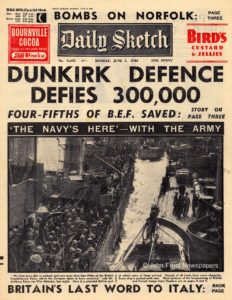
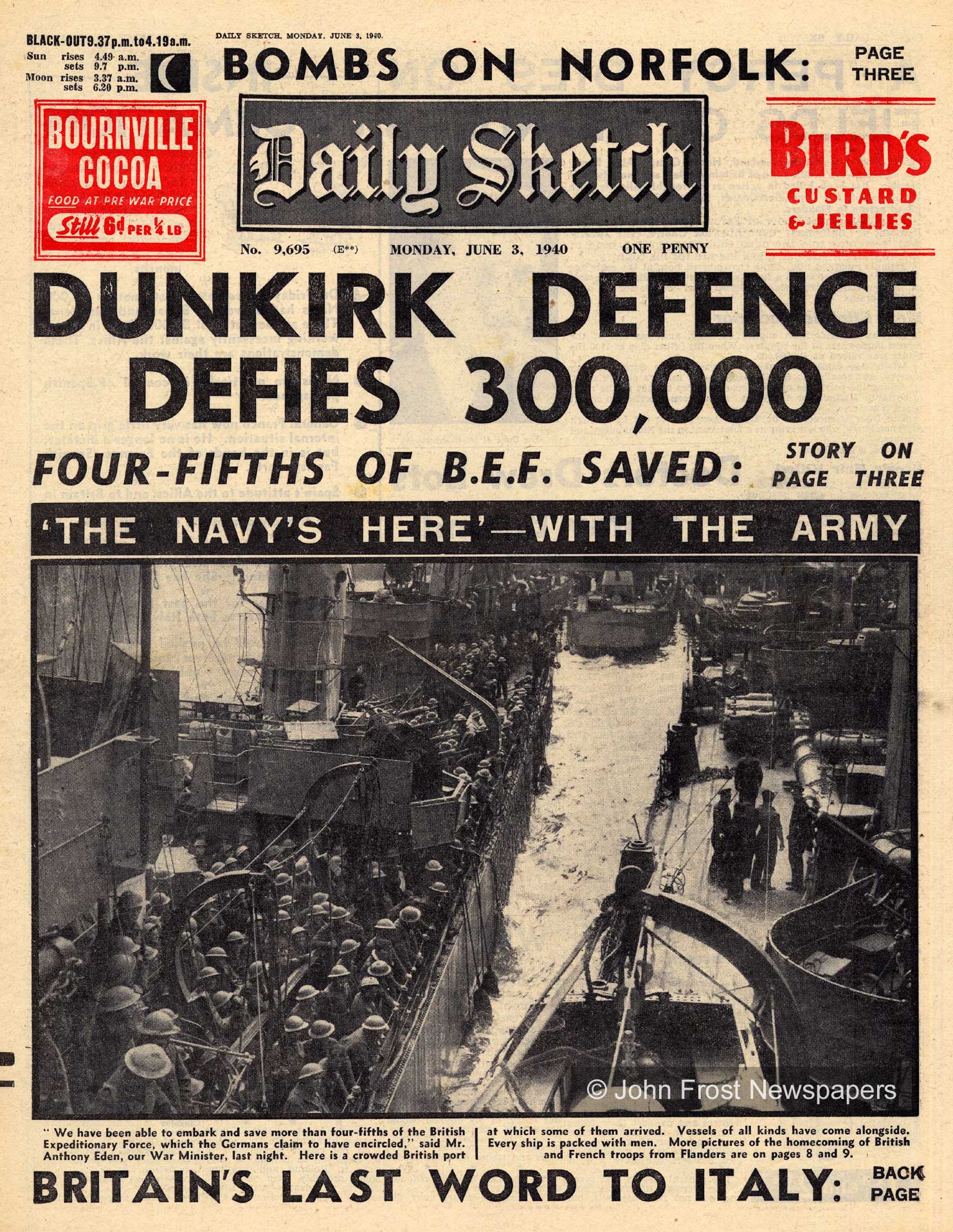
Why Hitler Let The British Escape At Dunkirk

B. H. Liddell Hart


Editor’s Note:

B. H. Liddell Hart was a highly-acclaimed English soldier, military historian, and military theorist, and a prolific author. The following text is excerpted from his book The Other Side of the Hill: Germany’s Generals, their Rise and Fall, with their own Account of Military Events 1939–1945 (London: Cassell, 1948), chapter 10, “How Hitler Beat France—and Saved England,” pp. 139–43. The title is editorial.—Greg Johnson 

Hitler’s Halt Order

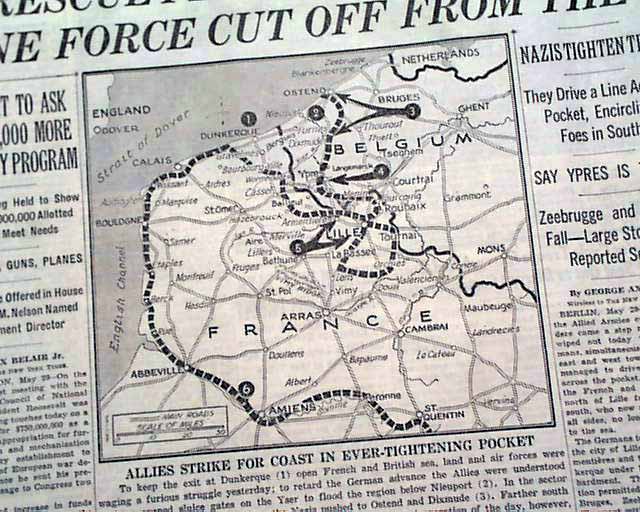
On wheeling north, Guderian’s Panzer Corps headed for Calais while Reinhardt’s swept west of Arras towards St. Omer and Dunkirk. On the 22nd, Boulogne was isolated by Guderian’s advance, and next day Calais. That same day Reinhardt reached the Aire-St Omer Canal, less than twenty miles from Dunkirk — the only escape port left to the B.E.F. [British Expeditionary Force]. The German armoured forces were much nearer to it than the bulk of the B.E.F.

“At that moment,” Rundstedt told me, “a sudden telephone call came from Colonel von Grieffenberg at O.K.H. [German headquarters], saying that Kleist’s forces were to halt on the line of the canal. It was the Fuhrer’s direct order—and contrary to General Halder’s view. I questioned it in a message of protest, but received a curt telegram in reply, saying: ‘The armoured divisions are to remain at medium artillery range from Dunkirk’ (a distance of eight or nine miles). ‘Permission is only granted for reconnaissance and protective movements’.”

Kleist said that when he got the order it seemed to make no sense to him. “I decided to ignore it, and to push on across the Canal. My armoured cars actually entered Hazebrouck, and cut across the British lines of retreat. I heard later that the British Commander-in-Chief, Lord Gort, had been in Hazebrouck at the time. But then came a more emphatic order that I was to withdraw behind the canal. My tanks were kept halted there for three days.”

Thoma, who was chief of the tank side of the General Staff, told me that he was right up forward with the leading tanks, near Bergues, where he could look into the town of Dunkirk itself. He sent back wireless messages direct to O.K.H., begging for permission to let the tanks push on. But his appeal had no effect. Referring to Hitler’s attitude, he bitingly remarked: “You can never talk to a fool. Hitler spoilt the chance of victory ”

Meanwhile the British forces streamed back towards Dunkirk, and cemented a defensive position to cover their re-embarkation. The German tank commanders had to sit and watch the British slipping away under their very nose.

“After three days the ban was lifted,” Kleist said, “and the advance was resumed—against stiffening opposition. It had just begun to make headway when it was interrupted by a fresh order from Hitler—that my forces were to be withdrawn, and sent southward for the attack on the line that the remainder of the French Army had improvised along the Somme. It was left to the infantry forces which had come down from Belgium to complete the occupation of Dunkirk—after the British had gone.”

Hitler’s Reasons

A few days later Kleist met Hitler on the airfield at Cambrai, and ventured to remark that a great opportunity had been lost of reaching Dunkirk before the British escaped. Hitler replied, ”That may be so. But I did not want to send the tanks into the Flanders marshes—and the British won’t come back in this war.”

To others Hitler gave a somewhat different excuse—that so many of the tanks had fallen out from mechanical breakdowns that he wanted to build up his strength and reconnoitre the position before pushing on. He also explained that he wanted to be sure of having sufficient tanks in hand for the subsequent offensive against the rest of the French Army.

I found that most of the generals, including Kleist, had accepted these explanations with little question, though they were sore about the decision that had deprived them of complete victory. They felt that Hitler’s anxiety about the marshy ground was exaggerated, and were convinced that they could have easily avoided it. They knew that lots of fresh tanks had been arriving daily to replace wastage. Nevertheless, Hitler’s decision was assumed to be purely an error of judgment or excess of caution.

But certain members of Rundstedt’s staff regarded the excuses as thin, and believed that Hitler had a deeper motive for his halt order. They connected it with the surprising way he had talked when visiting their headquarters at Charleville on May 24th, the day after the armoured forces had been halted in their stride.

Hitler was accompanied by only one of his staff, and talked in private to Rundstedt and the two key men of his staff—Sodenstern and Blumentritt. Here is what the latter told me—”Hitler was in very good humour, he admitted that the course of the campaign had been ‘a decided miracle’, and gave us his opinion that the war would be finished in six weeks. After that he wished to conclude a reasonable peace with France, and then the way would be free for an agreement with Britain.

“He then astonished us by speaking with admiration of the British Empire, of the necessity for its existence, and of the civilization that Britain had brought into the world. He remarked, with a shrug of the shoulders, that the creation of its Empire had been achieved by means that were often harsh, but ‘where there is planing, there are shavings flying’. He compared the British Empire with the Catholic Church—saying they were both essential elements of stability in the world. He said that all he wanted from Britain was that she should acknowledge Germany’s position on the Continent. The return of Germany’s lost colonies would be desirable but not essential, and he would even offer to support Britain with troops if she should be involved in any difficulties anywhere. He remarked that the colonies were primarily a matter of prestige, since they could not be held in war, and few Germans could settle in the tropics.

“He concluded by saying that his aim was to make peace with Britain on a basis that she would regard as compatible with her honour to accept.

“Field-Marshal von Rundstedt, who was always for agreement with France and Britain, expressed his satisfaction, and later, after Hitler’s departure, remarked with a sigh of relief—‘Well if he wants nothing else, then we shall have peace at last’.”

When Hitler continued to keep on the brake, Blumentritt’s thoughts ran back to this conversation. He felt that the “halt had been called for more than military reasons, and that it was part of a political scheme to make peace easier to reach. If the British Army had been captured at Dunkirk, the British people might have felt that their honour had suffered a stain which they must wipe out. By letting it escape Hitler hoped to conciliate them.”

This conviction of Hitler’s deeper motive was confirmed by his strangely dilatory attitude over the subsequent plans for the invasion of England. “He showed little interest in the plans,” Blumentritt said, “and made no effort to speed up the preparations. That was utterly different to his usual behaviour.” Before the invasion of Poland, of France, and later of Russia, he repeatedly spurred them on. But on this occasion he sat back.

Since the account of his conversation at Charleville and subsequent holding back comes from a section of the generals who had long distrusted Hitler’s policy and became more hostile to him as the war continued, that makes their testimony on this point more notable. They have criticized Hitler on almost every score. It would be natural to expect, that, in the present circumstances, they would portray him as intent on the capture of the British Army, and themselves as holding him back. Their evidence has the opposite effect. They very honestly admit that, as soldiers, they wanted to finish off their victory, and were upset at the way they were checked from doing so. Significantly, their account of Hitler’s thoughts about England at the decisive hour before Dunkirk fits in with much that he himself wrote earlier in Mein Kampf—and it is remarkable how closely he followed his own bible in other respects.

Was this attitude of his towards England prompted only by the political idea, which he had long entertained, of securing an alliance with her? Or was it inspired by a deeper feeling which reasserted itself at this crucial moment? There were some complex elements in his make-up which suggest that he had a mixed love-hate feeling towards England similar to the Kaiser’s.

Whatever be the true explanation, we can at least be content with the result. For his hesitations came to Britain’s rescue at the most critical moment of her history.