
Friday, August 11, 2017

Free Trade Doesn't Work

                      By Donald Thoresen


Ian Fletcher
Free Trade Doesn’t Work: What Should Replace It and Why
Washington, D.C.: U.S. Business and Industry Council, 2010

Among those who consider themselves part of the New Right, there has been an increasing level of awareness of the problems inherent in the theories and practices of neoliberal capitalism, in particular those of globalism and free trade. This is not a surprising development. The foundational principle of the New Right and all of its various factions is that there is a racial basis to culture. Once one develops the intellectual courage and capacity to start thinking practically about this fundamental truth, the contradictions between advocating for whites as a legitimate racial political collective and advocating for an internationalist economic system become jarringly obvious. The core problem is actually very simple: under free trade, the capitalist class is able to flee to other countries in order to avoid laws and regulations designed to increase the general health and happiness of national citizens, while continuing to extract wealth from those very people, and, crucially, without making good on the promise of increased wealth through “efficient” allocation of resources in a global market–often even decreasing their net worth. With this, of course, comes many other related problems, not least of which is radical demographic change.

Western governments have been moving in this direction for decades, as a result of political corruption, ideology, and bad economics. By colluding with internationalist free traders, these states have become exploiters rather than protectors. And instead of existing as the ultimate expressions of particular racial cultures, these states have become plastic shells of banalities and spectral remnants of their historical pasts. Citizens have been pauperized and replaced by cheap foreign labor (either through offshoring or immigration) and their once homogeneous and orderly communities have become increasingly multicultural and correspondingly unfamiliar, unpleasant, and unsafe.

For capitalist free traders (and, not entirely coincidentally, Marxists) the economy is the bedrock of all human activity. But for those who believe in race as the foundational element of culture, the economy must be, at its very roots, little more than a social construct that can either benefit or harm people depending on how it is organized and, most importantly, who organizes it. As such, New Rightists are forced to realize that certain presumed economic givens, which are tied intimately to our contemporary Judaized culture, must be evaluated first and foremost with one fundamental criterion: does a particular policy or theory aid the long term survival and prosperity of whites? If so, how? If not, why not?

In any discussion of economics, there will be many complex issues involved and various ways to approach them. It can often be confusing to try to make sense of any of them, especially as most arguments, from Left to Right, tap in easily to deeply embedded, but ambiguous and easily manipulable, cultural values such as “freedom” and “fairness.” There is, however, a particularly good book that can help anyone navigate the particulars of free trade arguments and understand why they are both fallacious and outright harmful: Ian Fletcher’s Free Trade Doesn’t Work: What Should Replace It and Why.

Mr. Fletcher is a San Francisco-based economist who studied at Columbia University and the University of Chicago. He was the senior economist for the Coalition For a Prosperous America from 2010-2012 and a research fellow at the U.S. Business and Industry Council, in addition to having been in private practice and having worked as a columnist for the Huffington Post.[1] In this book, Mr. Fletcher refutes many of the basic assumptions held by free traders in very straight-forward language so that “ordinary citizens. . . [can] know enough about the economics that supposedly justifies free trade to hold their ground in confrontations with the experts and not get ruled out of public debate on grounds of ignorance” (p. 4). The book covers so much ground that it would be impossible to do justice to each of his various points, but this review will highlight some of the most important ones.

In the introduction, entitled “Why We Can’t Trust the Economists,” Mr. Fletcher makes clear his reservations about professional economists. He argues that those economists who support free trade generally do so for a few different reasons. First, that, despite knowing the problems of free trade, they simply believe that the alternative would be worse. He writes: “The great fear is that if protectionism is conceded any legitimacy, special interests will seize control and economic logic will fall by the wayside” (p. 6). But this, he argues, is based in a fear that is “not actually a part of economic science. . . It is just a somewhat cynical intuition about the American political system” (p. 6). Second, he argues that there is a significant amount of corruption within the field that contributes to the free trade mania. Economists, he writes, are sometimes “paid shills of special interests. . . . Economics consulting firms like Global Insight, MiCRA, and Strategic Policy Research basically retail the service of providing whatever conclusions are required, albeit with sufficient sophistication that nobody has to tell any literal lies” (p. 7). But another less explicit form of corruption results from the fact that in order to “win clients, economists in private practice. . . must cultivate a reputation for saying the kinds of things that clients want to hear” (p. 7). The effect of this corruption is that it “debases the quality of thinking over time, and a nation that insists on being told what it wants to hear will eventually lose the ability to figure out what the truth actually is” (p. 8).

Mr. Fletcher, aware of the propaganda against any kind of protectionism (it is socialist, it is fascist, it is xenophobic, et cetera), relates how his ideas square with the concept of nationalism. He states that both sides of the political spectrum tend to reject the primacy of the nation in economic relationships.[2] But, he writes: “Globally, for good or ill, the nation-state is still where the buck of political legitimacy stops. (Higher or lower political entities, from Kansas to the United Nations, enjoy political legitimacy only because nation-states have given it to them)” (p. 14). He then goes on to say that a “blanket rejection of even the mildest economic nationalism . . . simply hands a blank check to multinational corporations, foreign powers, and distorted market forces to do as they please” (p. 14). He refuses to take a stand on nationalism per se, but the idea that economic questions can be answered without taking into account nation-states is, to him, misguided and naive. Since it is doubtful that Mr. Fletcher is aware of the ongoing demographic destruction of the white race and the role of Jews in this process, he tends to see “bad economics” where there is often malevolent calculation, but this does not affect the value of his arguments.

Mr. Fletcher begins the first part of his book, “The Problem,” by stating that the “fundamental message of this book is that nations, including the U.S., should seek strategic, not unconditional integration with the rest of the world economy. Economic openness, like most things in life, is valuable up to a point–but not beyond it” (pp. 20-21). He then proceeds to discuss various myths about free trade: its historical inevitability; the irrelevancy of the nation-state; the “cliché that we live in a borderless global economy” (p. 26); and the childish notion that free trade as foreign policy will lead to world peace. He also critiques those “empty, flashy arguments” of free traders that amount to little more than ad hominem attacks (p. 28). For example, responding to Barack Obama’s infamous remarks to an audience of campaign donors in San Francisco, in which he lambasted middle (read white) Americans for clinging to “guns and religion” and expressing anti-immigrant and anti-free trade sentiments, Mr. Fletcher writes: “God forbid the unemployed of an old-line industrial state should think trade has anything to do with their problems” (p. 29).[3] Though the author himself misses the connection between trade and “guns-religion-immigration,” New Rightists’ ears should perk up when seeing trade included in this list of “things white people like.” Free trade is a major part of the larger process by which white influence in historically white nations has been, and continues to be, reduced. That the soon-to-be nominal “head free trader” made this connection explicit to a group of drooling Bay Area boot-lickers is telling, to say the least.

Mr. Fletcher then proceeds to discuss certain other basic assertions commonly made by free traders. One is that free trade creates billions of new consumers for American products, the most frequent example of which is the supposed economic opening of China. However, in addition to the fact that America runs a huge deficit with China, “China deliberately blocks imports, mainly with non-tariff barriers, in order to decrease consumption, increase savings, and boost investment. . . . As a result, even the limited purchasing power China’s mostly poor population does have rarely gets spent on American goods” and the “dream of selling to the Chinese functions primarily as bait to lure in American companies, which are then forced by the government to hand over their technological know-how as the price of entry. . . . They then build facilities which they discover they can only pay off by producing for export” (p. 31). This general formula applies to nations other than China, of course. It is one of the odd facts of modern geopolitical economy that white nations somehow believe in the efficacy of economic policies that are not practiced by those nations that pose the greatest economic threats.

Another common argument in defense of free trade is that cheap foreign labor will drive up wages overseas, rendering the threat to American labor impotent. Mr. Fletcher writes: “While this may be true in the long run, at currently observed rates of income growth, it will take decades at best. And it may not happen at all, as the past experience of nations like Japan, which rose from poverty to wages similar to the U.S., may not be replicated” (p. 32). He then points to United Nations figures from 2003 which state that “54 nations were poorer than they had been in 1990” (p. 32). The rise of Japan following its devastating defeat in World War II was certainly not merely a result of economic policy, nor is the decreasing prosperity of the other 54 nations. But, as usual, disciplinary compartmentalization leads to an incomplete picture. If economists in general, and Mr. Fletcher in particular, would weigh their observations against the observations of, say, geneticists and historians, some of these economic “miracles” and failures would be seen in a different light. For example, if American labor is expected by free traders to suffer in silence while waiting for wages to rise “naturally” in South Asia or Sub-Saharan Africa, American labor is destined to suffer for eternity, because nature has not rendered all races equal in the skills required for wealth-creation in the modern world.[4]

Free traders also frequently claim that cheaper imports from foreign countries somehow off-set the consumer’s lost wages. As Mr. Fletcher points out, “there is no data that actually proves this, particularly since the crucial data concerns the long term, which we have not yet had the opportunity to observe. And there is no principle of economics that guarantees that this will be true, even in theory” (p. 33). An oft-linked assertion is that low-paying jobs might be lost but high-paying jobs are created. This is false. The author notes that the statistics do not show this to be the case. He writes that “the hard data actually show America losing both kinds of jobs. For example, according to the Bureau of Labor Statistics, the U.S. lost over 54,000 engineer and architect jobs between 2000 and 2008″ (p. 33). These various myths about free trade have been so effectively inserted into the collective American political consciousness that extricating them is, and will continue to be, a serious challenge. But, like other issues that concern the New Right, the coming reality, barring a radical shift in politics and governance, will eventually rear its ugly head and change American minds in perhaps very unpleasant ways.

All of this leads the author to believe that free trade threatens to turn America into Brazil. He writes: “Free trade squeezes the wages of ordinary Americans largely because it expands the world’s supply of labor, which can move from rice paddy to factory overnight, faster than its supply of capital, which takes decades to accumulate at prevailing savings rates” (p. 34). This, obviously, privileges capital over labor. He explains that this is not some “cranky Marxist canard” but rather a commonly understood economic phenomenon called the Stolper-Samuelson theorem, which states that “freer trade raises returns to the abundant input to production (in America, capital) and lowers returns to the scarce one (in America, labor). Because America has more capital per person, and fewer workers per dollar of capital, than the rest of the world, free trade tends to hurt American workers” (p. 34). Simply put, the “occupations that suffer the most are those whose products are easily traded and can be produced by cheap labor abroad. This is why unskilled manufacturing jobs were the first to get hurt in the US: there is a huge pool of labor abroad capable of doing this work, and manufactures goods can be packed up and shipped around the globe” (p. 35). Those Americans with lower incomes were the first to feel the effects of free trade but, increasingly, the virus is spreading upwards. Even if our economy expands under free trade, as the free traders claim it will and Mr. Fletcher claims it will not, poverty could still increase because the benefits of the expansion would not likely be felt by a large percentage of the population, just as is the case in Latin America. A future in which “an advanced First World economy exists side-by-side with Third World squalor, the rich live behind barbed wire, and shopkeepers hire off-duty policemen to kill street children” (p. 35) is not exceedingly far off. And the reader must remember that Mr. Fletcher is only dealing with purely economic issues. That is to say, he is doing little other than number-crunching. When one factors in different racial propensities for crime, alien social mores, the capabilities of low-IQ immigrant populations and so on, this prediction become even more terrifying.

According to Mr. Fletcher, the trade deficit is the most important indicator of the problems of free trade. He writes: “Americans are poorer simply because we own less and owe more. Our net worth is lower” (p. 38). Some of his figures are shocking. For instance, he writes: “Net foreign ownership of American assets (what they own here minus what we own there) is now $3.4 trillion–over a quarter of U.S. GDP” (p. 40). He also writes that “every billion dollars of trade deficit costs America about 9,000 jobs, So it has been estimated that our deficit costs is approximately one-fifth of all manufacturing jobs that would otherwise exist” (p. 41). The economist William Bahr has “estimated that American’s trade deficits since 1991 alone–they stretch back to 1976–have caused our economy to be 13 percent smaller than it otherwise would be. That’s an economic hole larger than the entire Canadian economy” (p. 41).

Another major problem with this scenario is that much of this debt is financed by the selling of assets. As the author points out, Americans only hear of such things when they involve landmarks of some sort. He uses the example of the 1989 purchase of Rockefeller Center by the Japanese as an example, but such purchases happen frequently under the noses of the public, by both private foreign investors and foreign governments (p. 42). For Mr. Fletcher, this is a serious national security issue in addition to being an economic problem. The institutions in place to guard Americans from these problems are ineffective and rely on outdated models of national security. The Committee on Foreign Investment in the United States (CFIUS), for example, “deliberately limit themselves to conventional national security concerns and ignore economic security. CFIUS rarely blocks transactions. Of the 404 foreign investments evaluated in the most recent reporting period (2006-2008), not one was actually blocked, although a number were withdrawn in response to security” (p. 43).[5] The economic security of Americans is simply no longer a concern of the state.

At the end of the first part of the book, Mr. Fletcher addresses any free market libertarians who might still be reading. Such people would doubtless assume that there are free-market solutions to the numerous problems the author has addressed up to this point (only a few of which have been mentioned here). It is worth quoting the author at length here, because he very effectively describes a fundamental truth about free trade arguments:

The root problem is simple: when free-market economics says free trade is best for the economy, it takes no position on whether this is best in the long or the short term. In fact, free-market economics takes no position on whether any policy it recommends is best in the long or the short term. It treats short- vs. long-term well-being as an arbitrary consumer-driven preference. . . The technical way of saying all this is that free-market economics “treats the time discount on consumption as an exogenous preference”. . .Time horizons are the idea that outcomes matter up to some point in the future (the “horizon”) and then don’t matter after that. Instead, economics deals in time discount, which is the idea that the further into the future an economic event is, the less it means today. . . . So “treating the time discount on consumption as exogenous” means that while economics can give us lots of advice about the most efficient way to produce whatever it is we want, it cannot tell us what we ought to want (or when we ought to want it!) in the first place (pp. 45-46).

Free-market economists believe that efficiency and utility-maximization occur whenever two nations get exactly what it is they want or need at any given moment. But instant gratification always comes with costs at some point. If a nation ends up poorer in the future after “maximizing its utility” in the present, what has it achieved?

Different economic behavioral patterns between nations, even if small in scale, have major ramifications. Mathematical modeling demonstrates that “under free trade between nations with merely different time discounts on consumption, the nation with the higher discount (more impatient) will tend to maximize present consumption by having past generations (who produced the assets that can be sold off) or future generations (who will service the debt) pay for present consumption” (p. 47). This idea is so important that it is again worth quoting the author at length:

If the “decadents” in a society can borrow from the “diligents” in the same society, then every borrower creates a lender in the same society, keeping society as a whole in balance. So no amount of decadence (whatever other problems it may cause) can reduce that society’s total net worth or future consumption possibilities. But if members of a society can borrow from outside that society, then it can. Worse, things can spiral out of control, given the self-reinforcing way in which social and cultural validation of behavior creates more behavior, then more validation, and so on. So it matters whether people engage in economic relations with compatriots, with whom they share a social and cultural system, or with foreigners, with whom they share only arms-length economic relations (pp. 47-48).

This basic principle is universally applicable, but it is obvious that there is much to be said about how it pertains to America and other historically white nations, which are not only being flooded with “decadents” at a rapidly accelerating pace, but whose major culture-producing institutions and governments have been co-opted by a powerful internationalist merchant and financier class with deep-seated antipathy towards their various host nations. These people facilitate indulgence on the part of the “decadents” at the expense of the “diligents” because they stand to profit, both economically and culturally.

In part two of the book, entitled “Ye Olde Theory of Comparative Advantage,” the author denounces as false the famous “192 year old” theory of Jewish economist David Ricardo, which serves as the conceptual basis for free trade arguments (p. 95). He begins by discussing the concept of absolute advantage, an idea that is easily grasped by non-specialists. Indeed, it is the seemingly commonsensical nature of this concept that makes free trade arguments so appealing to the public. In Mr. Fletcher’s words, the “concept of absolute advantage simply says that if some foreign nation is a more efficient producer of some product than we are, then free trade will cause us to import that product from them, and that this is good for both nations” (p. 96). The simple reason behind this is that it “is good for us because we get the product for less money than it would have cost us to make it ourselves. It is good for the foreign nation because it gets a market for its goods. And it is good for the economy as a whole because it causes production to come from the most efficient producer, maximizing world output” (p. 96).

It seems to be a perfectly sound concept. But it is incorrect. He explains this by saying that under free trade “America observably imports products of which we are the most efficient producer–which makes no sense by the standard of absolute advantage” (p. 96). This theory “not only predicts that less efficient producers will sometimes win (observably true) but argues that this is good for us” (p. 97). As Pat Buchanan once wrote, “Are Chinese factories more efficient than U.S. factories? Of course not” (p. 96). From the simple starting point of absolute advantage, Mr. Fletcher expounds on the theory of comparative advantage.

This theory “says that it is advantageous to America to import some goods simply in order to free up our workforce to produce more-valuable goods instead” (p. 97). In the free trade model of global economy, nations will automatically devote their economies to those industries that are the most valuable to them–that is, to the industries with the lowest opportunity costs. He uses China as an example once again:

[I]f America devoted millions of workers to making cheap plastic toys (we don’t; China does) then these workers could not produce anything else. In America, we (hopefully) have more-productive jobs for them to do, even if American industry could hypothetically grind out more plastic toys per man-hour of labor and ton of plastic than the Chinese. So we’re better off leaving this work to China and having our own workers do more-productive work instead (p. 99).

By this logic, Mr. Fletcher argues, nothing but free trade can prevent economies from wasting time and money on inefficient industries. And by this logic, “when imports drive a nation out of an industry, this must actually be good for that nation, as it means the nation must be allocating its factors of production to producing something more valuable instead” (p. 99). It all seems so simple. The theory of comparative advantage relies, however, on “seven dubious assumptions” (p. 104):

The first assumption is that trade is sustainable. But nations do not have an unlimited supply of “accumulated inheritance” and may run out of things to export (pp. 104-05).


The second assumption is that there are no externalities. Mr. Fletcher writes: “The classic negative externality is environmental damage, which reduces the economic value of natural resources without raising the price of the product that harmed them. The classic positive externality is technological spillover, where one company’s inventing a product enables others to copy or build upon it, generating wealth that the original company doesn’t capture” (p. 105). Free traders simply suggest that these problems are insignificant.


The third assumption is that “factors of production move easily between industries” (p. 106). Free traders assume that a nation that has been pushed out of one industry will be able to simply move into another. If this cannot be done, imports “will just kill off [the nation’s] existing industries and leave nothing in their place” (p. 106).


The fourth assumption is that trade does not raise income inequality. It is possible, as discussed above, that even if an economy grows, the benefits will not reach the masses. As an example, the author compares clothing production to airplane production. If a nation switches from clothing to airplanes, an industry which requires more white collar workers than blue collar workers, the demand for white collar workers will increase and so will their salaries. But since most workers are blue collar workers, the majority of the population would be hurt by this transition (pp. 108-09).


The fifth assumption is that capital is not internationally mobile. Just as factories can move to different regions within a country in order to maximize profit, under free trade companies can relocate to other parts of the globe. This in no way guarantees the “win-win” promised by the theory of comparative advantage. To illustrate the effects of this, the author writes: “In 1950, Michigan had absolute advantage in automobiles and Alabama in cotton. But by 2000, automobile plants were closing in Michigan and opening in Alabama. This benefitted Alabamans but did not necessarily benefit Michigan. (It only would have if Michigan had been transferring to a higher-value industry than automobiles. Helicopters?) The same scenario is possible for entire nations if capital is internationally mobile” (p. 110). Even David Ricardo himself understood that his theory relied upon the immobility of capital and explained away these objections by suggesting that capitalists would be connected to their native lands by patriotism and fear of unknown foreign cultural climates. Such an idea certainly seems ridiculous now but, as the author points out, was already demonstrably false when it was proposed (p. 111).


The sixth assumption is that short-term efficiency causes long-term growth. Mr. Fletcher writes that “even if the theory of comparative advantage tells us our best move today, given our productivities and opportunity costs in various industries, it doesn’t tell us the best way to raise those productivities tomorrow” (p. 112). As an example to illustrate this concept he uses a secretary and a banker. It is in both their interests today to be the best they can be at their particular jobs but, for the secretary, “the path to personal success doesn’t consist in being the best possible secretary forever; it consists in upgrading one’s skills to better occupations, like banker. And there is very little about being the best possible secretary that tells one how to do this” (p. 113).


The seventh assumption is that trade does not induce adverse productivity growth abroad. If free trade works as promised and raises productivity in foreign nations, any benefits we may have received from their cheap products might disappear. If a foreign nation achieves economic parity with us through the various benefits free trade might have had for them, it might hurt us in the long run. In one example, the author compares Canada to the United States: “If Canada’s wheat vs. corn trade-off is two units per acre vs. three and ours is four vs. six, all bets are off. Because both nations now face the same tradeoff ratio between producing one grain and the other, all possible trades will cost Canada exactly as much as they benefit the US–leaving no profit, no motivation to trade, and no gain from doing so. And if free trade helped raise Canada’s productivity to this point, then free trade deprived us of benefits we used to get” (p. 115). As the author notes, this invisible shift in productivity ratios goes unnoticed because it carries with it no drama or easily discernible victims. And, as with the problem of capital mobility, David Ricardo was aware of this as well.


Upon reading Mr. Fletcher’s critiques, one cannot help but wonder whether the business community is aware of these problems and, if so, how they get away with pushing free trade on the public. According to the author, they are indeed aware of all of the above. But, he writes, “the business community and its lobbyists in Washington use comparative advantage all the time in politics to lobby for more free trade. So to a huge extent, the American business community has been using, broadcasting to the public through the media, economic ideas in which it does not itself believe and refuses to live by” (p. 121). So much for David Ricardo’s assertion that capitalist free traders will ultimately remain loyal to their own nations.

Later in the second part of the book, the author discusses the history of free trade. He points to the fact that “no major developed nation got that way by practicing free trade. . . . Every single one did it by way of protectionism and industrial policy” (p. 122). He spends a fair amount of time on the economic history of Great Britain, which according to “the creation myth of free trade, [was] the original motherland of free markets, home of Adam Smith and David Ricardo both, the first nation to break free of the misguided gold-hoarding mercantilism that came before and consequently the industrial superpower of the 19th century, erector of a global empire upon free-trade principles” (p. 123). Mr. Fletcher demonstrates very effectively that this is, to a large extent, a deception.

A short history of American economic policy comes next, in which he argues that industrial policy was one of the causes of the American Revolution, that slavery and free trade were intimately connected, and in which he provides an excellent overview of the tariff debates that have been a regular feature of American politics since its founding. He also discusses the effect of Cold War rhetoric on American economic policy, the “disappearance of middle income nations” (p. 156), and analyzes the North American Free Trade Agreement (NAFTA), which, unsurprisingly, he argues was a complete failure.

His discussion of free trade diplomacy is particularly valuable. Though trade treaties often “contain free trade agreements, and their sponsors would certainly like the public to debate them as if they were nothing else, 90 percent of their legal substance concerns other things” (p. 165). Various legal protections for foreign investors is generally the major concern. Though Mr. Fletcher believes that protecting foreign investors from corrupt thieving politicians might be a reasonable thing within certain limits, these agreements “embrace the dangerously elastic principle that any action which reduces the future profitability of foreign investments constitutes expropriation” (p. 165). In effect, this makes the “profitability of investments . . . the supreme priority of state policy–overriding health, safety, human rights, labor law, fiscal policy, macroeconomic stability, industrial policy, national security, cultural autonomy, the environment, and everything else” (p. 166). In the name of free trade, numerous sensible and democratically-decided laws have been struck down over the years, many of which were environmental protections and food safety regulations designed to increase the quality of life of various national citizens.

Needless to say, these trade negotiations are at least partially secret. Mr. Fletcher writes: “American trade negotiators have even been known to withhold details of these treaties from other U.S. government departments whose laws they would overturn” (p.168). The two houses of Congress have also aided the anti-democratic moves on the part of trade negotiators by forfeiting various procedural rights, such as the right to debate the details of these treaties and the ability amend them (p. 168). And, of course, the administration of these agreements is handled by international bodies with no obligations to any particular nation or its citizens. This is a dangerously radical shift in the nature of the state and to whom it owes its legitimacy.[6] When citizens do take action, as in the case of the 1999 Battle of Seattle, the World Trade Organization (WTO) reacted not by addressing the various concerns of the protesters but by increasing its secrecy: the next WTO meeting was held in Doha, the capital of Qatar (p. 174).

So what is to be done? Mr. Fletcher offers his solutions in the appropriately titled third part of the book, “The Solution.” After discussing further problems with free-market economics, Ricardian thinking, and the “trade secret” that economists really do not completely understand how economic growth occurs, he argues that certain varieties of protectionism and industrial policy will be required to remedy the damage done by free trade. One of the first steps towards this should be educating the public about the real nature of American free-market “success” stories. Silicon Valley, for example, is touted as the quintessential example of the value of free-market economics. Yet the internet developed from military technology and even Google, “the ultimate better-mousetrap free-market success story, was based on research done by founders Larry Page and Sergey Brin at Stanford while supported by National Science Foundation grant IRA-9411306-4 to research digital libraries” (p. 203). There are numerous other and better examples of the role of industrial policy in the formation, maintenance, and expansion of American industry but the author, while dealing with a number of them, seems to take particular delight in exposing the hypocrisy of the libertarian Wired magazine crowd.

Another important lesson Americans must learn is that deindustrialization in one area sets off a chain reaction throughout the economy, often unnoticed by those who are not directly affected. Mr. Fletcher writes:

Declining sales undermine their scale economies, driving up their costs and making them even less competitive. Less profit means less money to plow into future technology development. Less access to sophisticated foreign markets means less exposure to sophisticated foreign technology and diverse foreign buyer needs. When an industry shrinks, it ceases to support the complex web of skills, many of them outside the industry itself, upon which it depends. These skills often take years to master, so they only survive if the industry (and its supporting industries, several tiers deep into the supply chain) remain in continuous operation (p. 205).

As America loses key industries, it suffers in the short-term but it also means that future innovations will occur with decreasing frequency because there will not be a large receptive and collaborative space in which these ideas can be developed and refined. And those that do occur will likely be commercialized in foreign countries. Free traders are ideologically committed to the denial of any type of holistic national economy and refuse on principle to think long term–the market is always right and the market is always “happening” in the present.

In addition to educating the public about the dangers of free trade, Mr. Fletcher proposes a tariff. He is aware of the dangers of special interests and political meddling but he argues that if the tariff is sufficiently broad it can work, even with the inevitable political complications. He writes: “We do not need an intricate, brittle, difficult policy that will only create work for bureaucrats, lawyers, and lobbyists. Among other things, any policy too complex for the public to understand will be beyond the reach of democratic accountability, the only ultimate guarantee that any tariff policy will remain aimed at the public good” (p. 232). Specifically, he wants a “flat tax on all imported goods and services” (p. 233). For the sake of argument, he chooses a rate of 30 percent, which is within the historic rate of American tariffs (p. 239). This would, he argues, bring back a number of valuable lost industries, though, to be sure, not all of them. He refers to this as a “natural strategic tariff.” The clothing industry, for example, would find it advantageous to remain on foreign soil but high-tech manufacturing would return to America: “This is the key, as these industries are precisely the ones we should want to relocate. They have the scale economies that cause retainability, high returns, high wages, and all the other effects of good industries” (p. 233). The benefits of a flat tariff, according to Mr. Fletcher, are:

“It is unlikely to be supported for the wrong reasons (like producer special interests) because it does not single out any specific industries for protection” (pp. 238-39).


“It would . . . create the right balance of special-interest group pressures: some interests would favor a higher tariff, others a lower one. This is a prerequisite for fruitful debate, as it means both views will find institutional homes and political patrons” (p. 239).


There would be no danger of “getting stuck with a tariff policy that made sense when it was adopted but gradually became an outdated captive of special interests over time, always a risk with tariffs” (p. 239).


“The tariff’s uniformity across industries also avoids the problems that occur when upstream but not downstream industries get tariff protection” (p. 239).


It would curtail the “political bickering that a tariff varying by industry would cause. . .” (p. 239).


“The natural strategic tariff is also more palatable than most other tariff solutions. Above all, it respects the free market be leaving all specific decisions about which industries a tariff will favor up to the marketplace . . .[it will] operate at the periphery of our economy, leaving most of its internal mechanisms untouched. In fact, the more wisely we control our economic border, the less we will probably need to control the inside of our economy” (p. 240).


After this proposal he deals with some inevitable objections, as well as various proposed alternatives such as a US Value Added Tax (VAT), but none seems to refute his basic logic and each has political or economic problems that are likely insurmountable in America.

In the final chapter of the book, entitled “The End of the Free Trade Coalition,” he discusses whether or not America has the capability to accomplish what he proposes. He notes that Americans are increasingly susceptible to the harmful effects of free trade and that a coalition is possible. The number of jobs untouched directly by trade is diminishing. Even professions like law and advertising, which have traditionally depended on local and/or national cultural knowledge, are increasingly being offshored. And privatization of public services, including the military, will make those occupations increasingly susceptible to offshoring as well (p. 248). What this means is that free trade hurts Republicans and Democrats equally. Those Republicans who have tended to identify with capital (what the author calls the “psychological bourgeoisie”) are starting to feel the effects of free trade and are losing their faith in the concept (p. 248).[7] Democrats, on the other hand, have “sold out so completely to free trade under Bill Clinton (and never came back) that they threw away their natural position, earned over 70 years, as the party that protects Americans from the rougher edges of capitalism” (p. 249). That people ranging from Pat Buchanan to Ralph Nader have argued for protectionism suggests to Mr. Fletcher not “ideological incoherence” but rather that “protectionism can be credibly sold to voters from one end of the political spectrum to the other. The policy can plausibly be packaged as anything from a right-wing tub-thumping America First appeal to a left-wing tie-dyed hippie sob story” (p. 250).

Mr. Fletcher spends the remainder of the book discussing the contemporary free trade regimes of George W. Bush and Barack Obama as well as the economic policies of various other American political bigwigs. One is left with the feeling that no one in power is on the side of the American people any longer–but few readers who have made it this far believed such a thing in the first place.

There are two major flaws with this book that must be pointed out before concluding: the first is that the author does not discuss the rapidly accelerating immigration crisis, its obvious relevance to the plight of white Americans (and, of course, whites around the world) and its connection to globalist free trade; the other is that the author does not see these problems as relating to anything other than economics. He writes: “If free trade is wrong, then it is coldly, factually wrong on its merits, and turning it into a drama of villains and innocents is unnecessary” (p. 80). This is yet another example of a member of one profession not engaging others outside his discipline, as well as refusing to “name names,” something that is endemic to all areas of modern thought but is inexcusable in a field that is as open to easy inspection as that of economics.

These two things are, of course, of the utmost importance and should be incorporated into any and all discussions of free trade within the New Right. It is precisely our ability to provide the missing pieces of information in such important discussions that gives the New Right a distinct intellectual advantage over the mainstream.

These reservations aside, however, anyone interested in these issues will find tremendous value in this book. It is an easy, entertaining, intelligent and thought-provoking work that is packed with information that can help us effectively combat internationalist propaganda and the steady stream of deceptions spewing forth from the parasitic culture-distorting class.

Notes


1. http://www.freetradedoesntwork.com/author.htm (accessed September 8, 2015).

http://www.huffingtonpost.com/ian-fletcher/ (accessed September 8, 2015).

2. Clearly, he is generalizing based on mainstream American politics. He makes no mention of the “far-right” anywhere in the book.

3. For the full text of the speech see: Mayhill Fowler, “Obama: No Surprise That Hard-Pressed Pennsylvanians Turn Bitter,” Huffington Post, November 17, 2008, http://www.huffingtonpost.com/mayhill-fowler/obama-no-surprise-that-ha_b_96188.html (accessed September 12, 2015).

For a short audio clip of the quote see: https://www.youtube.com/watch?v=XojFDLdvnJ4

4. In case anyone starts think that this is evidence that “might makes right” please see: Greg Johnson, “The Philosopher Is In: Might & Right,” Counter-Currents, January 20, 2015, https://www.counter-currents.com/2015/01/might-and-right/ (accessed September 12, 2015).

5. Of the nine department heads who currently make up the CFIUS, only one is definitely a white man: Secretary of Defense Ashton Carter, known for his hawkish pro-Israel views. The rest includes four confirmed Jews, one possible Jew (John Holdren, director of the Office of Science and Technology Policy), a black man, a black woman, and a Portuguese man of indeterminate race (Ernest Moniz, Secretary of Energy).

6. For more on the changing nature of the modern state see: Donald Thoresen, “Beyond Left & Right: Wolfgang Streeck’s Buying Time: The Delayed Crisis of Democratic Capitalism,” Counter-Currents, August 21, 2015, https://www.counter-currents.com/2015/08/buying-time/ (accessed September 14, 2015).

7. Donald Trump has, for example, called for various tariffs ranging from 20 to 35 percent over the past few years, although not in any systematic and consistent way.

The Clan Vs. Modern, State-Dependent "Individualism"

By Jack Donovan

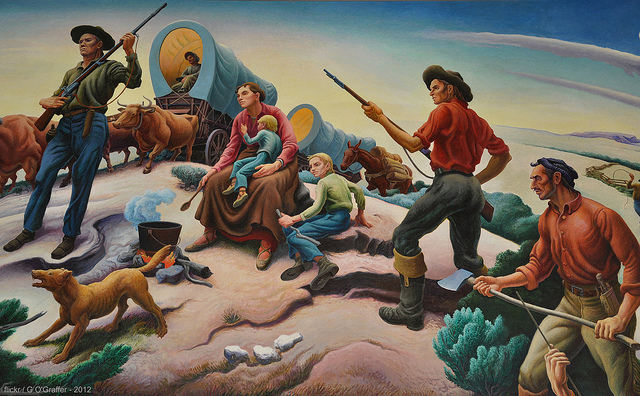
Thomas Hart Benton, “Independence and the Opening of the West,” 1961


Writing for Cato Unbound, Mark Weiner, author of The Rule of the Clan, recently made several correct observations about the problem of reconciling statelessness or “small government” with American conceptions of individual liberty. 

Many of my readers tend toward libertarianism, and I favor libertarian ideas by default. As a natural-born American, it’s in my DNA. You know what I’m talking about.

However, I also think it’s important to look at how the State makes this swaggering self-conception of the romantic one-against-all rugged individualist possible, and how this modern anti-clannishness actually makes the individual more dependent on the modern State.

To begin, let’s look at Weiner’s essay, and go over what he got right.

What Weiner calls “rule of the clan” is similar to the male group mentality I identified in The Way of Men  as “the way of the gang.” Weiner admits that the “rule of the clan” is a natural, universal form of human organization which exerts a “gravitational pull,” and that it is the object of modern liberal government to resist that pull. He defines the “rule of the clan” first as a society based on kinship, but notes that extra-genetic kinship is possible, and points to the existence of gangs and criminal brotherhoods which inevitably form in the smooth, derelict spaces of failed or impotent State influence.

Weiner is also sharp for making the distinction between the modern, liberal idea of honor, which is a self-imposed standard of moral goodness, and the clannish or traditional idea of honor, where individual honor is linked to both the reputation of the group as a whole and the individual’s reputation within the group. He reduces and degrades this primal, tribal form of honor with a vulgar financial analogy, but recognizes that group honor enables group autonomy and group independence. He also recognizes the profound benefits offered by group identification. In his words, the way of the clan “fosters a powerful sense of group solidarity,” “gives persons the dignity and unshakable identity that comes from clan membership,” and “generates a powerful drive toward social justice — a political economy that prizes equality.”

Weiner’s admission of the benefits of clannishness is significant, because he sums up many far-right and reactionary criticisms of modern liberalism and globalism. The prices of liberal, globalist modernity include rootlessness, detachment, an emptiness and desperation for identity that is easily exploited by commercial interests, a lack of community, and a lack of intra-national loyalty that encourages financial greed and insulates elites from the social responsibilities of nobility and the social penalties for betraying their kin, neighbors and countrymen. As the modern, liberal State is easily influenced by large amounts of money, it also insulates the wealthiest individuals from taking physical responsibility for their crimes and betrayals.

Can there be any doubt that it is only the armed protection of the State that has made it possible for the gun-grabbing billionaire Michael Bloomberg to escape a spectacular skyscraper defenestration?

Weiner argues that the modern libertarian idea of individualism, “the modern self” — which generally includes a freedom from responsibility to clan beyond the immediate nuclear family and voluntary instead of mandatory association with groups — is a in fact a product of state development which owes its fragile sense of individual autonomy to the legal protections provided by the state and the conditions of modern life.

This makes perfect sense to me, because I’ve never understood the weird, crypto-religious libertarian obsession with the idea of “natural rights.”  I have always understood “rights” as a bargain between rulers and subjects, or in the case of the American democratic ideal, between “the people” and “their” government. In nature, men have no rights. There are no police to call and there is no mechanism to sue any entity that has wronged you or “infringed upon your natural rights.” This is why the primal form of human organization is not the pioneer nuclear family of libertarian individualist fantasy, but the patriarchal clan or tribe or gang of men who unite to provide coordinated protection against danger, and a communal mechanism for righting wrongs or resolving disputes. How “fair” or “just” these tribal systems of resolution and retribution actually are is varied, culturally relative, and subject to taste.

Weiner has concluded that, for the liberal state to thrive and continue to deliver on its promise of individual freedom and autonomy, it must do a better job of doing the things the clan has always done better. He suggests that the state “pursue policies that moderate economic inequality,” “provide space for the flourishing of voluntary civil society organizations that provide opportunities for solidarity,” and “ensure that individuals have fair opportunities to exercise their autonomy within the marketplace,” whatever that means.

At first glance, his suggestions sound OK, if you’re into that whole “saving the modern liberal state” thing.

However, after a closer look, they quickly become unworkable. He is also overindulgent of the fictions of the modern State, and he barely mentions the biggest elephants in the room.

When the State pursues policies that moderate economic inequality,  to do so, it must become more nationalistic — more clannish, even — not more economically libertarian. A chief contributor to economic inequality in America is surely the ability of corporations, wealthy individuals, even small businesses to undercut American labor and outsource it to foreigners. A little more economic protectionism and certain degree of nationalistic isolationism might go a long way in the long term, but would be damaging to “the economy” in the short term. American politicians are necessarily short-term planners, because they are held accountable in the short-term, so the likelihood of American politicians acting to serve the long term good of the nation while cutting off a foreign supply of cheap labor for corporations, wealthy individuals and small business owners in the short term is approximately zero. This is probably why, for all of their populist posturing about getting tough on immigration, and despite widespread popular support for immigration control, conservative politicians almost always fold.

When Weiner says he wants the State to “provide space for the flourishing of voluntary civil society organizations that provide opportunities for solidarity,” that sounds good, but the reality is that the State as it currently exists would end up micromanaging these organizations to the point where no one would actually want to be members of them anyway. The alternative would be the State creating space for organizations which, if left to flourish organically in harmony with human nature, would eventually challenge the authority of the State itself. Surely, no explicitly kin-oriented groups could be encouraged, especially for white people, because that would be racist. No groups that exclude women could be allowed, because that would be sexist. And the more the State intervenes to regulate and sanction the activities of individuals who associate voluntarily, the more laughable this whole idea of individual autonomy within the context of the State becomes.

What Weiner really fails to acknowledge with this suggestion, even though it is implicit in everything he has written, is that opportunities for “solidarity” and truly meaningful group bonding are a threat to the State, which exactly why there isn’t more room for them now.

People already express group solidarity in ways that are acceptable to the state and its corporate sponsors. They become sports fans. They invest money and time and emotional energy in a group identity that revolves around the dramatic but completely inconsequential activities of, usually, a gang of men.

If men put the same amount of time or energy into forming a highly visible organization with ethnic concerns, for example, half of their enthusiastic new members would probably be FBI agents, because that kind of loyalty would threaten the interests of the liberal state by creating an alternative — and clannish — network of support. The power of the liberal state depends on dependency, and as Weiner has noted, even libertarianism depends on it to protect “rights” and “liberties.”

Finally, in his ode to the State, Weiner perpetuates the fiction that the American State is some kind of benevolent expression of the will of its citizen voters, and he all but ignores the most powerful actors in American politics: corporations. Corporations amass enough money to fund, manufacture and distribute the scientific miracles we use on an everyday basis, but they also perpetuate their own amoral existences by using that money to buy and exert influence on the American political system, whether they are American or foreign-based corporations. Because corporations can exert so much more influence on politics than any voter, the modern liberal state has become a tool of corporate interests, not as Weiner idealizes, a guarantor of individual liberty.

The clan, gang or tribe poses an economic threat to corporations by creating alternative support systems, reduced consumption of goods produced extra-tribally, and the possibility of supply-chain disrupting inter-tribal violence or violence against the State. The State will always oppose clannishness because the state responds first to the interests of self-perpetuating legal entities known as corporations, and because the State is, itself, a self-perpetuating legal entity that will, like any fundamentally amoral corporation, act to perpetuate its own survival above all other concerns.

If the State is over-reaching and becoming the biggest threat to the liberties it supposedly protects, as many men with libertarian tendencies now believe, the solution is not a return to the atomized, go-it-alone individualism that ultimately relies on the liberal State. The only viable option is to increase clannishness or tribalism, which Weiner correctly identified as the natural counter to the modern liberal State.

Source: http://www.jack-donovan.com/axis/2014/03/the-clan-vs-modern-state-dependent-individualism/

Saturday, August 5, 2017

Deleuze, Guattari, & The New Right, Part 3: Capitalism & Schizophrenia

By Mark Dyal


“There are things which do not disturb thought and those which force us to think. The first are objects of recognition: thought and all its faculties may be fully employed therein, thought may busy itself thereby, but such employment and such activity have nothing to do with thinking. Something in the world forces us to think. This something is an object not of recognition but of a fundamental encounter.” – Gilles Deleuze[1]

The Search for Smooth Space

Part Two of this examination of the philosophy of Gilles Deleuze and Félix Guattari from a radical New Right perspective introduced the Deleuzian split between nomos and logos, and Deleuze’s insistence on difference as a radical counter to Plato’s Idea, to representational thought, as well as to the logic of the bourgeois Cogitatio natura universalis. While the paper presented Deleuze’s highly Nietzschean reading of post-Socratic Greece, its thinkers, and its forms of thought, as the triumph of decadence and degenerative social forces, it did so with the intention of promoting critical awareness of how the radical impetus of nomocentric thought can bolster forms of rebellion that are deeply entrenched in  logocentric thought.

As we move deeper into Deleuze’s philosophy – and connect it with that of Félix Guattari – the elaboration of nomos becomes more clearly a celebration of forms of thought that do not conform to the foundations of liberal modernity, which themselves become identified as “State-sponsored” thought. If he draws a line from Plato to the liberal nation-State, it is not only to highlight the relationship between forms of thought and political possibilities, but also to show that forms of thought and political structures directly represent instinctual forces and their appropriate valuation of values. For the New Right, this has critical ramifications, as the transvaluation of values must include the forms of thought that give rise to the State, as these also give rise to the bourgeois liberal values and evaluations against which we are aligned.

It is entirely probable that the primordial pre-Socratic form of Greek thought that some corners of the New Right seek to emulate stands in direct opposition to the logocentrism that spawned representative democracy, egalitarianism, and even race and nation. That there is something to Deleuze’s evaluation of nomos as a break with modern quantitative rationality is apparent to any good student of Homeric Greece, as the lack of orthodoxy regarding the composition and function of the Olympian deities has led scholars to claim that the Olympians, therefore, are not even religious entities. Of course, modern religion is a product of logos, so the confusion is perhaps one of instincts and not merely of evaluation.

In Capitalism and Schizophrenia (the collective title of the two-part series Anti-Oedipusand A Thousand Plateaus), nomos and logos become the bases of two new binary oppositions: schizophrenia and paranoia, and smooth and striated space, both of which set the ontological and epistemological boundaries between modern man and his revolutionary counterpart. It is hoped that at the conclusion of this series, more political actors on the Right edges of modernity will understand themselves and their project as the search for schizophrenia and smooth space.

Without giving away the punch line, this would entail a complete transvaluation of modern values and forms of thought, the subsequent disconnection from modernity that that would entail, and finally a reengagement with modernity as a revolutionary adversary that creates spaces of exteriority in the heart of the liberal State.[2] In this too-brief summary, one clearly sees the potential for the New Right and other forms of Right revolution to be on the front lines of what Thomas Nail calls a “return to revolution.” For what the true Right has made essential – and that the Left has never understood – is precisely the transvaluation of modern values. And while the Left only fights for a more inclusive and compassionate modernity,[3] the true Right fights to destroy modernity itself.[4]

The State, Capitalism, and Desire: Secondo la Guerra Lampo[5]

This, more than “cultural Marxism,” explains the exclusion of New Right thought from the Academy; for the New Right is simply beyond the terms of inclusion, and rightly so, as nothing revolutionary can be included in the State. From the State’s perspective (and in Deleuze’s language), the New Right is different. It is minor – at odds with truth and morality. It is a derelict space.

And in turn, the liberal State is a taxation and conscription machine. It is repressive and destructive of logos, nomos, creativity, and all critical thought.[6] It seeks only one thing: human energy to labor for its economy. Not White, Black, Latino, or any other particular human energy – just plain ol’ universal bourgeois human energy. It makes of citizenship a right to labor. It discriminates or outlaws discrimination only in the name of commerce.[7] It psychologizes every man, woman, and child – making a teleology of development – so as to optimize the economic value of each and all.

It cares nothing of peoples, homelands, races, ethnicities, genders, or individuals, but only uses these to produce more economic production – as markets of labor and the production of consumption. It is the enemy of art, cultural particularity, and the will – unless these can be brought into the service of the economy by reducing them to multicultural fads.

It is not, however, the enemy of Philosophy, History, Anthropology, Biology, or Political Science, because these and other disciplines are in the service of the State, making the Academy merely the finishing ground of the State’s bourgeois purpose.

It forces us to send our children to school, it asks us to be pious and attend church, it provides us with entertainment and employment, and demands only that we obey laws put in place for our own benefit – and at each and every turn we not only become the rational homo economicus, but are also given a plethora of rewards for participating in the form of life at hand.[8] And it makes sense, but how? It does all of this without ideology or deception, but instead with our deepest consent. For how could it not?

Enter Deleuze and Guattari, who created a philosophical system designed to explain how the liberal State works to create a particular (bourgeois) form of life that is craved like the corporate death burgers and sugary chemical drinks with which it is most closely associated. The point of entry into Deleuze and Guattari’s philosophy involves the State, capitalism, and desire.

The liberal State is an agent of capitalism, providing rational, economically sensible labor from the vast flow of human potential, and economically exploitable resources from the equally vast flow of natural potential.

Capitalism is a system of unceasing economic production that successfully utilizes these flows while demanding nothing in return beyond unceasing production.

And desire is the human will to produce, consume, and make connections with life.

The State, then, codifies desire in order to produce bourgeois humans. Capitalism uses these humans, but at the same time undermines (decodes, or deterritorializes) the State’s codes by reducing all of life – even the previously useful codes like myth, tradition, life, death, tribe, and peoples – to economic rationality.

But desire is always aloof. Like capitalism, it desires only production: to flow, to explore, and to connect.[9] Give it homo economicus and American Idol, and it will function as required, quickly falling in love with the opportunity to produce and consume in a bourgeois manner. Tell desire that it is defined by lack, as modern State-sponsored thought demands, and it will see lack everywhere and seek to fill it with the spoils of the labor, democratic politics, and popular culture that the State provides. But recode desire to connect with transvaluation and the destruction of liberal modernity and it will create new possibilities for life.

Why, then, do the masses shun revolution? The easy answer is because they desire homo economicus, the comfort and safety of the liberal State, and the productive and consumptive possibilities of capitalism. The more complicated answer is that homo economicus, the State, and capitalism are easy investments for our instincts and desire.

So, where is the potential for revolt? Well, the body, say Deleuze and Guattari, is a desiring-machine, and as said above, it will produce, flow, and connect by nature. The problem, ultimately, is with what modernity, the liberal State, and capitalism give the body to connect. This is why mere regime change is of little value, revolutionarily speaking.

The locus of revolution must be desire.[10] In order to create new decoded or deterritorialized flows of desire, we must first create spaces that cause breaks in the bourgeois order. These derelict spaces have to be zones of schizophrenic bodily decoding, wherein state-sponsored thought, capitalist production and consumption, and liberal humanism are no longer functional.[11]

Perhaps we are beginning to see why the New Right and other forms of Right revolution have a prominent role to play in the revolt against modernity prescribed by Deleuze and Guattari.

Félix Guattari: An Aside

We have yet to spend much time on either the life or philosophy of Félix Guattari. This is partly symptomatic of a general neglect of Guattari’s contributions to Deleuze’s philosophy found in the secondary literature on the duo,[12] but also a purposeful neglect based on Guattari’s political life and a favoring of Deleuze’s profound Nietzscheanism. Nonetheless, Guattari played an important role in turning Deleuze toward explicit political philosophy.

While Deleuze always remained a committed academic and professor – keeping a respectful distance from liberal and anti-liberal politics, Guattari remained a radical Trotskyite – becoming known in the French press as “Mr. Anti-” for his role in the politics of anti-colonialism, gay rights, prisoner rights, and environmentalism.[13] He befriended Antonio Negri when the radical Leftist sociologist fled to France in the wake of charges that his Autonomia Operaia movement was the brains behind Red Brigade terrorism. Guattari openly supported the Autonomia movement and celebrated Italy as the only site of true revolution in the West.

Theoretically, Guattari combined Lacanian psychoanalysis with radical Marxian anti-capitalism, seeking to find links between the productive energy of desire and the process of capitalist production. Anti-Oedipus is the apotheosis of this project, which came to fruition only after Deleuze imposed Nietzsche’s vitalist naturalism on the matter.

Toward Capitalism and Schizophrenia

Deleuze and Guattari met in 1969. The student uprising of the previous spring enchanted both of them, and they sought a way to explain the unscripted and uncontained unrest as a revolution. While Guattari’s approach led him to discern exploitable ruptures in the State and capitalist market, Deleuze further developed difference and nomos into political concepts capable of debilitating the liberal human.

These are not concepts that seek to create more inclusion in the modern project, but to offer a way beyond that project. Nomos, as we have already seen, was developed as a counter to Platonic forms of thought. In Capitalism and Schizophrenia it functions as a political metaphor for spatial dynamics of thought and social organization, with nomos becoming nomadic thought and behavior, and logos, “State science,” and economic rationality. Politically, logos is the regime of modernity, while nomos leads one beyond the regime.

Likewise, difference (the great mass of individual specimens that resist all forms of representation and universalization) leads one beyond the regime of universalization and standardization promoted by statist logos. In the context of Capitalism and Schizophrenia, difference entails a relationship between majority – or, those who conform to the standard or ideal type of the collectivity in question – and minority – or, those who are defined by the gap between themselves and that standard.

Far from vulgar liberal politics of difference, which defends the right of the minority to be included in the majority by continually reconfiguring the standards of majority inclusion, Deleuze and Guattari propose the process of becoming-minor, wherein individuals and groups actively diverge from the majority. In other words, becoming-minor involves the same active transvaluation of the bourgeois form of life that has prompted the creation of the revolutionary Right. Becoming-minor, then, places the onus of revolutionary action squarely on our shoulders, as the potential for social transformation is not a determination of those seeking majority inclusion, but of those who are no longer subjugated by a majority.

Desire is crucial for Deleuze and Guattari’s politics of difference, because it is the location of power’s influence on the individual. In Marxist terms, desire is central to the infrastructure – investing it, organizing power, and even organizing systems of repression.[14] But against the Marxist orthodoxy that conceptualizes power as repressive, Deleuze and Guattari’s philosophy gives power a positive and creative quality. Life, as the continual interaction of various desiring-machines, strives to preserve and enhance itself by connecting desires with other desires. These connections produce social wholes and communities, from the level of human populations to the relationship between wasps and orchids.[15]

Power, then, is not the repression of desire, but its expansion. Social wholes do not use ideology to repress desire but are themselves productive and positive, using desire to produce interests – the coded, regular, collective, and organized forms of desire that make it quantifiable. Given this explanation of desire, power, and social forms, one concludes that interests like humanism, capitalism, and egalitarianism have their roots in desire.[16] Clearly, desire and the investments that it produces can turn against life, becoming reactive and producing values and evaluations based in ressentiment. For, what do our investments in the bourgeois form of life make of us? The body, individualism, willful ignorance, greed, and moralism are not merely personal features added onto character but impersonal forces from which bourgeois character itself is effected. Being bourgeois, then, is a symptomology of a collection of investments, but, as the derelict space of the “true Right” has demonstrated, it can be broken.

Capitalism and Schizophrenia

Welcome to the world of Capitalism and Schizophrenia, the two-part opus that first seeks to explain how capitalism makes an economy of desire and then to demonstrate how to destroy that economy. It is a world of erudition for those who read it – a true marvel of philosophical exposition – but a cloth and paper Molotov for those who use it. In fact, in one of Deleuze and Guattari’s interviews about the bipartite philosophy (Anti-Oedipus[1983] and A Thousand Plateaus[1987]),[17] they suggested that the books have far more uses than merely being read, that they have no inherent purpose. One might even find them useful as gas soaked and burning projectiles to hurl at a police line.

Anti-Oedipus focuses primarily on the relationship between the individual and capitalism, while A Thousand Plateaus focuses on the individual and the State. Both volumes create a rich tapestry of concepts, theories, and examples – none of which, the authors insist, are to be read metaphorically – that change the function of almost every word in either book on multiple occasions. That being said, it is Anti-Oedipus that is more rewarding to the reader, but A Thousand Plateaus that best rewards the man in revolt.

Capitalism and Schizophrenia begins by explaining how unconscious desire gets invested in economic, social, and political fields.[18] Desiring-production (desire in machinic form, as it makes connections and investments) is repressed by social-production (the social manifestation of desiring-production) in order to create specific forms of life. Oedipus enters the fray as the form of repression specific to capitalist modernity. Deleuze and Guattari demonstrate this by comparing social-production in three social forms: savage, despotic/State, and capitalist.

In the savage form, life and desire are determined by a superabundance of codes that connect the individual to the tribe and earth. Kinship relations are strictly social and are designed to make connections amongst families, not to prohibit incest. Social-production is entirely social as well, with individuals sharing the fruits of labor. While this leads to a repression of the desire to directly appropriate ones own production, it is a form of life with an open system of debt that does not work to castrate the flow of life.[19]

In the despotic/State form, life and desire are still determined by codes but where they were once horizontally organized, they are now vertical, as all value flows to and from the despot. It is the despot who imposes infinite and unilateral debt paid as tribute, which Deleuze and Guattari – following Nietzsche – explain as the origin of money. This is an important thread running through both books, as money is not only bound up with guilt and debt but also with the establishment of transcendent standards of equivalence and value – acting in both senses as a judgment against life.[20]

But the despot also makes existence a form of infinite debt, as he holds the power to make and extinguish life at will. Thus he has access to every woman beneath him, creating an overcoding of desire that in turn makes incest a symbolic form of sexual normalcy and makes desire a desire of what one lacks. This infinite debt also diminishes, if not demolishes, the alliances that once created the boundaries between life and death.[21]

Under the despot, desire becomes entirely reactive, lashing out in ressentiment at the State, even when it is democratic in form. From the perspective of desire, the State is a system of continual terror, as it holds the permanent possibility of death over every subject, either through transgression of law or simply the needs of the State. It is here that one may begin to enquire about the possibilities of personal enemy formation that is at odds with the enemies provided by the State.[22]

Whereas the savage form of life was constructed territorially – that is, with a specific and grounded association between individual, tribe, and earth – the State makes these affiliations abstract, turning the earth into land capable of producing rent and resources. This is striated space – “drawn and riddled with lines of divide and demarcation that name, measure, appropriate, and distribute space according to political designs, history, or economic conflict” – that is appropriated by the State in a form of capture.[23] Capture is the process whereby a form of thought or sociality is forcefully brought under the domain of the State, detaching it from its previous purposes in order to serve those of the State. Deleuze and Guattari use anthropological and historical sources to explain capturing processes, focusing upon the transformation of earth into land, and political reason into public opinion.

While striated space is opposed by smooth space, the latter is not embodied in savage territory, but instead – as we shall soon see – in striated space made smooth by war machines that stand opposed to the State.[24]

This abstraction is a boon for capitalism, which follows the same path laid out by the State in disconnecting peoples from territory. However, it goes even further, reducing all of life to the market. In capitalism, the codes and overcodes that once governed conception and behavior have no value, as all meaning is eliminated from life (hence the first function of schizophrenia, as a form of normalcy of a life devoid of meaning). Where savagery and the despotic State had need of codes in order to arrange/codify desire to local forms of social-production, these codes now impede the purely abstract, and global economic, flows of capital. This is because all desiring-production and social-production now flows through the market. “Alliances and filiations no longer pass through people but through money.”[25]

And because the market that determines the possibilities of life under capitalism is devoid of meaning – providing only the pure truth of economic rationality – Deleuze and Guattari describe its social field as an axiomatic, or a domain that need not provide definitions of its constituent parts in order to function. The capitalist axiomatic controls flows without the introduction of a transcendent agent – making it the most lethal form of domination ever invented.[26] As Eugene Holland says, “were it not for the inconvenience of having human workers, managers, and consumers, capitalism would do nicely without any meanings whatsoever.”[27]

For these, however, capitalism is dependent upon the State, which, while still producing codes and meanings – job training for workers, research for schools and corporations, image making for marketing – these never add up to a stable global code that could challenge the axiomatic life. To make their message more clear, Deleuze and Guattari actually switch from discussing codes to territories (making codification = territorialization, decoding = deterritorialization, and recoding = reterritorialization), because without meaning there can be no codes.

Under the capitalist axiomatic, the limited access to consumption that defined the status of the individual vis-à-vis the savage tribe gives way to a hyper-consumption that is not designed to sate the lack-full desire of the individual but instead to sate the capitalist demand to produce at any cost. But, in fact, the desire of the individual is sated, making desire immanent to the system of production. Thus while the infinite despotic debt remains, it is paid to capital itself, allowing surplus-value to flourish as a road to redemption, and making the individual a happy component of the ceaseless creation of capitalist over-production.

In other words (those of Deleuze and Guattari), capitalism deterritorializes the codes and meanings provided human life by savage and despotic/Statist forms of life – leaving the human in a position wherein the possibility of creating new values is possible. But, this moment is ever-so fleeting, as the axiomatic reterritorializes desire in the terms of the surplus-values of capitalist production. This, then, is not the terrain of the Marxist opposition between labor and owners of capital, but between the social-production of surplus-value and its private ownership and management, whereby sociality (desiring-production connected to a conformity-machine) and labor (desiring production connected to a profit-machine) are quantifiable in the terms of the production and consumption that valorize capitalism.[28]

However, this is a continual process, and as such, capitalism will soon enact a deterritorialization of the desire it previously reterritorialized in order to maintain production and the flow of capital. Over time, and from the perspective of the liberal State, this process establishes the purely economic basis of all social institutions. But, while all institutions are apparently social, the one major exception is the nuclear family, which becomes the site of a private submission to the authority and sensibility of the bourgeois regimentation of life.

Deleuze and Guattari return to Nietzsche’s suggestion that money is not only about exchange but also debt and guilt, making these central to how capitalism is lived by individuals. And this, as suggested above, is what makes capitalism truly insidious. Devoid of meaning but in need of subjects (laborers and consumers), capitalism hands responsibility for creating these subjects to the State.

But the State is beholden only to capitalism, so it leaves subject formation up to the family, and for the first time, makes reproduction a “private” affair. While this is the origin of the Oedipus complex, as primal sexuality is focused on members of the immediate family that are forbidden it (training desire to manifest itself as lack), it is also the perfect domain for making production, consumption, and submission a matter of free will, choice, opinion, taste, aesthetics, and many more bourgeois justifications. Thus, the State’s work is done for it by the family, and children are inculcated in the process by an unending succession of advertising, leisure activities, learning actions, and even food digestions that all point to the primacy of both the capitalist axiomatic and the bourgeois codes of the liberal State: produce to consume, movement is money, money is freedom.

The Nomadic War Machine against the State

But all the while, desire is flowing, wanting only to produce, taking no joy in consumption. This, for Deleuze and Guattari, is what points to a beyond modernity, especially when combined with the destruction of codes and the deterritorialization of desire inherent in capitalism. While the system seems monolithic – especially and perhaps exclusively from America – it is inherently unstable; but that instability can only be exploited if desire goes to war with capitalism and liberal modernity.

Deleuze and Guattari posit schizophrenia as a revolutionary process. Whereas the first function of schizophrenia, mentioned above, is a form of normalcy in an axiomatic life devoid of meaning, the second is as a radical opposition to Statist paranoia. At the macropolitical level, this opposition explains the contrary needs of the State and capitalism, in that capitalism seeks the diminution of the State and the creation of a single global market and what Deleuze and Guattari call “universal history.” The liberal State obliges these goals particularly because its entire existence is predicated on the triumph of the capitalist axiomatic, and not the elevation or well-being of its subjects. In this light, multiculturalism, security, and the prohibition against certain forms of violence are laid bare as tools of axiomatization.

At the micropolitical level, schizophrenia and paranoia become poles in an opposition based upon the nomocentric and logocentric forms of thought. Nomos as schizophrenia is the tool of the nomadic war machine – individuals, groups, or processes that lie beyond the sovereignty (or interiority) of the State – that can take the form of anything from social relations and methods of production to nomadic tribes and squadristi. And, while the war machine is often schizophrenic, it is less often revolutionary, because it is not enough to escape the State, but to “make what one is escaping escape.”[29]

In other words, revolution is not merely ascetic but must actively engage in warfare against the State. “The state is sovereignty,” say Deleuze and Guattari, “but sovereignty only reigns over what it is capable of internalizing, or appropriating locally.”[30] Sovereignty and appropriation bring us back to the idea of the State as a mechanism of capture, whereby communities (or local particularities) are brought into a general space of comparison – in which access is equal and free to all whom the State judges worthy (in effect justifying the capitalist axiomatic in one fell swoop by making money the adjudicating factor) – and sovereign power – through which the Good of the State trumps all other considerations of value.

Given this conception of sovereignty, logocentric thought becomes the lingua franca of the liberal State, with its paranoid insistence upon codifying and territorializing every aspect of life, as well as its normalization of universal conceptions of man.

But, while we are witnessing the omnipresent universalization of the bourgeois human, it is not the State that is driving his apotheosis but capitalism. For while there are many spaces of dereliction – smooth space that can neither be codified nor axiomatized – in relation to the State, there are less so in relation to the capitalist market. This explains why the post-WWII liberal State has allowed capitalism to dictate its foreign and domestic policy.

Much of A Thousand Plateaus consists of either making smooth space of one’s image of thought or of presenting a myriad of (mainly scientific and anthropological) examples of types of war machines and the lines of flight that they may use to escape the State. The important thing to remember is that escape is possible. In one of their most interesting chapters on nomadology and the war machine Deleuze and Guattari use Georges Dumézil – a fascist philologist who studied the creation of sovereignty in modern States – and Pierre Clastres – a radical anthropologist who studied how nomadic tribes in South America used agonic war as a tool to keep the State from capturing its people and territory – to explain the necessary gulf between the State and the war machine.[31]

Via Clastres, Deleuze and Guattari conclude that the liberal State ultimately uses labor to capture the war machine, by reducing warring to a job while keeping space striated so that men cannot war on their own behalf.[32]

While nomadic warriors vanished from Europe because of a process of capture involving sovereignty and the appropriation of the right to wage war, there are still aspects of European life that are irreducible – and exterior – to the State. These can be formalized in a line from Nietzsche’s thought to the examples of ultra-localism that have erupted since the establishment of the European Union. In other words, new forms of sovereignty, just like forms of representation, always leave a large swath of experience running free. While these experience used to be understood as civil society, they are now something much less central to State sovereignty due to the development of neo-liberal methods of controlling civil society through capitalism, communication, and perpetual connection to a global village.[33] Instead, Deleuze and Guattari point to the always local and particular instances of exteriority (like CasaPound Italia) that do not have to rival the sovereignty of the State but only call it into question. The challenge for these types of experiences, as mentioned above, is to do more than just escape, but to become-revolutionary.

The New Right, Right anarchism, and secessionism each point to a type of becoming-minor that can become-revolutionary. From the perspective of the war machine, the logic of the State is not all or nothing, but a relationship between interiority and exteriority: being at once engulfed by, and beyond, the State. While this is a dangerous existence, it is also one that affords maximum opportunities for revolutionary engagement.

The challenge to Deleuze and Guattari posed by the revolutionary Right hinges upon its own reading of Nietzsche’s naturalism. Does becoming – and becoming-revolutionary in particular – that points to a line of flight beyond the bourgeois liberal human look like peace or agon? Does modernity impose peaceful coexistence with impersonal forces of mediocrity on human desire or something else? Deleuze and Guattari ignored these questions, even while proposing that desiring-production is made knowable through Nietzsche’s – rather than Freud’s and Marx’s – engagement with modernity. Knowing the answers to these questions makes the true Right a nascent war machine.

Conclusion

As this concludes the critical exposition of Deleuze and Guattari’s philosophy, it should be noted that several works by both authors – and many by each of them – have been ignored. The most important of these is What Is Philosophy?(1994), the last book Deleuze and Guattari wrote together. But while the book was ignored, its focus on philosophy as an exercise in the creation of concepts was not. In fact, the idea of creation – along with affirmation – has been central to this series of papers.

Affirmation as Nietzsche, Deleuze, and Guattari understand it, is the basis of a noble form of life; that is, a form of life that does not condemn as its primary energy and intensity, that knows and needs nothing of an oppositional force to justify its existence, that is critical in valuation and evaluation on its own terms. In sum, it is the diametric transvaluation of ressentiment. This affirmation is what separates the “true Right” from the liberal Right, the liberal Left, and illiberal Left.

However, this is not always apparent, given our propensity for “outing” our adversaries. But, as the conclusory paper to this series will make clear, to be a successful war machine we need to make use of every single weapon at our disposal. We must also have a greater desire to create than to destroy. As said Deleuze:

What we most lack is a belief in the world, it has been taken from us. If you believe in the world you precipitate events, however inconspicuous, that elude control, you engender new space-times, however small their surface or volumes. Our ability to resist control, or our submission to it, has to be assessed at the level of our every move. We need both creativity and a people.[34]

Notes


[1] Gilles Deleuze, Difference and Repetition, trans. Paul Patton (New York: Columbia University Press, 1994), 139.

[2] Thomas Nail, Returning to Revolution: Deleuze, Guattari, and Zapatismo (Edinburgh: Edinburgh University Press, 2012), 50.

[3] http://attackthesystem.com/2013/04/16/bill-ayers-gets-it-right/

[4] This paper, like the two that preceded it, rests on an explanation of the revolutionary potential of both the New Right and Nietzschean transvaluation. But as was the case with the first two parts, this paper will move in directions that might obscure that avowed goal, as it will problematize many aspects of New Right thought – bringing to the fore the question of whether or not the New Right truly seeks to destroy modernity, or just make it less inclusive and compassionate.

[5] A lightning strike. This is a very light glossing of Capitalism and Schizophrenia’s political philosophy that is meant only to orient the reader. In no way does it suffice as an explanation Capitalism and Schizophrenia.

[6] Gilles Deleuze and Félix Guattari, A Thousand Plateaus: Capitalism and Schizophrenia, trans. Brian Massumi (Minneapolis: University of Minnesota Press, 1987), 442–43.

[7] The regulation of interstate commerce was the linchpin of the Civil Rights Act of 1964.

[8] Brian Massumi, A User’s Guide to Capitalism and Schizophrenia: Deviations from Deleuze and Guattari (Cambridge: Swerve/MIT Press, 1992), 125.

[9] Gilles Deleuze and Fèlix Guattari, Anti-Oedipus: Capitalism and Schizophrenia, trans. Robert Hurley, Mark Seem, and Helen R. Lane (Minneapolis: University of Minnesota Press, 1983), 345.

[10] Félix Guattari, Chaosophy, Sylvére Lotringer, ed. (New York: Semiotext(e), 1995), 62.

[11] Functional is used in opposition to meaning. Deleuze and Guattari, unlike deconstructionists, care nothing about meaning, as it is erased from being human by Capitalism.

[12] Gary Genosko, “Deleuze and Guattari: Guattareuze & Co.” in The Cambridge Companion to Deleuze, Daniel W. Smith and Henry Somers-Hall, eds. (Cambridge: Cambridge University Press, 2012), 154.

[13] Ian Buchanan, Deleuze and Guattari’s Anti-Oedipus (London: Continuum, 2008), 5.

[14] Gilles Deleuze, Desert Islands and Other Texts, 1953–1974, trans. Michael Taormina (Cambridge: Semiotext(e)/MIT Press, 2004), 264.

[15] A Thousand Plateaus 10.

[16] Claire Colebrook, Gilles Deleuze (London: Routledge, 2002), 91.

[17] For those seeking the context in which these ideas arose, Anti Oedipus was published in French in 1972 and A Thousand Plateaus in 1980.

[18] Deleuze 2004: 228.

[19] Anti-Oedipus 146.

[20] Eugene W. Holland, Nomad Citizenship: Free-Market Communism and the Slow-Motion General Strike (Minneapolis: University of Minnesota Press, 2011), 7.

[21] Eugene W. Holland, Deleuze and Guattari’s Anti-Oedipus: Introduction to Schizoanalysis (London: Routledge, 1999), 78.

[22] Anti-Oedipus 196.

[23] Tom Conley, “Space,” in The Deleuze Dictionary, Revised Edition. Adrian Parr, ed. (Edinburgh: Edinburgh University Press, 2010), 262.

[24] Deleuze 2004: 33.

[25] Anti-Oedipus 264.

[26] A Thousand Plateaus 460.

[27] Holland 1999: 21.

[28] Anti-Oedipus 250.

[29] Anti-Oedipus 341.

[30] A Thousand Plateaus 360.

[31] A Thousand Plateaus 351–60.

[32] A Thousand Plateaus 490–91.

[33] Gilles Deleuze, Negotiations, 1972–1990, trans. Martin Joughin (New York: Columbia University Press, 1995), 177–82.

[34] Negotiations 176.