Wednesday, May 31, 2017

Nations Don't Go Extinct Due To Loss Of Material Comforts: A Response To Bain Dewitt

By Riki Rei

Jared Kushner donned his smartest business casual attire for his visit to American troops in Iraq, while Ivanka wrote his name across the front of his bulletproof vest so that everyone in the changing room would know it was his.


The article “Russians Are Not #Ourguys” by Mr. Dewitt has generated a whirlwind of heated response from Counter-Currents readers. In my humble and candid opinion, the article reeks of being a piece of neocon shilling (dotted by some ostensibly decent and rational remarks, admittedly) which reads like it’s straight from the National Review or even The Weekly Standard.

The article does make some valid and reasonable points, albeit of a highly dubious nature. It seems to argue from the viewpoint of advancing and defending the geopolitical interests and economic benefits of the Western nations at large, and the US and UK in particular, in the Middle East, which is a common line of argument of the neocon ideologues over the past twenty years, and the recurring usage of the term “(American) hegemony” deepens that impression. But honestly, can White Nationalism afford that luxury, with our homelands increasingly flooded and swamped by hostile aliens as a result of the same neocon forces at the helm, preaching their tiresome and nation-wrecking agenda of “invade the world, invite the world”? Hasn’t that same clichéd and trite policy been enshrined in and guided American foreign policy, only to repeatedly fail catastrophically, with astronomical costs for America, Britain, and other nations?

The author seems totally blind to those glaring and indisputable facts, ignoring all the dangerous and deleterious ramifications of his propositions while insisting on bolstering and consolidating the Western geostrategic presence in the Middle East as part of its rivalry with Russia, blah, blah, blah. Simply put, he is awfully confused and utterly at a loss about the concepts of “priority” and “proportion” with his flawed and misguided focus on the alleged material interests to be obtained from the Middle East and his adamant critique of the Alt Right. He seems to be cardinally concerned with the oil and gas resources of the Middle East and securing arms sales through “coalition” maintenance under the shining, self-congratulating veneer of “Western hegemony,” believing that economic interests are everything while consigning vital and fundamental racial, cultural, social, and demographic factors to the backburner. In light of this, he is either insincere or incredibly naïve and blinkered (a term he likes to apply to the Alt Right), and his specious and condescending viewpoints are mostly misleading. A few typical examples coupled by my own comments are as follows.

In the fourth paragraph, the author simplistically dismisses the stance of Alt Right supporters of President Trump during his election campaign as an “isolationist agenda,” and that they thought Trump “has betrayed his loyal fans and acquiesced to Israeli influence. I don’t believe he has done any such thing, and now that the last debris of the last Hebrew Hammers has been swept away, I think it is clear that the Alt Right’s hysterics have been totally premature and unjustified . . .” This is a willful disregard of innumerable facts regarding the Jewish forces surrounding Trump, starting from his son-in-law Jared Kushner, who have been exerting considerable influence on his decision-making as amply demonstrated by a series of incidents, ranging from his backtracking on his former “America First” platform to his unwillingness or inability to defend the more nationalist members of his cabinet, such as Steve Bannon. And the so-called sweeping away of the last “Hebrew Hammers” is certainly inconsistent with the facts.

In the fifth paragraph, the author insists on maintaining the façade of the corrupt, old-world system epitomized by today’s US and the West at large – namely, the petrodollar, NATO, arms sales, military adventurism, and so on – by fervently arguing that these are all good things keeping America from collapsing and should be preserved, going so far as to blatantly announce “we are all Anglo-Zionists,” as if it were a badge of honor. Even taking into consideration all the realpolitik and geopolitical factors, such audacious and misguiding arguments for the “status quo” are hardly convincing. My question to the author is, aren’t your propositions what the US political establishment and its allies have been following for decades? Did their actions make the white people of the West in any way better? Has the collective prospect of survival for whites in America or elsewhere in the western world improved? Fear of change (or, in the author’s word, “revolution”) and “conservatives” using pretenses like economic prosperity and securing resources is precisely what has corrupted and atrophied America and led whites to their current state of misery and crisis.

In the sixth and seventh paragraphs, the author mainly employs the economic interests and energy needs of the UK to justify his anti-Russian and pro-Gulf theocracies proposal. While some of his arguments sound reasonable or realistic, they are still inadvisable in a deeper context. First, the so-called coalition partners of the US in the Middle East (i.e., the corrupt, terrorism-exporting, and extortionist Sunni theocracies from Saudi to Qatar) aren’t the only source of energy for the West. There are alternatives, such as American shelf oil in Alaska. And let’s not forget about Iran, which is yearning to improve ties with America and Europe, and which hasn’t been involved in any terrorist attack on the West in decades, but nevertheless remains the most vilified nation on the hit list of the Jew-pandering neocon political establishment and its court media.

Second, as for Russia, it certainly has its own interests, as does any country, but it certainly is not unreasonable or unwilling to negotiate. The author is kindly reminded of the fact that the West has chosen to continuously and obstinately antagonize, exclude, and threaten Russia ever since the rise of Putin with acts of political isolation, economic sanctions, propaganda demonization, and strategic encirclement. If the West changes its attitude and were to sincerely engage with Russia and Iran, it will not only help the Middle East by checking the radical and smug Sunni states, and thus contributing to the overall security and stability of the region, as well as improving Russia’s means of supplying Western Europe with gas on friendlier and stable terms, but it would also help to drive a wedge between Russia and China – the latter being a great adversary of the white race.

It has long been a well-known fact that there is an ingrained historical and geopolitical rivalry and mutual mistrust between Russia and China, as observed by astute scholars such as Dr. Kerry Bolton and this humble writer. Russia, for its part, harbors deep-seated wariness and misgivings toward China, especially the latter’s rapid demographic expansion into Russia’s Far East. It is only the arrogant exclusionism of the West toward Russia that has driven the cash-strapped and resource-rich country into China’s bosom, who is eager to use its bulging wallet to buy advanced military hardware and other technologies from them. In a word, the current alliance between Russia (and, to a lesser extent, Iran) with China is but a temporary and expedient one, and could be made to unravel if the West were to develop the will and wisdom to do so.

In the tenth paragraph, the author almost appears to sympathize with ISIS and castigates Obama for being “played” by Assad. This passage – “thus illustrating that he cared little for the blood and treasure that had been spent in Iraq to secure US-UK stability in years to come” – not only serves to rationalize and whitewash the monstrously wrongheaded Iraq War, but confuses the picture by fabricating a so-called US-UK stability in Iraq which never existed in the first place.

The thirteenth paragraph is a non-starter: “Having shown that the US lacked the will to fight, applying pressure on China to cooperate on trade would be a non-starter. The Chinese Premier was present for the strikes for the specific reason of showing that Trump would no longer allow Russian expansionism and creating a stranglehold on the European gas market.” First, Trump reneged on his campaign promise and refused to apply pressure on China over trade not because America lacked the will to fight in the Middle East, but precisely because it lacks the will to fight China (not in terms of actual warfighting, of course, but to impose essential restrictive measures on it to gradually choke off its predatory trade exports to the US) as a result of the intense pressure from international Jewry and traitorous American corporations hand-in-glove with the Chinese regime, which has been going on for the last thirty years. It is the status quo and the system the author vigorously defends that actually enabled the rise of China in the first place and which continues to fuel that rise, even though the author rightfully decries that rise (notice his confused and contradictory thinking?).

The author’s nonsense then escalates. In the fourteenth paragraph, he went so far to argue that “[a] Syria led by Assad that has defeated ISIS and settled into peace is no friend to the West” simply due to its being a close ally of Russia’s. An image of the Cold War mindset, rising like an ugly phoenix from the ashes, unfolds before my eyes. He then states that millions of Syrians and other refugees who have fled to Europe will not be welcomed back by a victorious Assad, and uses this in opposition to the legitimate Assad government with a straight face. This is highly questionable. First, you can’t know for certain that Assad will refuse to take refugees back incrementally provided that the West is willing to discard its antagonism toward him. Second, if the Syrian chaos persists, whatever else happens it will definitely result in even more uprooted refugees flooding towards Europe – a predictable outcome the author refuses to see. Talk about selective logic!

In the fifteenth paragraph, the author again enlists superficial economic benefits to justify the West’s support for unreasonable and vehemently anti-Western states such as Turkey, whose policies regarding Turks living in other countries resembles that of Israel in the sense it claims a vigorous attachment to and the right of governance over Turks living in Europe, and uses its demographic weapon to persistently intimidate and blackmail European countries. The author’s claim that “the Turks don’t supply the Taliban with IEDs to blow up British soldiers. Russia does,” is such a slanted reproof that it is truly flabbergasting. Even if what the author accused Russia of doing were factually accurate, he failed to explain why the British and American soldiers were there in the first place. To spread democracy and liberty across the globe? To secure the oil interests of the West? To help shore up the position of our dear and irreplaceable ally, Israel? An endless supply of blood and wealth must therefore be squandered there, right? It must be right according to the author.

In the sixteenth paragraph, the author bares his teeth at the American Alt Right with ridicule and name-calling. He defines it as a “malaise” and calls their “America First” ideal an ”unrealistic, principle-first isolationism policy.” The author seems utterly contemptuous of the Alt Right“ and its intellectual leaders as a redneck, lowbrow class of peasantry while regarding himself, and for that matter, the button-pushing Trump, as masterminds of real-world pragmatism and statecraft on a par with (((Henry Kissinger))) and Zbigniew Brzezinski. Bravo!

In the last seven paragraphs, the author’s searing attack on the Alt Right reaches its climax, and unsurprisingly is filled with bogus and spurious and accusations. In the seventeenth paragraph, he explains that he wants peace but detests peacenik, and exhorts us to remember that life is a struggle. However, wanting America to become less involved in the Middle East mess, refrain from fighting wars on behalf of Israel, and showing more flexibility toward a non-confrontational and non-threatening Syria and Iran is not a peacenik response, and “life is a struggle” rhetoric still requires us to choose the struggle rightly and wisely, not foolishly and futilely. Then comes his most classically neocon point: “Without Middle Eastern wars on the neocon hitlist, American hegemony is threatened, and our “way of life” – read: First World luxury – is directly threatened.” Whoa, just whoa. “Neocon hitlist,” “American hegemony,” and “First World luxury” – what invaluable and indispensable goals! But isn’t all that materialism and hegemony stuff what has been undermining the health and integrity of the white race and America for the last half a century, at least? Besides which no perceptive minds in the Alt Right camp have solely blamed Jews for the military adventurism which the author advocates. The myopic, venal, and corrupt white elites certainly did as they were bid and contributed to this gigantic folly. Likewise, hardly anyone on the Alt Right actually shed tears for the loss of Syrian lives as a result of the strike. Rather, we only lamented Trump’s spinelessness and lack of foresight, which played right into the hand of the Jews and neocon interventionists, further exacerbating the situation and demonstrating his vulnerability and obsequiousness before bullying Jewry and the military-industrial complex of America.

In the eighteenth paragraph, the author sings the praises of Trump’s decision to teach a lesson to the Russians by attacking Syria and highlights that the cost of the missile strikes is nothing compared to the cost saved by securing a profitable arms deal. Again, one cannot help but ask, is it impossible to check Russia’s aggression by other means? If America moves to alter its antagonistic behavior toward Assad and Iran, can’t America and Britain, with their infinitely more advanced technologies and richer resources, fare better in competition with Russia? It is only when one insists on the current course of antagonizing Syria and Iran in the first place that one is forced to resort to interventionism.

Next, the author’s sudden pounce on North Korea (another member of the shopworn Axis of Evil) likewise smacks of neocon subversion – yet another attempt to topple the government of a sovereign nation to bring it into the globalist new world order, just like what happened to Iraq and Libya previously. He never bothers to mention the fact that the Norks have never attacked America, and have no real intention to attack the US (for all their pugnaciously provocative and incendiary anti-American rhetoric) as long as they are left alone. They will never attack America or South Korea given that they are fully aware that any such aggression means their own instant demise. While fanning alarmism, the author seems insouciant about China, which is the genuine mammoth geostrategic adversary, not merely to America but to white people everywhere in the years to come, given that it stands in lockstep with the largely Jewish political and economic establishment to consistently fatten and empower the latter at the expense of the interests of America and the white middle and working classes in particular.

The nineteenth paragraph is another confusing and untendable passage. While the author has to admit that “[t]he same news agencies that were breathlessly reporting on a Tomahawk strike against a Russian ally a few weeks ago are now trying to revive their Russian Connection narrative,” he then inexplicably remarks that “they are floundering and on the back foot.” The reality of the situation seems not so positive, though, with the liberal political establishment plotting to mount a new round of attacks to compromise, if not derail, the Trump Presidency. The author goes on to praise Trump’s firing of Comey, which of course was the right move, and predicts that those in Camp Clinton are now worrying about their own uncertain fate. Then he suddenly reverts back to claim that the stage was set with the Syria strike, which was a “firm statement,” and that Trump acted “in America’s best interest, not Russia’s.” The last argument is not only unfounded, it’s also a deviation from his preceding statement, as one is left agape as to what is actually his main theme.

In the twenty-second paragraph, the author again denounced and sneered at the leaders of the Alt Right movement, accusing them of “sacrificing America’s interests for ones’ own sensibilities.” Apparently, America’s national interests in the author’s mind do not go deeper or higher than ingratiating with Middle Eastern customers who “buy American products,” attaching huge importance to “deliver[ing] trade deals” with such countries, “winning” (of wasteful and fruitless interventionist wars in the Middle East while doing the bidding of Israel, Turkey, Saudi, and Qatar, and propping up ISIS), and the “great quality of life” for decadent and pampered American consumers.

The last paragraph reads almost like a hagiography written by a starry-eyed Trump devotee. We see the author’s implicit summary of what constitutes “vital national security interest” (which seems to be tantamount to bullying Assad, jettisoning the America First “isolationism,” and adopting Clintonian international meddling). We see the author’s strong and sweeping claim that “the Tomahawk strike flattened the opposition – domestically and internationally,” and his breathlessly exultant conclusion that “Trump has set policy, set leadership, and established dominance with effectively zero cost. The Syria strike was a win, and America is winning again.” Considering the dreadful and dismal reality of America as a whole and the imperative of securing the future existence of white people amidst great difficulties, the last sentence reads almost like sarcasm, though we do know the author is earnest.

I have never truly been a Russophile, and I am ambivalent towards the Russian nation. I admire some of their qualities, such as their perseverance and tenacity, while I detest some traits of theirs, such as habitual bullying, vengefulness, brazenness, and unabashed self-justification. I can’t forgive their shameless unilateral violation of the Japanese-Soviet Non-Aggression Treaty near the end of the Second World War, invading Manchuria from North, brutally slaughtering and pillaging Japanese civilians and occupying a few small – yet indisputably and inherently Japanese – islands north of Hokkaido to this day, an egregious and despicable act of “looting a burning house” that has been conducted without a trace of moral compunction. But in spite of the title of the article and the author’s call to resist Russia’s advances in the Middle East, the focus of this article really is not on Russia or how to counter it but rather on the American establishment and its existing Middle East policy, which serves the agenda of corporate America and Britain. It’s about more status, more empire-building, more closed-door power games, more arms and pipeline deals, more corporate profits, more globalist mercantilism, more foreign wars, more depraved material prosperity, more dodging of the ingrained structural problems of the Western countries that were created and are maintained by the ruling plutocracy through the banks and other anti-white institutions, more shilling for Israel and the Sunni Arab states, and more senseless antagonism of Syria, Iran, and Russia. At bottom, no White Nationalist ideal or interest can be identified in the author’s propositions or his glorification of Trump’s “leadership,” “dominance,” and “winning.”

The type of hegemony the author lavishly plays up may sound good on the surface, but in fact it is nothing more than an illusion that is unsustainable for today’s whites, not to mention being morally questionable. It is at best a wistful anachronism and, at worst, a detriment and anathema to White Nationalism. Let me conclude this humble critique by revisiting the principle that underlies White Nationalism in relation to mainstream politics and politicians who are ostensibly, and rudimentarily, sympathetic to our ideas: we should serve as a supervisory force to prod, remind, and alert them, constantly exhorting and admonishing them, but never buying into them with blind loyalty. If we prod them by a foot, they may move an inch in our direction. Although if we uncritically fall for them, they will unfailingly betray us quickly, and by doing so, we also forfeit our own political and social foundations, as well as the core of our vitality as a significant force for change.

Thursday, May 18, 2017

Martin Heidegger

The Great Philosophers 10: Martin Heidegger

The field is not without other distinguished contestants, but in the competitive history of incomprehensible German philosophers, Martin Heidegger must, by any reckoning, emerge as the overall victor. Nothing quite rivals the prose of his masterpiece Being and Time (1927) in terms of contortions and the sheer number of complex compound German words which the author coined, among them ‘Seinsvergessenheit’ (Forgetfulness of Being), ‘Bodenständigkeit’ (Rootedness-in-soil) and ‘Wesensverfassung’ (Essential Constitution).

At first, it is likely to be puzzling and perhaps irritating, but gradually, one may warm to the style and understand that beneath its vaporous surface, Heidegger is telling us some simple, even at times homespun truths about the meaning of our lives, the sicknesses of our time and the routes to freedom. We should bother.

He was born, and in many ways remained, a rural provincial German, who loved picking mushrooms, walking in the countryside and going to bed early. He hated television, aeroplanes, pop music and processed food. Born in 1889 to a poor Catholic family, he became an academic star after the publication of Being and Time – but made the fatal misstep of taking Hitler at his word in the mid 1930s (he wasn’t alone). He hoped that the Nazis would restore order and dignity to Germany and, to fit in with the mood of the times, he made a few fiery speeches and tried to ban Jewish academics from Freiburg University, where he was rector. One can almost forgive him this period of lunacy, for which he paid dearly and repented for over decades – in his own way. After Germany’s defeat in 1945, he was hauled in front of a Denazification Commission and was forbidden to teach until the end of the decade. Amazingly (it was a testimony to the appeal of his ideas), his career gradually revived, though he spent more and more time in a hut he owned in the woods, away from modern civilisation, until his death in 1976.

Throughout his career, he sought to help us live more wisely. He wanted us to be braver about facing up to certain truths, and to lead richer, more thoughtful, happier lives. Philosophy was no academic exercise. It was – as it had been for the Ancient Greeks – a spiritual vocation and a form of therapy. He diagnosed modern humanity as suffering from a number of new diseases of the soul:

One: We have forgotten to notice we’re alive

We know it in theory, of course, but we aren’t day-to-day properly in touch with the sheer mystery of existence, the mystery of what Heidegger called ‘das Sein’ or ‘Being’. Much of his philosophy is devoted to trying to wake us up to the strangeness of existing on a planet spinning in an otherwise seemingly silent, alien and uninhabited universe.

It’s only at a few odd moments, perhaps late at night, or when we’re ill and have been alone all day, or are on a walk through the countryside, that we come up against the uncanny strangeness of everything: why things exist as they do, why we are here rather than there, why the world is like this, why that tree or this house are the way they are. To capture these rare moments when the normal state of things wobbles a little, Heidegger talks, with capital letters, of the Mystery of Being. His entire philosophy is devoted to getting us to appreciate, and respond appropriately to, this rather abstract but crucial concept.

For Heidegger, the modern world is an infernal machine dedicated to distracting us from the basic wondrous nature of Being. It constantly pulls towards practical tasks, it overwhelms us with information, it kills silence, it doesn’t want to leave us alone – partly because realising the mystery of Being has its frightening dimensions. Doing so, we may be seized by fear (‘Angst’) as we become conscious that everything that had seemed rooted, necessary and oh-so-important may be contingent, senseless and without true purpose. We may ask why we have this job rather than that one, are in a relationship with one person rather than another, are alive when we might so easily be dead… Much of daily life is designed to keep these odd, unnerving but crucial questions at bay.

What we’re really running away from is a confrontation with – and even non-German speakers might respond to the sonorous depth of this key Heideggerian term – ‘das Nichts’ (The Nothing), which lies on the other side of Being.

The Nothing is everywhere, it stalks us, it will swallow us up eventually, but – Heidegger insists – a life is only well lived when one has taken Nothingness and the brief nature of Being on board – as we might do when, for example, a gentle evening light gives way to darkness at the end of a warm summer’s day in the foothills of the Bavarian alps.

Two: We have forgotten that all Being is connected

We look at the world through the prism of our own narrow interests. Our professional needs colour what we pay attention to and bother with. We treat others and nature as means and not as ends.

But occasionally (and again walks in the country are particularly conducive to this realisation), we may be able to step outside our narrow orbit and take a more generous view of our connection with the rest of existence. We may sense what Heidegger termed the Unity of Being, noticing – in a way we hadn’t previously – that we, and that ladybird on the bark, and that rock, and that cloud are all in existence right now and are fundamentally united by the basic fact of Being.

Heidegger values these moments – and wants us to use them as the springboard to a deeper form of generosity, an overcoming of alienation and egoism and a more profound appreciation of the brief time that remains to us before ‘das Nichts’ claims us in turn.

Three: We forget to be free and to live for ourselves

Much about us isn’t of course very free. We are – in Heidegger’s unusual formulation – ‘thrown into the world’ at the start of our lives: thrown into a particular and narrow social milieu, surrounded by rigid attitudes, archaic prejudices and practical necessities not of our own making.

The philosopher wants to help us to overcome this ‘Thrownness’ (this ‘Geworfenheit’) by understanding its multiple features. We should aim to grasp our psychological, social and professional provincialism – and then rise above it to a more universal perspective.

In so doing, we’ll make the classic Heideggerian journey away from ‘Uneigentlichkeit’ to ‘Eigentlichkeit’ (from Inauthenticity to Authenticity). We will, in essence, start to live for ourselves.

And yet most of the time, for Heidegger, we fail dismally at this task. We merely surrender to a socialised, superficial mode of being he called ‘they-self’ (as opposed to ‘our-selves’). We follow The Chatter (‘das Gerede’), which we hear about in the newspapers, on TV and in the large cities Heidegger hated to spend time in.

What will help us to pull away from the ‘they-self’ is an appropriately intense focus on our own upcoming death. It’s only when we realise that other people cannot save us from ‘das Nichts’ that we’re likely to stop living for them; to stop worrying so much about what others think, and to cease giving up the lion’s share of our lives and energies to impress people who never really liked us in the first place. ‘Angst’ about ‘The Nothing’, though uncomfortable, can save us: awareness of our ‘Sein-zum-Tode’ (our ‘Being-toward-death’) is the road to life. When in a lecture, in 1961, Heidegger was asked how we might recover authenticity, he replied tersely that we should simply aim to spend more time ‘in graveyards’.

Four: We treat others as objects

Most of the time, without quite meaning to, we treat people as what Heidegger terms ‘Equipment’: ‘das Zeug’ – as if they were tools, rather than Beings in Themselves.

The cure for this selfishness lies in exposure to great art. It is works of art that will help us to step back from ourselves and appreciate the independent existence of other people and things.

Heidegger elaborated this idea in the course of a discussion of a painting by Van Gogh of a pair of peasant shoes. Normally, we don’t pay much attention to shoes, they are merely another bit of ‘equipment’ that we need to get by. But when they are presented to us on a canvas, we’re liable to notice them – as if for the first time – for their own sakes.

The same might happen to us when confronted by other bits of the natural and the man-made world represented by great artists. Thanks to art, we’ll feel a new kind of ‘Care’ (‘Sorge’) for Being that lies beyond our selves.

Conclusion

It would be lying to say that Heidegger’s meaning and moral is ever very clear. Nevertheless, what he tells us is intermittently fascinating, wise and surprisingly useful. Despite the extraordinary words and language, in a sense, we know a lot of it already. We merely need reminding and emboldening to take it seriously, which the odd prose style helps us to do. We know in our hearts that it is time to overcome our ‘Geworfenheit’, that we should become more conscious of ‘das Nichts’ day-to-day, and that we owe it to ourselves to escape the clutches of ‘das Gerede’ for the sake of ‘Eigentlichkeit’ – with a little help from the graveyard.


Wednesday, May 3, 2017

The Hellstrom Chronicle

The Hellstrom Chronicle

Remarkable footage of insect predation and survival tactics. 


Here http://www.youtube.com/profile?user=Bratgoul#g/u 

More Info From: http://en.wikipedia.org/wiki/The_Hellstrom_Chronicle 

The Hellstrom Chronicle is an American film released in 1971 which combines elements of documentary and science fiction to present a gripping depiction of the Darwinian struggle for survival between humans and insects. It was conceived and produced by David L. Wolper, directed by Walon Green and written by David Seltzer, who earned a Writers Guild of America Award nomination for his screenplay.

Several cinematographers photographed this film using stop-motion photography with microscopic and telescopic lenses. The trailer resembled an announcement for a science fiction movie. The film provided the inspiration for Frank Herbert's science fiction novel Hellstrom's Hive.

A fictitious scientist called Dr. Nils Hellstrom (played by Lawrence Pressman) guides viewers throughout the film. He claims, on the basis of scientific-sounding theories, that insects will ultimately win the fight for survival on planet Earth because of their adaptability and ability to reproduce rapidly, and that the human race will lose this fight largely because of excessive individualism. The film combines short clips from horror and science fiction movies with extraordinary camera sequences of butterflies, locusts, wasps, termites, ants, mayflies, other insects rarely seen before on film and insectivorous plants/insects.

IMDB: http://www.imdb.com/title/tt0067197

Intelligence & Inheritance

Intelligence & Inheritance

By Aedon Cassiel


Audio Version: To listen in a player, click here. To download the mp3, right-click hereand choose “save target or link as.”

Now that I’ve given a cursory definition and defense of “race,” it’s time to move on to IQ. This essay will address IQ separately, before synthesizing the two subjects in a subsequent follow-up. While I will explain the core foundational concepts in IQ science, I’ll also demonstrate why this is important in race-neutral terms by showing how the issues apply to education – and impact how we ought to think about, and practice, educational policy.

If minds are essentially blank slates which are carved into what they become by their environment, then the only thing limiting our ability as a society to turn anyone into anything at all is the skill of our teachers. Teachers, who influence most of the mind-shaping period of childhood, are the ones who deserve the most praise when people succeed and who deserve the most scorn when people fail.

There’s a saying one often sees on motivational posters for educators: “Teachers plant the seeds of knowledge that last a lifetime.”

But what if people themselves are already more like seeds than soil?

Soil is an empty receptacle that will generally grow whatever you can plant in it. If a gardener chooses to plant oak seeds instead of apricot seeds, then by virtue of that action, he is responsible for the fact that his garden grew oak trees instead of apricots.

On the other hand, the seed depends on certain elements in its environment in order to grow properly, but it already comes with its own built-in “blueprint” for what it is going to become, even when it is still indistinguishable from any other seed. The gardener deserves credit for watering his plants and ensuring the health of his soil, but he is not responsible for the fact that an oak seed becomes an oak tree. Its environment can stunt its capacity to grow, but its nature comes from within.

Are children like soil, passively waiting to grow whatever type of seed the gardeners of education choose to plant in them – or are they more like seeds, unfolding into what they will become according to their own internal blueprints, requiring only that their environment contains the preconditions to allow this process to take place?

If we assume that people are like soil, then we will take the fact that one group excels over another in a given subject as evidence that the first group is getting too much, and the second group is getting too little of our resources and attention. We’ll want to increase our focus on the second group until it achieves comparable outcomes. If people are blank slates, then their unequal outcomes must axiomatically be the result of the fact that we have treated them unequally — and therefore treated them unfairly.

But if children are more like seeds, then this will all be wasted effort. Pouring more water on a crape myrtle, or planting it in better soil, will never make it grow as tall as a redwood. And if you try to make that happen, you’ll waste incredible amounts of time and resources that could have achieved something far more productive if used in another way.

When it comes down to it, you simply have to accept crape myrtle seeds and redwood seeds for what they are. You’ll never grow the world’s tallest tree by planting crape myrtles, but you wouldn’t want to plant redwoods in your front yard. The key is to first accept them for what they are so that you can find places where their inherent traits fit in appropriately.

There is another important upshot of this distinction between seeds and soil. Suppose we had a variety of seeds, and we didn’t know what they were, and we needed to create the tallest row of trees possible. They’ve all been placed in equally bad soil so far, so they’re all withered, and it’s impossible to tell if some would naturally grow to be taller than the others if placed in better soil. In this scenario, what should you do?

As we discovered which seeds responded to being watered and placed in good soil by growing taller than the others, we would want to devote even more of our time and resources to those trees, and even less to those that still seemed to come up short once placed in better soil. We have limited time and resources on hand to produce the outcomes we need to achieve, and we will get far better dividends by investing in the better seeds than to expend them on those that lag behind.

The application to people is obvious: if people are more like seeds than soil, then failing to devote more resources to the most gifted is a far greater sin than failing to do so for those who lag behind. The most gifted are like redwoods: in a proper environment, they’ll grow to become the tallest trees on Earth. By impoverishing their environment, you can stunt their development and make it seem as though the difference between redwoods and crape myrtles isn’t as great as it really is. But the redwood doesn’t owe the fact that it is a redwood to its environment: a crape myrtle planted in the same soil will never grow as tall. If we neglect the most intelligent children in a vain attempt to let slower children catch up, we aren’t just wasting time, we’re stunting the growth of those redwoods while trying in vain to make the crabapples grow equally tall.

In fact, some educational systems do this.

Germany, for example, tracks children into different types of schools based on teachers’ and parents’ assessment of their potential, beginning as early as fifth grade.

So, what has this produced?

An unemployment rate that is half that of the United States, and a world-renowned reputation for high-quality products like the BMW. Students of low-to-average intellectual ability are directed towards apprenticeships rather than universities.

Rather than attempting to turn crabapples into redwoods, the German system aims to plant crabapples in their most appropriate place and tries to make them into the best crabapples they can be. In the end, this serves the best interests of everyone, from the workers themselves to the national economy of Germany as a whole.

Yet, Left-wing critics, including Vernor Muñoz, whose report to the UN on the “right to education” gave Germany low marks, describe the German system as an “anachronism” and as a “refuge for the privileged” which “emphasizes social inequality.”

Sure. Clearly, Germany should become more like the United States, where spending on K-12 education, even once adjusted for inflation, has roughly tripled over the last four decades, and yet scores on reading, math, and science have remained perfectly flat.

While most Americans polled in 2007 expressed the belief that the biggest problem with public schooling is insufficient funding, the last four decades have in fact been a national experiment in rampantly increased educational spending – and the results of that experiment have been clear: as a society, no one, including our children, has benefited from this massive influx of resources into education.

The proponent of the people-as-seeds perspective can easily explain this discrepancy: placing crabapples in better soil won’t turn them into redwoods. But the proponent of the people-as-soil perspective has a serious problem: how could we add this much additional fertilizer into the soil and see literally no increase in our trees’ height? That just doesn’t make sense.

Thankfully, science has reached the stage where it can answer this question once and for all. And the evidence is clear: people are not soil as much as they are seeds. To explain what the science says about this, we’ll have to perform a rundown of a few basic concepts.

First: heritability.

This is the concept that all of the studies we usually perform to try to estimate “how genetic” a behavior is are going to be measuring. Strictly speaking, how heritable something is and “how genetic” it is are not the same thing. The distinction is that heritability measurements do not measure the total influence that an individual’s genes have on that individual’s behavior. As we’ll see in a moment, heritability estimates can both overestimate or underestimate “how genetic” something is in this sense.

What these studies do is take for granted the amount of currently seen variation in behavior and personality between individuals in a given population, and then estimate how much of that variation is the result of differences between those individuals’ genes or environments. Thus, without any change in “how genetic” a behavior or personality trait is, the heritability of that trait can change! So heritability is a relative, and not an absolute, value.

I’ll proceed with examples.

If we study the heritability of height by looking at the United States in 2017, we’re going to find a very high value for that heritability. It is mostly genes that determine who is taller in the United States in 2017. But this is because very few people are being exposed to the environmental influences that can influence how tall people grow to be as adults. For instance, very few people in the United States in 2017 experience the kind of severe caloric deprivation it takes to stunt their physical growth. If half of the United States were to experience an economic crash in 2018, and this kind of severe caloric deprivation appeared again, what would happen when we remeasured the heritability of height in the United States in 2018? The heritability would fall significantly, because an environmental factor would then explain a much larger proportion of the differences in height found between the United States’ two halves – the one where severe caloric deprivation is prevalent and the one where it is not.

But heritability estimates can also underestimate the total degree to which a trait “is genetic” as well. We know, for example, that there is a small minority of people who can spend years smoking cigarettes and still have perfectly healthy lungs. We know that this is due to the protective effect of a few unique genes which studies have now precisely identified.

If we studied the heritability of lung cancer today, smoking would be the most significant predictor of someone developing it, and we would find an extremely low value for heritability. But what if this situation were to change? What if these “good genes” that protect against the damage from smoking were to spread throughout most of the population, and smoking as a habit became more prevalent?

Well, suddenly the heritability of lung cancer in America would become extremely high, because now that almost everyone is exposed to cigarette smoke, it is a less effective way of predicting who will develop lung cancer than looking at who has the protective genes. With almost everyone being exposed to cigarette smoke, knowing someone had been exposed wouldn’t give you very solid grounds for predicting how things will turn out in the future.

In short, heritability is as close as we can get to trying to estimate “how genetic” a trait or behavior is. While it doesn’t tell us how responsible an individual’s genes are for that individual’s traits or behaviors, it can tell us how responsible genes are for the differences found within groups of people in a large population.

How do heritability studies accomplish that?

Traditional heritability studies primarily focus on two techniques. The first technique is to control the environment in order to see how much variation between individuals remains (since what remains is the amount of variation that is due to genetics). The second technique is to control for genes in order to see how much variation remains (since what remains is the amount of variation that is the result of the environment). You can achieve the former by comparing adopted and biological children raised in the same home from young ages. You can achieve the latter by looking at identical twins raised separately. Of course, this is not exhaustive; there are many other techniques you can employ, such as measuring the similarity found between identical and non-identical twins, and comparing this with the proportion of genes shared by them, but for the purposes of this article I’m going to focus on the more straightforward methods.

Without exception, the results of all of these studies show that personality and intellectual ability are very heritable: in other words, when people in the modern world differ in IQ, that difference is owed to genes more than it is to environmental factors. What this means in concrete terms is that adopted children grow up to be more like their biological parents than they are like the siblings they grew up with, or their adoptive parents. Yet at the same time, identical twins grow up to be significantly more like each other than non-twin siblings do. And this happens even if their childhoods never intersect because they grew up in different homes.

Now let’s discuss the heritability of IQ.

By the lowest estimates made by nearly anyone, anywhere, in any respectable academic position, the heritability of IQ is at least around fifty percent. Scientific debate is no longer over whether IQ is heritable. There is literally no respectable scientific theory which supposes that IQ is determined primarily by the environment. The debate is between “environmentalists” and “hereditarians,” but even those “environmentalists” take the position that IQ is somewhere around fifty percent heritable. The “hereditarians” who take a stronger stance simply raise that estimate to around eighty percent.

To get a more tangible idea of what these values mean, let’s plug some overly simplified numbers into a hypothetical scenario.

Suppose that in the population we’re studying, the range in IQ stretches from scores of exactly eighty at the low end to exactly one hundred twenty at the top. If IQ were fifty percent heritable in this population, then people would be born with genes that set their IQ somewhere between ninety and one hundred ten – then the very best or worst environments that any part of this population is ever exposed to would be capable of adding or taking away another ten points to determine a person’s IQ. The total range of IQ in this population is forty points, and genes would be responsible for half of that, which means genes would be responsible for twenty total IQ points. Thus, if we start in the middle at one hundred, genes would first add or take away up to ten total points in either direction, and then the environment would add or take away up to ten more points.

Thus, someone born with the worst genes for IQ seen in this population would start at ninety. They could reach an IQ as high as one hundred with the help of the most beneficial environmental boost possible, and being placed in the most corrosive environment seen anywhere in this population could cause their IQ to fall to as low as eighty. Meanwhile, someone born with the best genes for IQ seen in this population could only reach an IQ of one hundred by being exposed to the worst environment ever seen in this population.

But he will never, under any circumstances, perform worse on IQ tests than the individual with the worst genes for IQ in this population; it would take exposure to the worst environment possible just to make him do equally as poorly as the individual with the worst genes for IQ can do only with the help of the best environment possible.

If you can, try to let it sink in that this is what the “environmentalists” in the modern scientific debate believe to be true regarding the hereditability of IQ. Even in this scenario, as you can see, genes are still extremely significant for explaining the differences between individuals.

On the other hand, if the hereditarians were correct about this population and its IQ were found to be eighty percent heritable, then a person would be born with genes that would place their IQ somewhere between eighty-four and one hundred sixteen. Then the best and worst environments could add or take away at most only four points to produce that individual’s IQ.

The total range in variation between an IQ of eighty and an IQ of one hundred twenty is still forty points. If genes are responsible for eighty percent of that variation, then they are responsible for thirty-two total points. Thus, starting in the middle at one hundred, a person’s genes start them off with up to an extra sixteen points for or against them, and then the environment fills in the remaining twenty percent of variation by adding or taking away up to four points. This might not be “genetic determinism,” but damn if it isn’t close.

Children and Adults

One important point that gets missed in many entry-level discussions of this topic is that the heritability of IQ changes across different age groups. In children, the heritability of IQ is relatively low. In one’s late teens and in both younger and older adults, the heritability of IQ rises substantially. Environmentalist arguments have often tried to draw power from studies that solely looked at the heritability of IQ in children. In one study we’ll look at in the next entry in this series, the environmental influence over the IQ of children adopted into the homes of parents of a different race was large – and the heritability was low.

“Case closed!” the environmentalists wanted to shout – except that when a follow-up was performed ten years later, that environmental influence had almost totally washed out. The IQ of those children’s biological parents was, once again, the most significant predictor of their current IQ – not the IQs of the adoptive parents who had raised them or the siblings they grew up with.

The best way to think about this discrepancy is to imagine that children come with blueprints given to them by their parents which lay out the plan for what their adult IQ is going to be. However, the speed at which those children are exposed to different environmental stimuli will have a significant impact on how fast they put that blueprint together.

Can we infer from the heritability of individual IQ that there is a heritability of IQ between races?

Technically, no. That is, again, because heritability is a relative value. We have to establish that the environment that two individuals are exposed to is the same before we can estimate the amount of variation left over that must be due to genetics. Since the Left-wing argument is that members of different racial groups are exposed to systematically different environments because of their race, it would beg the question of whether or not what is true of the heritability of IQ between two white individuals must also be true for the heritability of IQ between a white individual and a black one. That is why an important part of this debate will always belong to sociology – a topic I’ve taken a reasonable start on addressing in many of my previous articles (“Is the War on Drugs Racist?”, “An Open Letter to Jesse Williams,” and “Employers Hate Blacks, but They Love ‘Ebony’?”).

Obviously, we wouldn’t be able to learn anything interesting by comparing poor black individuals to wealthy white individuals. If all blacks were poor, and all whites were from wealthy homes, then using the methods of heritability studies would be absolutely incapable of giving us any meaningful information about the causes of the differences between black and white IQs. Fortunately, I think most people are aware by now that not all blacks are poor and not all whites come from wealthy homes. But it does take extra work to figure out the cause of the differences between two different groups, even once you know the causes of the differences between the various individuals within those different groups. We’ll take a look in the next article at how far the science is capable of taking us on that question.

Further reading: Steve Sailer, ”The College Paradox: Not Everyone Gains by Higher Education,” VDARE.

Wednesday, April 26, 2017

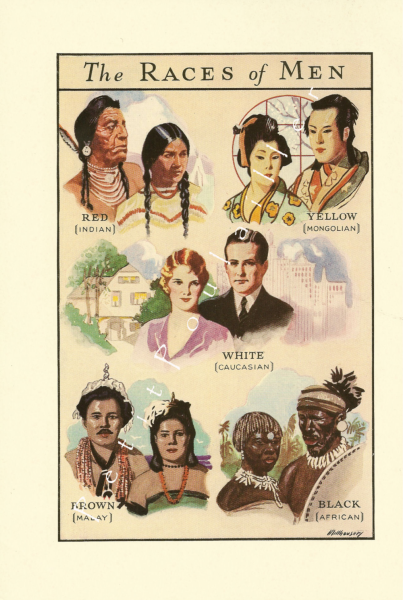
An Introduction To The Reality Of Race

An Introduction To The Reality Of Race

By Aedon Cassiel


Now that we’ve gotten a few of the philosophical issues out of the way in the first entry of this series, it’s time to proceed to a discussion of the basic scientific concepts involved in human biodiversity. If you didn’t read that first entry, its central point could be summarized as follows:

A lot of people think that if you say people are the way they are more because of nature than nurture, then that entails believing that they deserve whatever they get even, if they are suffering because of their station in life. They think that someone who wants people to be made as equal as possible will for that reason have to believe that the differences between people are a result of their environments or upbringings rather than their genetics, and only someone who opposes the desire for equality could believe that human nature poses an obstacle to making people equal by making their environments equal. Therefore, if somebody believes that this statement is true, it can only be because they are a bad person with very poor values and morals.

However, all of this is false, because all of it is rooted in conflating facts with values. What we have, in reality, are claims about what is true on the one hand, and feelings about what we ought to do about it on the other. And what people want to do is going to be determined by what kind of people they are, not by what they happen to believe is true about the causes of peoples’ differences. You can think people are made the way they are by nurture rather than nature and still basically not give a damn about making them all equal, and you can think people are made the way they are by nature rather than nurture and still want to find ways to increase human equality however you still can (perhaps even by applying gene therapy directly). Both of these are perfectly logical possibilities, because facts and values are separate kinds of things. If someone cares about another person’s suffering from disease because they are the kind of person who cares, then it won’t matter to them whether that disease turns out to be genetic or viral. So you, the reader, had better be prepared not to let your feelings about what kind of society you want get in the way of what I’m about to explain to you about what is true, because it’s up to you decide what you want to do about it once I’ve shown you what the facts actually are. Even if I convince you that the argument that I’m going to make is true, and you come to agree with me, you won’t have to therefore sign on to the Alt Right’s overall political agenda; indeed, you can even continue being a Left-wing liberal, if it turns out that that is still what you want. The truth of what I aim to prove in this series stands completely irrespective of whether we in our ultimate political goals. As we move forward, I’ll be illustrating this with a variety of concrete examples.

To address a concern held by some of the constructive critics of that essay, it was a bit of a misnomer to title that first entry, “Human Biodiversity for Normies.” The aim of the series as a whole is to lay out the concepts and information that one would need in order to understand human biodiversity as a whole, while avoiding a number of common, predictable pitfalls and fallacies that tend to stand in the way of people doing so. Since the requisite concepts as well as these pitfalls and fallacies will all vary in complexity, I’m aiming for something that will ultimately work quite well both for “normies” and for relatively more intelligent liberals who have never been exposed to an intelligent argument from our side. That introduction was obviously necessary more for the sake of the potentially reasonable liberal than it is for the “normie.” But with this entry, we’re back into territory that should serve perfectly well as the beginning of an introduction for actual normies, even if they couldn’t follow the first entry, or found it too complicated or verbose. The downside of this approach is that any one person who tries to read the series from beginning to end will either find some pieces of it over their heads or else other parts too basic and oversimplified, but the upside is that mixing and matching pieces of interest should also make this a versatile series that can be adapted to many different needs.

This essay was originally going to offer a basic introduction to the meaning of “race,” and a range of concepts related to IQ such as the meaning of such basic fundamental concepts as “g” and “heredity.” However, the entry on “race” ended up being long enough to qualify as its own entry. In any case, this is a topic where even the most intelligent liberals are quite often stuck at a “normie” level of understanding regarding even the basics. I imagine that little of this will be new to my “choir” in the Alt Right, but I hope to at least be able to add at least a few fresh perspectives and insights in along the way – at least by introducing you to a few new rhetorical strategies – to keep you interested while I attempt to reach a new audience.

What is “race”?

Somehow, even this simple question has become a topic of controversy and confusion in the modern world. Some people will tell you that scientists have discovered that race is just a “social construct.” Now, when a Leftist or liberal says this, they clearly imply that if this were true, it would mean that race isn’t a real thing. But they obviously aren’t even thinking particularly hard about what a “social construct” is, because even if race is a social construct, that doesn’t inherently mean that it can’t also be a real thing.

I’ll illustrate an example of what a social construct is, and explain why being a social construct doesn’t always make something “unreal”: the color spectrum. In an important sense, the color spectrum is a social construct, because where we define the boundaries between “red,” “orange,” and “yellow” is up to us. In fact, even the fact that we define three major boundaries along this spectrum (from “red” to “orange” to “yellow”) instead of two (from “red” to “yellow,” cutting “orange” in half to divide between them) or two dozen (from “mahogany” all the way through “marigold,” with no groupings of these into “red” or “yellow” at all) is a matter of basically arbitrary social convention.

Similarly, advocates of the “race is a social construct” argument will point out that earlier in American history, anyone who had even “one drop” of black blood was classified as black. Is someone with ninety-nine drops of white blood and one drop of black blood black or white? Even if there is a “correct” answer, that answer is only “correct” because of conventions that we came up with – and could change if we wanted. Indeed, the historical American “one drop rule” is reversed in modern Brazil, where anyone who has even one drop of white blood is classified by society as “white.”

This is what people are referring to when they say that race is a “social construct”: that to some extent, people have defined it in different ways at different times. But they follow this point up with the bizarre interpretation that because people have defined the boundaries between the races in different ways over time, there is therefore no truth about what “race” to which a person belongs besides an arbitrary label.

This is like noticing that in English that a certain animal is called a duck, whereas in Spanish it is called patos, and then concluding that there’s no truth as to whether the thing being referred to by these different names is a duck or an airplane.

Even as the boundaries between “red,” “orange,” and “yellow” are defined by us and created by social convention, the colors labeled by those words are not. Whether we divide this piece of the color spectrum up into a spectrum from red to yellow, or from red to orange to yellow, or from crimson and mahogany to persimmon and orange peel to merigold and aureolin, the colors that are being named and divided up by these terms are still obviously real. Nothing about the fact that our color spectrum is a social construct entails that there is no difference between the colors which are being labeled by the terms red, orange, and yellow themselves. And the fact that racial categories are “socially constructed” (which they are) does not entail that human populations and the differences between them aren’t real, either (and they aren’t).

That’s why a somewhat more intelligent liberal won’t rely on just the “social construct” argument alone. They’ll use it, but they’ll add to it that the idea of race is meaningless because we now know there to be more variation between the people collected within racial groups than there is between people standing across racial divisions. In other words, according to some formulations of this argument, you are likely to have greater genetic similarity with a randomly chosen person from outside of your “race” than you are with a randomly chosen person within your “race.”

The old response to this was to name the fallacy contained within its reasoning: Lewontin’s Fallacy.

An example which illustrates this fallacy would go something like this: if we look at the range of how short or tall men can be, and then we look at the range of how short or tall women can be, those ranges are much larger than the difference between the shortest men and women, or the tallest men and women. Thus, it is also true that there is “more variation in height between the people within a given gender than there is between the genders.” However, this does not change the fact that men are significantly taller than women on average, or that it is useful to know this. Despite the fact that the “more variation in x feature within-group than between groups” applies here as well, it nonetheless does not change the observable fact that men are indeed taller than women, on average. Supposing we had a roller coaster ride with a height requirement of 6’2”, and we saw more men taking the ride than women, the fact that men are taller than women on average would most likely be a crucial part of the explanation why.

So even if the premise of that argument had been true, its conclusion that race is meaningless still wouldn’t have followed. Even if the absolute variation within your race was larger than the absolute variation between your race and another, there could still be significant differences on average between the average member of your race and the average member of the other which it would be useful to know if you were trying to figure out why some difference in net social outcome was occurring between them.

However, more recently we’ve also begun establishing conclusively that the premise was always false to begin with. It turns out that the genetic differences found between the races are, in fact, bigger than the differences found within them.

See here for a short discussion of that fact from an Asian physicist, and here for a few more charts from the same physicist illustrating the genetic clustering of Nigerians, Europeans, and Asians. These charts look at the sequence of genes in a person’s genome rather than just considering the genes in isolation. Guess what happens when they do that? They find literally no genetic overlap between the races at all. So why does Stephen Hsu’s analysis here seem to find a different result than others have?

Thanks to research conducted at the University of Cambridge, we’ve recently learned that even when people have the same type of cancer, resulting from the same genetic mutations, the order in which they developed those mutations still changes the way the cancer behaves and how responsive the patient is to therapy which targets the mutated genes. And according to researchconducted by Joseph Nadeau at Case Western Reserve University in Cleveland, certain traits in mice appear to be influenced by genes that show up in their parents’ or grandparents’ chromosomes, but which do not show up in their own. After conducting a study in which two female mice had identical sets of genes, but who had a father whose Y chromosomes (which should not have been inherited by the females, and as far as they could tell, aren’t) came from a different strain of mice, they discovered that these offspring had behavioral patterns which more closely resembled that strain’s normal behavior, and they concluded that the “transgenerational genetic effects rival conventional genetics in frequency and strength.”

Elsewhere, Nadeau has studied gene-gene interaction directly.

To illustrate how complicated this idea is, Nadeau hops out of his chair and rushes over to the whiteboard in his office, where he quickly sketches out how these “completely crazy” context-dependent effects can act even within a single chromosome. The experiments focus on a genetic variant they have identified on chromosome 6 in the A/J mice that completely protects the animal against obesity. When they drop the chromosome into Black 6 mice, they too are protected against obesity. But it’s not that simple. When researchers stitch a bit of the DNA from the A/J strain into a large section of chromosome 6 in the Black 6 mice, the resulting mice are obese. When they trim away some of the Black 6 DNA and replace it with more A/J DNA, the resistance gene becomes active and the mice are lean. But when they add even more A/J DNA to this hybrid chromosome, the resistance gene turns off again. This on-off genetics continues even when the researchers add or subtract extremely small portions of chromosome 6. In fact, no matter how small the patch of DNA, nibbling away at it alternately confers or erases resistance to obesity. The reason is not known, but the larger message is that the effect of any variant seems to depend on its genetic surroundings. “We see that effect all the time,” Nadeau says. “All the time! Everywhere, in every trait we look at.”

Greater estimates of the degree to which different human populations are genetically similar look only at the genes in isolation. But this is like saying that the Bible and Atlas Shrugged must be basically the same book since they contain all of the same letters. In both cases, the sequences those segments are arranged in matters a whole lot more than anything else. The different genomes of the human race may contain most of the same letters, but it turns out that the sequences they’re arranged in are different enough to transmit quite different biological messages – just like with words and letters in novels. We’ll discuss more about what those differences are, and how confident we can be that they do in fact partially result from genetic differences, later; for now, the only point that we need to establish is that such differences do exist. In order to understand the magnitude of differences and where they lie, we will obviously have to go deeper than we are here.

Back to Basics

Before I had attained any proper understanding of this subject which went beyond the standard liberal platitudes, a writer by the name of Steve Sailer served as my own “normie introduction” to sane thinking about race. The way Sailer explained race very quickly made me feel like an idiot for ever having bought into these platitudes at all. The way Steve Sailer explains it in his Race FAQ, race is just literally a very extended family. How extended? Going back to our arguments concerning “social constructs,” wouldn’t the degree to which we decided to stretch the extended family before marking a limit and calling what we’ve circled a “racial” group arbitrary? Actually, no. The relevant point at which a “racial” group emerges is the point at which the extended group you’re looking at is large enough to be considered somewhat “inbred” compared to the rest of the human population, yet small enough that there is still a “rest of the human population” left. The definition of “race” is therefore relative, but not arbitrary.

Yet even without the added nuance involved in explaining where to cut off the “extendedness” of the extended family, the simple point that race is an “extended family” was all that it took to cut through a great deal of the pedantic bullshit I had been conditioned to think and say about race. It was more than obvious to me even then, no matter how deeply I had been indoctrinated with Leftist ideas, that it wasn’t a “social construct” to say that I belonged to an extended family. On the level of common sense alone, it was also pretty obvious that all the members of my extended family were more like each other in many ways on average than they were like people who weren’t related to us at all. If someone were actually neurotic enough to pose the argument to me that there is more variation within my extended family than there is between my family and others, it wouldn’t take much study for me to suspect that this was probably some kind of bullshit right off the bat.

Of course, the argument is even weaker for a racial group than it would be for a smaller extended family, because in normal circumstances where literal inbreeding is not prevalent, the members of smaller “extended families” are not shuffling genes more frequently among themselves (at least, not more than once) than they are with the outside: by definition, every new mating partner in a small “extended family” comes from “outside” the extended family. But if you keep expanding the tree of that extended family far enough into the past, you would reach a point where this is no longer true – where on average, the members of that tree are mating among themselves more often than they are with “the outside.” And this would be the point at which you had identified a “racial group.” The technical term for this is “pedigree collapse,” but I’ll leave further discussion of that term to Sailer himself. If you want to find deeper explanations regarding where the cutoff points between “racial” groupings are, and why they are not arbitrary, this is the term you’re looking for, and Sailer’s discussion of it should be illuminating.

This answers questions about how large or small a group has to be before qualifying as a “racial group” – questions about how closely we can zoom in on the fine differences between individuals while still calling those individual differences “racial” – perfectly. Every time you can extend a family tree back far enough to have identified a group which is relatively more “inbred” than it is with people from outside that tree, you have identified a group which is shuffling genes among itself which will therefore end up being more common inside of that group than they are outside of it. If Montana were cut off from the rest of the United States due to exposed fault lines for several generations, and the population of Montana thus bred within itself exclusively during that period, you would have a population whose members would become increasingly more genetically similar to each other and increasingly more dissimilar to the outside – even if the people you started with had, at that time, belonged to different racial categories. After a while, you would be able to recognize Montanans by distinct similarities in their appearances, and these similarities would begin to correlate with things like adaptation to high elevations above sea level. Eventually, the differences would become great enough that, in fact, a new Montanan “race” would have been created.

In retrospect, this should always have been obvious. There’s no other way for a different racial group to evolve in the first place other than through something that looks much like this process.

In his Race FAQ, Sailer dispatches pseudo-questions such as, “If races exist, how can somebody belong to more than one race?” with incredible common-sense efficiency: “If extended families exist, how can you belong to your mother’s extended family and to your father’s extended family?” I think everyone reading this understands the reproductive process well enough to realize that someone can only be mixed-race by having parents who are of mixed races. So in the case of the children of mixed–race parents, the pseudo-question and Sailer’s retort literally collapse into being exactly the same question. “If races exist, how can somebody belong to more than one race?” Well, if families exist, how can a mixed-race child have a white family and a black family? The punchline effect of his response reminds me of an old joke about a motorist who was stopped after speeding as part of a group of several speeding cars, and who is offended that the officer stopped him while letting all the other speeding motorists get away. The officer asks him, “Have you ever gone fishing?” The motorist responds, “Yes,” and the officer replies, “Did you ever catch all of the fish?”

With common-sense quips this direct, you don’t have to have the implication spelled out for you in order to see the point for yourself – unless you really are an idiot. That’s the level of obviousness and simplicity to which Sailer has distilled the concept of race. And that was the small beginning of significant shifts in how I came to understand the world as a whole.

Actually, the influence of race was obvious enough on the most visceral level even within my own extended family. When one of my cousins gave birth to a white child while another gave birth to a mixed-race, part-black child at the same time, the part-black child was walking around and trying to play-fight with the white child even while the white child was hardly beginning to crawl. During a series of family gatherings, the difference couldn’t have been more obvious. And the explanation clearly could not have been that they were receiving different nutrition, or that they were living in different socioeconomic strata. For that to even make sense as a postulate, the theory would have to be that receiving worse nutrition and living in poorer conditions accelerated black infants’ motor development. But in this case, I knew from observation that they were not being raised in environments that differed in any meaningful way. They were both spending the greater bulk of their time together, at the home where we had these family gatherings. They were even being fed the same brand of formula. In every way, their upbringings were effectively identical – and yet this extremely obvious difference had emerged nonetheless.

As I studied the science of race, I discovered that it had actually been a very well-supported piece of knowledge for a very long time that black infants do, in fact, develop motor skills faster, especially during their first year of life. Even though they’re born faster and require shorter gestation times in their mothers’ wombs, studies still consistently find that they are able to raise and hold their heads up sooner, sit steadily without help sooner, learn to walk sooner, and so on down the list of just about every benchmark of motor development that can be studied scientifically. These differences show up not only from birth, but in fact, even beforehand; while only a third of white children are born by thirty-nine weeks, fully half of black children are. And once half of white children have been born in week forty, a whopping seventy percent of black children have. And yet, despite how much faster they leave the womb, and thus how much less time they have to develop prior to infancy, they still pass every benchmark of motor skill development in infancy more quickly as well. This is a remarkable, large, and biologically-influenced “racial” difference that shows up worldwide in populations from different racial groups, no matter what country they’re found in, from the very moment of birth – nay, before it.

In retrospect, it seems absolutely remarkable now that it took so much science for me to finally just admit what I had been seeing with my own eyes. Why had I ever been afraid of admitting it, when it had been so obvious? The only reason I could give is that admitting that people innately differ – for any reason at all, whether race was one of the variables in the explanation or not – felt vaguely threatening to the generally liberal worldview I held at the time. Back then, I couldn’t even have articulated why, because there wasn’t really any coherent thought behind it. I guess I just knew that I enjoyed carrying the instinct to see differences in people as an excuse to look for some big, bad villain to direct righteous anger towards – and the thought that people might innately differ from each other in any way threw a fly into that cocktail of intoxicating righteousness, so it simply wasn’t something that I wanted to devote any of my time or energy toward thinking about one way or another.

I don’t think the story of my evolution is uncommon. I think the trends that caused me to think and feel in the way that I did are exerting the same influence upon others’ minds, too. I think the same facts that changed my mind will be more than sufficient to change those of others, also. And I think I can demonstrate that whether you regard yourself as someone who supports the Alt Right’s political programs in part, in whole, or not at all, there really is nothing to be afraid – even if you do want to demonize the Alt Right’s politics, it is illegitimate and unfair to demonize the concept of human biodiversity itself. Suppose we lived in a world where white activists were in a panic over the fact that white infants are developing motor skills more slowly compared to black ones, and thus demanded the establishment of a welfare institution to provide white infants assistance in order to grow faster.

And now suppose that we discovered something which we already know is true today: that this difference results primarily from innate biological differences between white and black infants that appear everywhere, no matter what environment they grow up in, throughout the world. Would white children be harmed if people came to acknowledge this? Obviously not. If we cared about the development of white children, we would simply stop wasting our time on what had objectively been a dead end, and find some other means of helping white children that would actually have a realistic chance of helping them. Whether we cared about white children or not, then – indeed, no matter what it is that we care about – understanding the true nature of the facts can only provide us with more efficient means for achieving more of our own goals, and wasting less of our time. Whatever those goals may be.

Saturday, April 22, 2017

On Libertarian Universalism


The libertarian worldview is based on the idea that every individual has a set of rights, which no one can take from him/her. This means that the state’s restrictions on individual freedom in most cases are seen as illegitimate. There are several forms of libertarianism; anarcho-capitalism, objectivism, minarchism, individualist anarchism and others, and they stem from different philosophical traditions but reach more or less the same conclusions.

I see these libertarian currents as incarnations of the Indo-Aryan longing for freedom and Norse “individualism”. My Norwegian ancestors were proud, strong and independent, and almost 70 years of social democracy has not been able to change this completely. But just like other incarnations of old ideals, such as nationalism and socialism, libertarianism lacks something from a traditional perspective.

Apoliteia

First we must establish that there are two kinds of traditionalists, two different attitudes towards the modern world. Both assume that the modern world is fundamentally bad, that we are living in the darkest phase of the Kali Yuga. There are however two ways of reacting to this, and Julius Evola expressed both in different stages of his life (James Mason expressed it in the most simple way: “Total Dropout or Total Revolution”). The first reaction is the ksatriya-reaction, full-scale revolt against the modern world, even political. Through his involvement in Italian Fascism and WWII, Evola demonstrated this reaction. The second reaction is more resigned, and was given the name apoliteia by Evola. Here, he contends that the Kali Yuga still has many years left in it, and that it’s unrealistic to try to fight it. The only thing one can try to do is to live a traditional life in the midst of it, and since there are no political movements worthy of support, one should distance oneself from politics (apoliteia).


I don’t agree with Evola’s later, more resigned analysis. There are many signs that the current world order has developed inner contradictions that will lead to its collapse in relatively short time, demonstrated especially by Marxists such as Immanuel Wallerstein (Third World immigration with its resulting ethnic conflicts, the lack of a hegemony to replace the United States, etc.). Thus, fighting the current system is not only a necessity in order to call oneself an ariya, it is also completely realistic.

Anyway, an interesting question that arises from the apoliteia perspective is which society is the best one to live in. Social democracy, totalitarianism, theocracy? This is where libertarianism becomes interesting, as a libertarian society offers a traditionalist the freedom to be himself and search for enlightenment/initiation in his own way. No thought police will come knocking on the door of the traditionalist when he has dared to express his thoughts on race or gender roles. No thought police will fire the traditionalist as soon as the media has “exposed” him as an anti-democrat (as the libertarian ideology itself is anti-democratic, i.e. opposed to the right of the majority to take away the rights of the individual). No benevolent nannies/politicians will imprison the traditionalist as soon as he, as part of his search for enlightenment, has tried the effects of marijuana.

From this fact, there are strictly practical affinities between a libertarian worldview and a traditional one. In many cases traditionalists will have great use of strong libertarian lobby groups, and in fact the libertarians have use of a number of traditionalists spreading their ideals about mature, honorable, and independent people as well (for freedom to work, the human material must have some degree of quality). As a traditionalist, one can also feel respect for the libertarians when they stand up to the state and the nanny mentality, and say: “I am a grown up, honorable person. I am fully capable of taking care of myself and answer to the consequences of my own actions. I don’t need a nanny state to take care of me”, as this is closer to the attitudes and human ideals of our ancestors.


Moreover, a libertarian society offers a framework which also traditionalism can function within. But it is just a framework, which can be filled with anything, and there is a great risk that many people will use it to defend their “choices” of purely animalistic lifestyles (“eat, shit, fuck, die”).

Ethnicity and progressive collectivism

But my objection to a libertarian worldview is its anti- or a-nationalism. It sees ethnicity as a non-issue, or a strictly private issue, something which can and should be kept separate from politics (for example, many libertarians defend an open border policy, something which from a traditional perspective would lead to the doom of the people and is thus a very strange, self-destructive and anti-popular position). To protect your kin and people is an important part of tradition, and to silently watch your people march towards certain doom is simply not honorable.

Empirical evidence clearly demonstrates that keeping ethnicity and politics separate is impossible, neither is it possible to, from a “selfish gene”-perspective, “distance yourself” from your group. Geneaologists, who have mapped the movements and fates of different genes throughout history, have found that in-group competition is not the most crucial factor in regards to what genes have survived and spread, it is the competition between groups. Genocide, displacement and silent extinction, this is what history has looked like. Those who want to protect the future of their own genes and their own bloodlines, are forced to protect that of their own people as well. And the research on “ethnic nepotism” also shows that this is exactly what human beings do. We have developed instincts and cultures (“group evolutionary strategies”, for those that have read the works of professor Kevin MacDonald) that makes us feel kinship with those who look like us, as they are also highly likely to share our genes to a greater extent. And those that we feel kinship with, we favor, in order to favor the survival of our own genes (note that phenomena like suicide bombings can also be explained from this perspective. Even if a childless person blows himself up, the genes of his relatives, which he shares, will live on).


The conclusion is, of course, that he who thinks he can “distance himself” from his group is in fact sadly mistaken, and has a lesser connection with reality than the “bigots” that he often implicitly wants to distinguish himself from. What consequences does this have for libertarian a-nationalism, when we have established that ethnic nepotism is inborn? Well, first we realize that we can’t be so certain that every group in a libertarian society will “follow the rules.” Groups that are numerous but not as economically well off, will take advantage of their strength in numbers to force advantages for themselves, and then the political arena will be reborn, maybe even the state (and maybe even an ethnic state). This is a very clear tendency throughout history, we can see it in Uganda where native Africans banished Asians which they saw as having become too rich. We can see it in Germany where the Germans turned against the Jews which they saw as “unfairly” successful, or in the US and the entire Western world where “minorities” force changes to their own advantage through politics and/or rioting. Such is the reality of ethnic relations, such is human nature. When people don’t see the rules as being to their advantage, and if they are numerous enough, they change them. Even if I saw ethnicity as a non-issue, there are many people that would disagree with me, and on the contrary see me as an “unfairly privileged Western man”. The circle closes, and those that tried to distance themselves mentally become the socio-economic losers when other, more self-conscious groups take away their privileges.


Thursday, April 20, 2017

On Gavin McInnes & The Alt Light

On Gavin McInnes & The Alt Light

By Spencer Quinn


Recently, Gavin McInnes, our friend over at Taki’s Magazine, helpfully released a video entitled “What is the Alt Right?” In it, he does a pretty good job of describing who (or what) most of us are, dividing us into the “Alt Light,” the “Alt Right,” and everyone else. The video is not for the Alt Right in a broader sense, of course. There really isn’t anything new in it. It’s just an introduction to the outer reaches of the Right for normies and an assurance that we’re not as bad as we are made out to be. Again, helpful, but not perfect. At one point, McInnes proclaims that Jared Taylor wishes to discriminate against Jews, which we all know isn’t true. McInnes also neglects to mention anyone, other than Richard Spencer, who is to the right of Jared Taylor – that is, the “everyone else” category above – and more or less questions the influence and sanity of those of us who are in that category.

McInnes’ overall point, as expected, is to make the Alt Light look good compared to the Alt Right. One of the ways in which he does this is by expressing a key difference between the two: the Alt Right consists of racial (namely, white) chauvinists, whereas the Alt Light consists of cultural (namely, Western) chauvinists. This we all know, and it is therefore uninteresting, but McInnes’ justification for preferring the latter over the former is. He just doesn’t have the heart to draw a color line when dealing with non-whites who conform to acceptable standards of Western chauvinism. He even states that the Alt Light should almost be more welcoming to blacks and other non-whites considering how hard it is for some of these people to gravitate to the Right in the first place. In his typical expressive, onomatopoetic manner, he imagines himself rejecting a Right-minded black as if he were a game show host getting buzzer-happy booting a losing contestant off a show. He then indicated without saying it that he could never do something so cruel and absurd.

As someone who, for the most part, belongs in the “everyone else” category of the Alt Right, I can say without the slightest hint of sarcasm that I like Gavin McInnes, and his reasoning behind promoting the Alt Light is one reason why. Despite his sneering, pugnacious persona (and his dismissive attitude towards people like me), he seems like a genuinely nice and funny guy whose heart and mind are in the right place in the grand scheme of things. I’ve said this before: the world is a better place with race realist writers like Gavin McInnes than without them, regardless of any disagreements I, or we, may have with them.

Furthermore, I like what he and the Alt Light have to say. Shouldn’t we all judge people for what’s on the inside rather than the outside? In my personal and professional life, I try to adhere to this dictum as much as possible, regardless of a person’s race. Isn’t that fair and just? When wouldn’t one want to be fair and just with people? A worldview like McInnes’, which accepts racial and sexual differences yet still promotes an ecumenical, equal-opportunity approach to in-group status is . . . attractive. Almost seductively so.

For example, if God were to come down and say to me, “Hey, Spence, you schlemiel! Gavin’s right. You’re wrong. Get on board with the Alt Light tout suite! Capiche?” I wouldn’t do so grudgingly. I would do so gladly, being all too eager to unburden myself of my cynical understanding of human nature and start singing “Kumbaya” with my moral betters.

I’m sure it would be nice, but once I awaken from such an idyllic reverie, I’m forced to realize that my sticking point with the Alt Light can be found in this cynical (yet accurate) understanding of human nature. There is more to race realism than accepting that blacks do poorly on their SATs, East Asians are really good at math, and white people have a thing for the Gap. Race realism also means that people are fundamentally racial; before all else they will express loyalty towards their own kind, especially when the red, white, and blue chips are down.

This alone is enough to obviate the Alt Light. Once enough people of various races enter and become a part of the West, what good would Western chauvinism be when these races use all the great aspects of the West to pursue their own interests at the expense of those of other races? Isn’t the point of Western chauvinism to suck in the rarefied oxygen above all that racial stuff? Were we big Western chauvinists when the Japanese made use of Western weapons and technology against us at Pearl Harbor? Are we Western chauvinists today as the North Koreans aim their very Western nukes at us? As Samuel Huntington pointed out concerning Arab Muslims (but it could apply to any non-white racial group), they wish to modernize, not Westernize.

Gavin McInnes fails to see that most non-whites will be Western chauvinists only insofar as it coincides with their racial chauvinism. And if these chauvinisms ultimately conflict with each other, the latter will subsume the former, always.

McInnes should also remember that one of the great flaws of the human mind is to assume that all other minds are (or potentially are) like the one doing the assuming. This is not an obvious mistake; in fact it is quite natural, so I am not blaming him for it. I’m reminded of the wonderful biopic of Temple Grandin, the autistic celebrity and scientist who, according to the movie, has the freakish ability to visualize complex mathematical equations in her mind. When a college instructor asks in disbelief if she really has such an ability, she looks puzzled and responds, “Doesn’t everybody?”

It seems that only white people in large numbers can overcome race to the point where they believe it doesn’t matter. I don’t know why – it could spring from genetics, or from two thousand years of Christian indoctrination, or from many hundreds of years of practice being a host population to other races. In any case, many whites, including those on the Alt Light (who, frankly, should know better), are more than happy to abjure race entirely and judge individuals strictly on a case-by-case basis.

I think this is noble, yet foolhardy.

When I look at the vast majority of non-whites (with the exception of some East Asians settled in the West), I see racial-minded people behaving racially, as well they should. Israel doesn’t just refuse entry to white Goyim and Syrian refugees from next door. They also give the pointy boot to black Jews from Africa. Furthermore, what nations besides white nations are making real efforts to take in other races in large numbers? Only white nations do this. And hundreds of years of exposure to Western Civ isn’t going to make non-whites do the same – if so, they would have done it by now. They are who they are, and all the West will ever do for them is modernize them, not Westernize them. Therefore, I don’t understand McInnes’ optimism about non-whites. The safer, more sensible path, in my opinion, can be found in the Alt Right, which states that the races for the most part would do best to be separate.

Such a conclusion is less attractive, but certainly more realistic than the ones reached by the Alt Light. Furthermore, the Alt Right can afford to be wrong. The Alt Light can’t. After enough race-mixing and miscegenation, as is promoted by the Alt Light, if it is eventually proven that race really is as important as the Alt Right says it is, then we’re courting disaster. And there’s no going back. You can’t unmix the races any more than you can turn back time.

With the Alt Right, we hedge our bets and play smart, putting white interests first. There’s also the point that Vox Day makes, which I agree with: whites should be shrewd about their racial interests, since what’s good for whites is ultimately good for everyone else. Whites are the architects of the modern world, after all. They have done more great things than all the other races combined. Why wouldn’t we want them to maintain their racial identity?

Another mistake McInnes makes is to assume it’s all about him. Remember his game show host imitation? What he is doing there is putting himself, Gavin McInnes, in the fictional role of an all-powerful guardian of a white ethnostate. He personally does not have the heart to reject people who have all their ducks are in a row just because the ducks are the wrong color. This speaks to the titanic sense of morality I find in many adherents of the Alt Light. As I said before, I genuinely like these guys. But just because they are going to go to Heaven when they die does not mean that they’re right, and does not mean that what they propose is best for white people (and by extension, for everyone else).

Again, I’m reminded of a movie, this time Martin Scorsese’s The Aviator. In one scene, Howard Hughes, as a young parvenu, is having dinner with Katharine Hepburn and her very wealthy family. When Katharine’s mother informs Howard that they don’t care about money in their household, Howard snaps back, “That’s because you have it.”

To make this analogy about race, Gavin McInnes is willing to disregard race because he, by virtue of being white, has it. He grew up in a world that was mostly white. For many years, only white people mattered in the development of the modern world. Whites were on top and experienced little, if any, oppression in their home territories from non-whites. I am quite certain that as things continue to change and as anti-white sentiment in the West turns more and more into anti-white violence and oppression (like it already has in South Africa and Zimbabwe), whites like McInnes will become less and less generous with this racial business. They will start drawing that racial line in their minds – the lines they are loath to draw today. And they will not care so much about going to Heaven.

I predict that as the proportion of non-whites in the West reaches a tipping point, and as they bring the average IQ of the Western nations further and further down as predicted by Byron Roth in his excellent work The Perils of Diversity, white countries will become what I call “prison nations.” In prisons, races congregate into gangs out of necessity. These gangs are tribal, first and foremost, and they quite fiercely look after their own.

As David Skarbek pointed out in his excellent book The Social Order of the Underworld: How Prison Gangs Govern the American Penal System:

The Mexican Mafia and the Nuestra Familia were the first two prison gangs to form in California, and they were not the last. As they rose to power, inmates of other races and ethnicities formed gangs as well. Morrill explains that, in the following years, inmates “who formed these other gangs felt they had to in order to protect themselves.” In the late 1950s and early 1960s, white inmates formed the Blue Bird Gang. Little is known about this organization, but by the late 1960s, the Federal Bureau of Investigation reported that it had become “apparent to other white inmates that a more powerful gang was necessary to protect white inmates from the Black and Mexican prison spawned gangs that were in power in the California Department of Corrections prison system.” The Aryan Brotherhood prison gang formed in 1967 with the explicit purpose of protecting white inmates from black and Hispanic gangs.

This is our future, folks. We will need to stick together in order to survive, just like humans have always done. The Alt Right recognizes this. The Alt Light, as of now, does not. But they will. And when they do, and when they come over to our side of the political spectrum and admit their mistakes, we should accept them and hold no grudges. At that point, there will only be one Alt Right in a world more dangerous for white people than the one we’re in now. And that will make me happy and sad at the same time.