Wednesday, October 10, 2018

The Left, the Right, and Social Revolt - Part 1

                            By Kerry Bolton
   

The revolutions of the past centuries have brought social revolt in the name of ‘the people’ — for the benefit of oligarchy.

The philosopher-historian par excellence of Western Civilization, Oswald Spengler, noted that there is no proletarian, nor even a communist, movement that does not serve the interests of ‘money’ and ‘in the direction indicated by money’. He pointed out that this is so because ‘socialism’ of the class-struggle variety arises from the same Zeitgeist as capitalism.1 Julius Evola said much the same, and even more stridently: ‘Nothing is more evident than that modern capitalism is just as subversive as Marxism. The materialistic view of life on which both systems are based is identical; both of their ideals are qualitatively identical.’2 Marx’s correspondence with Engels and others shows how thoroughly bourgeois Marx yearned to be. The distraction of the festering boils on his groin3 and his will to destruction prevented him from attaining the good things in life – the typically bourgeois things – for himself and his wife and daughters, other than what he could bludge from Engels, or from his father or other relatives. Marx’s doctrine was a projection of himself onto society as a failed bourgeois, his hatred of ownership a reflection of his detestation of small tradesmen who expected to be paid for their goods and services. His doctrine is a mirror reflection of capitalism, and the failure of an educated man with expensive tastes to rise beyond Soho squalor.4

Socialism does not aim to transcend capitalism. Its aim is to appropriate capitalism for another class.

Socialism does not aim to transcend capitalism. Its aim is to appropriate capitalism for another class. Hence, the proletariat becomes the owner, in theory, of capital, but capital retains its power; it is not overthrown.5

From the French Revolution to Marxism there is an unbroken lineage via Blanqui, Blanc, Babeuf and others. The Masonic lodges played a role in maintaining this lineage from the Illuminati and Jacobin clubs to the International Working Men’s Association. Hatred of Western Civilization, which is to say Christendom as exemplified by the Catholic Church, is a predominate theme for this line of revolutionists. It would not be surprising if this revolutionary ferment that aimed to destroy Western (Catholic) Civilization and hatched secret societies such as Freemasonry and Illuminism had its origins in the Reformation. Is it no more than coincidence that the personal crest of Martin Luther was the Rose-Cross, which became the name of a secret society, the Fraternity of the Rosy-Cross, Rosicrucians, from whence Masonry claims a lineage? What is known of the society is that it issued various manifestos calling for a new order to replace Catholicism. Masonry also claims lineage from the Knights Templar. Regardless of whether charges of heresy against the Templars were justified, Templar and Rosicrucian influences on secret societies would have provided an impetus for the anti-Catholic sentiment that found radical expression with the Illuminati, Grand Orient Masonry, Jacobinism and the rise of Leftism culminating in Marxism. Even if it is not a conspiratorial lineage, it is a world-view capable of proceeding with a life of its own.6

It is notable is that these revolts in the name of ‘the people’ have tended to consolidate the position not of the amorphous mass, but of oligarchy. This is done in the name of ‘democracy’ because traditional regimes based on a symbiosis or a synthesis between faith and monarch get in the way of the Free Market.

Right and Left

We might trace the Western malady back to the Reformation of Henry VIII. In the name of ‘freedom from popery’, the English Reformation led to the destruction of the Catholic social order that had ensured the social well-being of the common folk; it dispossessed the Church of property for the benefit of an emerging oligarchy, and perhaps more than any other upheaval set England on the path of decay – and, considering England’s role in hatching subsequent theories, set the West itself on the path of decay.7

Their democracy is really freedom for oligarchs to expand their power and wealth without the encumbrances of a traditional social order.

The Right and the Left assumed definitive form during the English Revolution: Cavaliers versus Roundheads, Puritans, Levellers and sundry other factions. Again, in the name of ‘the people’ we see a victory of the oligarchy. The Kingdom had been brought to near-ruin by the expenditures of King James and Queen Elizabeth. Parliament refused to allow King Charles I to levy taxes. He enraged the money merchants by grabbing their gold reserves stored at the Royal Mint and he confiscated the pepper and spice inventory of the East India Company, whose monopoly was challenged when he approved the rival Courteen Association. With the backing of mercantile interests, Cromwell usurped the authority of the Throne.8

Oligarchy Marches On

Something else called a ‘revolution’, and a ‘Glorious’ one no less, brought William of Orange from the Netherlands, then the centre of the money-merchants. It was from here that Rabbi Menasseh ben Israel, leader of the Amsterdam Jewish community, had petitioned Oliver Cromwell in 1655 to allow the Jews re-admittance to England on account of the international commercial relations they could provide (the precursor of ‘globalization’), on the grounds that the ‘world prefers’ the ‘profit motive’ ‘before all other things’.9 This outlook of materialism and profit justified by religion was the basis of Puritanism and its revolts, and hence of the capitalist revolution against tradition,10 in which can be included the American Revolution and the present-day neo-Puritan ‘prosperity gospel’ of the American televangelists, who have assumed a significant political role in the USA and as allies of the Israeli lobby. This revolution, or invasion, in England was yet another revolt against Catholicism, and a coup for the Whig (Liberal) party. William’s extravagant expenditure led to an act of lasting significance, the establishment of the Bank of England in 1694. The world financial centre gravitated from The Netherlands to England, and further undermined the authority of the Crown in favour of Parliament. Another ‘revolution’ in the name of resisting ‘popery’, extended the power of a Whig oligarchy. Party politics became fixed and the nexus between monarch and God, which is to say the foundation of traditional societies, was rent.11

It is a symptom of ideological befuddlement, promoted especially by the abysmal ignorance of journalists and political scientists, that today Whiggery, also called ‘Classical Liberalism’, is confused with the ‘Right’. The historical legacies of Whiggery and the Right are not only different but antithetical, as different as a fight between a Cavalier and a Roundhead.

When Henry VIII, Oliver Cromwell, William of Orange, Duc d’Orleans, Jacob Schiff, Woodrow Wilson, Franklin Roosevelt, Churchill, Mandela, Bush (X 2), Clinton (X 2), Obama, et al. – the immense gaggle of liberal-leftists whoring themselves for George Soros’ money, and the neo-Trotskyists of the National Endowment for Democracy (NED), shout ‘freedom’, ‘democracy’, and ‘human rights’, like their ideological forefathers shouted ‘down with popery’, and ‘liberty, equality, fraternity’. Their democracy is really freedom for oligarchs to expand their power and wealth without the encumbrances of a traditional social order.12 Hence the jubilation of American banking interests when the March 1917 revolution,13 prepared since 1905 by hack journalist George Kennan, with funding from Jacob Schiff of Kuhn Loeb & Co., brought down Czarism.14

The dozens of long-planned and well-funded ‘spontaneous’ ‘colour revolutions’ throughout Central and Eastern European and North Africa are of the same order, as is the combination of social revolt and NATO bombs that gave ‘freedom’ to globalize and privatize the immense mineral wealth of Kosovo, once the mines had been ‘liberated’ from the Serbian state. When the Allies sent their go-to man, Trotsky, from New York to Russia in 1917, and the Germans sent theirs, Lenin, it was a replay of William of Orange being sent from Holland to England. When the Bolsheviks set up Ruskombank under the direction of Olof Aschberg of Nye Banken, Stockholm, it was a replay of William establishing the Bank of England.

How far back this dialectic goes – social revolt in the name of ‘the people’ for the benefit of oligarchy – is indicated by Spengler’s reference to the revolt of Tiberius Gracchus, serving as a lackey for the Equites, a former military caste that had become an oligarchy.15 When the Duc d’Orleans paid the dregs of Marseilles to act as a revolutionary mob, expecting he would become First Citizen of the Republic, he was acting as a precursor of Jacob Schiff and George Soros. What the mob overthrew in the name of ‘liberty’ and for the benefit of the bourgeoisie and later oligarchs was the final vestige of the traditional – organic – social order of Western Civilization that had been inherited from Rome and fine-tuned by the Church into a uniquely Western ‘Gothic’ form. This was ‘class struggle’, but not precisely in the order and direction assume by Marx. Rather than a lineal ‘progression’ (the ‘dialectics of history’, according to Marx16) of serfdom – capitalism/liberalism – socialism – communism, the dialectic has been of serfdom – liberalism/socialism – capitalism – oligarchy. Spengler and Brooks Adams17 were much better historians in explaining cycles of rise and fall and the role played by money. Conversely, while Francis Fukuyama and other apologists for liberalism have argued that it is capitalism that is the epitome of history, beyond which there is nothing better, Spengler, Evola and other philosopher-historians of the actual Right, contend that capitalism is the final symptom of a civilization in its death-throes, the triumph of money; while Plato in The Republic long previously saw oligarchy and then democracy as the symptoms of decay.

Footnotes

1Oswald Spengler, The Decline of the West(London: Allen and Unwin, 1972, Vol. II), p. 402.

2Julius Evola, Men Among the Ruins ([1972] Inner Traditions, 2002), p. 166.

3‘Hidradenitis suppurativa’.

4On Marx see: Bolton, The Psychotic Left(London: Black House Publishing, 2013), pp. 70-100.

5Oswald Spengler, op. cit.

6Bolton, The Occult and Subversive Movements(London: Black House Publishing, 2017), passim.

7William Cobbett, The History of the Reformation in England and Ireland, (1824-1827).

8Some background on this is provided in John F. Riddick, The History of British India: A Chronology, (Westport, CT: Praeger Publishers, 2006), p. 4.

9Menasseh ben Israel to Oliver Cromwell. This lengthy letter, entitled ‘How Profitable the Nation of the Jews are’, reads like The Protocols of Zion, but its authenticity is not disputed. The letter was published in Paul R. Mendes-Flohr and Jehuda Reinharz (eds.), The Jews in the Modern World: A Documentary History (Oxford University Press, 1980), pp. 9-12.

10See the famous book by the German sociologist Max Weber, The Protestant Ethic and the Spirit of Capitalism (1905).

11E. Vallance, The Glorious Revolution: 1688 and Britain’s Fight for Liberty, (Little, Brown and Co, 2006).

12K. R. Bolton, Revolution from Above (London: Arktos Media Ltd.), passim.

13John B. Young, National City Bank, ‘Is a people’s revolution’, New York Times, 16 March, 1917.

14New York Times, 18 March 1917; and 24 March 1917, pp. 1-2. On the nexus between revolution in Russia and oligarchic interests see: Bolton, Revolution from Above. For the best scholarly documentation on the history of the Russian Revolution and its oligarchic sponsors see Dr. Richard B. Spence, Wall Street and the Russian Revolution 1905–1925 (Trine Day, 2017). Spence is a senior historian at Idaho State University, who has previously examined the enigma of Trotsky’s travel arrangements between New York and Russia.

15Spengler, Decline, op. cit., 402, 404 n1.

16Karl Marx and Fredrick Engels, The Communist Manifesto (1848).

17Brooks Adams, The Law of Civilisation and Decay ([1896] London: Black House Publishing). Anyone who has Spengler’s Decline of The West, should have Adams’ book beside it. (Do not be confused by comments on Amazon by reviewers about another ‘poor quality’ edition; the BHP edition is of fine quality.)

Sunday, October 7, 2018

Usurocracy Delenda Est

By Charles Lyons


I believe that banking institutions are more dangerous to our liberties than standing armies. — Thomas Jefferson

In the postmodern world, we find ourselves living in the age of Money-Power. With the exception of a few rogue nation-states or sectarian groups, there are no ‘fascist’ or ‘Communist’ Bogeymen lurking in the shadows. The current left vs. right paradigm we see played out in the political circus is nothing more than a dog and pony show. Instead, we are beginning to see the rise of a new paradigm in the West: the people vs. the elites.

Invoking the term ‘the elites’ is typically reserved for the tin-foil hat crowd tuning into Alex Jones – or at least it used to be. Understanding who ‘the elites’ are is extremely important. However, even more important than knowing who they are is understanding their power structure. Even your average partisan hack will call out the meddling of folks like George Soros or the Koch Brothers. Populists like Steve Bannon or Michael Anton will refer to the elites as the ‘Davosie’1 which is getting much closer to understanding the full scale of the problem.

Liberalism breeds useless men. It is thanks to useless men that we find ourselves in a situation where we are dominated by Money-Power.

The problem is nothing other than the very ideological foundation of the West. Liberalism – the triumph of individualism, egalitarianism, human rights, democracy, free markets – has paved the way for the ascendancy of usurers and merchants of the highest order. The Political has been usurped by the Economic. What is ‘The Political’ or what is politics? Politics, or The Political, is activity in relation to power.2 The Political divides the world into friend and enemy,3 whereas The Economic divides the world into consumer and producer. According to the foundational principles of Liberalism, the state is theoretically reduced to a watchman for fear that a state exercising authority may become authoritarian, thus potentially violating individual liberty or human rights. Of course, it is merely a theoretical concept that the watchman state will not exercise power. The watchman state is entirely capable of exercising power, and if ‘the people’ are unwilling to utilize the power of the state, then other actors will. According to Spengler, ‘it must be concluded that democracy and plutocracy are the same thing under the two aspects of wish and actuality, theory and practice, knowing and doing.’4 What we find is that the contemporary Conservative has no understanding of The Political. The Conservative is ideologically shackled by his very own principles, his belief in Liberal ideals such as limited government and the free market. His impotence is derived from his own ideological beliefs. As a political actor, he is entirely useless. Liberalism breeds useless men. It is thanks to useless men that we find ourselves in a situation where we are dominated by Money-Power.

When I speak of Money-Power, I speak of banks, markets, corporations, speculators, international finance, the corporate media etc. These various institutions form the organs of the current capitalist system. In order to change the system, all-out war against these institutions will be required. The capitalism-reformers who wish to rein in the excesses of capitalism are naively wrong because they fundamentally misunderstand the nature of the beast they wish to wrangle. To quote Alain de Benoist,

This is a double error, first, because it is precisely the impotence of the politicians to face the problems inherent in deregulated financial markets that has opened the way for the total liberalisation of the financial system. Second, and above all, because to is to ignore the fact that the very nature of capitalism makes it a system alien to every moral consideration. ‘Capital resents every limit as a fetter’, said Karl Marx. The logic of accumulation of capital is a lack of limitation, the rejection of every limit, the rule of the world by the logic of the market and the transformation of all values into goods, the Ge-stell of which Heidegger spoke.5


It is here we see that Money-Power run amok gives birth to the abstract horror of Globalism. We see its tentacles reach all across the globe, de-territorializing it, deracinating it, exploiting it, atomizing it. Only once it has paved over the planet in concrete and turned it into a giant strip mall will the process of total commoditization6 be complete. Concepts such as identity impose a limitation upon the global-capitalist system. Hence, the beast must either commoditize identity or destroy it.

Homo economicus displays sociopathic behaviors which allow him to thrive in this atomized, managerial system.

The economic system has mechanisms in place for breaking down barriers in order to continue its expansion. These various mechanisms affect us culturally, socially and psychologically. Money-Power has created a new man, Homo economicus, to serve as its subjects in the new world order. Per Samuel Francis, ‘the managerial state also is fused with and relies on the mass organizations of culture and communication for the legitimization of its social engineering.’7 Through currency manipulation, therapeutic managerialism, mass media, and corporate advertising, Homo economicusis born. According to Ron Paul,

The Fed encourages irresponsible accumulation of personal debt. People live beyond their means with the help of an expansionistic monetary policy. They trade in their futures for the present. They neglect the need to save in order to consume more and more. In this sense, the Fed is the ultimate promoter of consumerism and living for the present. This amounts to a terrible cultural distortion in which short-term thinking wins out over long-term planning.8


By means of currency manipulation alone, they are able to fundamentally alter the actions of society on an individual level. Through this cultural distortion, we see that the elites have altered the psychology of the individual to abandon long-term planning in favor of ‘living in the now’. An individual who lives ‘in the now’ is less likely to invest the time and resources in family and children. He is more concerned with the immediate gratification that has been internalized by market pressures, which are influenced in turn by monetary policy. These pscyhological internalizations are reinforced by a managerial therapeutic state which uses advertising, education, and propaganda to socially engineer the individual to become an ideal citizen in this new economic order. We see this on a daily basis throughout the West, for example with various media outlets telling us the benefits of not having children. People who are more concerned with ‘living in the now’ certainly do not care for the future of their progeny, and we can infer that they are more likely to disregard their history as well. This is compounded by Liberal individualism and capitalist alienation of the worker. We see the rise of an individual who has become totally atomized. He lacks any sense of belonging to a real community because he has been ‘emancipated’ from ‘archaic’ and ‘taboo’ communities and institutions, only to finally realize that he cannot find peace along this road.

This begins to describe what Christopher Lasch talked about in his book, The Culture of Narcissism, where he describes the development of a societal pathological narcissism that began to appear beginning back in the late 19th century, and which has only intensified as we have seen the progress of capitalism. Here, Lasch describes the inherent narcissism present in Homo economicus:

In the last twenty-five years, the borderline patient, who confronts the psychiatrist not with well-defined symptoms but with a diffuse dissatisfactions, has become increasingly common. He does not suffer from debilitating fixations or phobias or from the conversion of repressed sexual energy into nervous ailments; instead he complains ‘of vague, diffuse dissatisfactions with life’ and feels his ‘amorphous existence to be futile and purposeless’. He describes ‘subtly experienced yet pervasive feelings of emptiness and depression’, ‘violent oscillations of self-esteem’, and ‘a general inability to get along’.9


Lasch goes on to further describe how the narcissist becomes an ideal phenotype for working in business corporations, political organizations and government bureaucracies. Lasch adds, ‘for all his inner suffering, the narcissist has many traits that make for success in bureaucratic institutions, which put a premium on the manipulation of interpersonal relations, discourage the formation of deep personal attachments, and at the same time provide the narcissist with the approval he needs in order to validate his self-esteem.’10 Homo economicus displays sociopathic behaviors which allow him to thrive in this atomized, managerial system. The capitalist managerial state benefits from social engineering individuals with a narcissistic personality. As mentioned previously, their sociopathic tendency to view human relationships in a purely transactional sense makes them ideal cogs in a managerial bureaucracy.

Capitalism knows no other pluralism than the multitude of products, which is only the appearance of diversity.

Not only that, but the narcissist makes an ideal consumer as well. Given his vague dissatisfaction with life in general combined with his short-sighted behaviour, he is more likely to consume goods and services, often times recklessly. The consumption of goods provides them with a brief period of happiness in their otherwise empty-feeling lives. As one could imagine, this pathological narcissism, which is present throughout society, impacts other aspects of the human experience, such as relations between the sexes. One need only visit the average ‘manosphere’ website or read F. Roger Devlin’s Sexual Utopia in Power to get a larger picture of the current relations that exist between men and women in the postmodern world.

As one can see from this brief examination into the psychology of the average individual, the tentacles of Money-Power reach well beyond the economic realm and have a firm grasp on psychology, culture, sociology, etc. Through social engineering mechanisms we see the constant push towards cultural homogenization and the promotion of consumerism, with the end goal of creating the abstract ideal of ‘man’ as a consumer. Capitalism knows no other pluralism than the multitude of products, which is only the appearance of diversity. It aspires to a vast, homogeneous market where men can compete for the same possessions.11

What is to be done? Reformism is simply not an option given the degree of corruption that exists within society. Today it is capitalism and the market society on the economic level, liberalism on the political level, individualism on the philosophical level, the managerial-bourgeoisie on the social, and the United States on the geopolitical level12 – these are the enemies. A total comprehensive approach will be necessary in order to combat each of these on their planes of existence. The old saying is that politics makes for strange bedfellows and the same holds true here as unconventional alliances will have to be formed to oppose these enemies. In the mean time, as conflict against the system escalates, we may witness the transformation of this soft totalitarian regime into a hard totalitarian regime; this will become more and more necessary for it if it is to retain its power. We are already beginning to see this with tactics such as deplatforming, censorship, lawfare, and intimidation from the ruling class. If – or better yet, when – such a transformation takes place, you can expect many more people to be ‘awaken’ from their stupor, and for conflict to escalate even further.

The real question is: what will be left of the West when this final conflict is resolved? Only time will tell.

References

1Davosie was a term coined by Michael Anton in his essay The Flight 93 Election. It is a reference to the gathering of corporate, financial and political leaders at the World Economic Forum in Davos, Switzerland.

2Yockey, Francis Parker. Imperium (Wermod & Wermod), p. 167.

3Schmitt, Carl. The Concept of the Political (University of Chicago Press), p. 26.

4Spengler, Oswald. The Decline of The West, Volume II. (Borzoi Books), p. 401.

5de Benoist, Alain. On the Brink of the Abyss(Arktos Media), p. 18.

6Commoditization is the process by which all aspects of human existence have been diluted down to their economic value and nothing more.

7Francis, Samuel. Leviathan & Its Enemies (Washington Summit Publishers), p. 109.

8Paul, Ron. End the Fed (Grand Central Publishing). p. 151.

9Lasch, Christopher. The Culture of Narcissism (W. W. Norton & Company), p. 37.

10Ibid. p. 43–44.

11de Benoist, Alain. On the Brink of the Abyss(Arktos Media), p. 161.

12Ibid. p. 184.

Saturday, August 11, 2018

We Are Not Conservatives

                            By Alex Stark


If there is one thing that frustrates me to end, it’s seeing white nationalists/advocates actively supporting conservatism, especially after it has proven just as destructive to our cause as liberalism on ethnic issues and vastly more destructive than liberalism on every other matter.

I find that white advocates generally support conservatism for two reasons. The first reason is that they essentially become single-issue voters because they believe that conservatives will be more hawkish in regard to illegal immigration. While white nationalist conservatives understand that mainstream conservatives still fully support third-world immigration and multiculturalism, they will settle for anyone who will do something about our demographic situation, however insignificant it may be.

This approach baffles me, as anyone who thinks conservatives are substantially better on immigration than liberals is extremely misguided. Did we forget that in 1986, Reagan gave amnesty to 3 million illegal immigrants and that his act didn’t even obligate employers to verify the authenticity of workers’ documents?

I think liberals have better reasons for their support of immigration and multiculturalism than conservatives. It strikes me that liberals actually believe that immigrants enrich our country culturally and economically, while conservatives (being good corporate puppets) support immigration as a way to get cheap labor and to weaken unions. I can’t think of a single conservative politician who has done anything to meaningfully combat multiculturalism in any way. Conservatives are truly just cowards afraid to address any of America’s demographic threats and alienating potential voters and afraid of upsetting their corporate overlords, so in the public discourse they generally parrot liberal lines about diversity being our strength and so on.

In a way, I can respect liberals for their belief that a multicultural society is a good thing, even though I profoundly disagree with this view, because they are sincere, while conservatives hide their true reasons for supporting immigration. Just look at Mitt Romney as a perfect example of conservative cowardice on this issue. In recent debates he called Arizona’s SB1070 law a model for the nation. Anyone with eyes can see that he was only trying to cut down his primary opponents by moving to their right to win the support of gullible blue-collar whites. Just weeks ago, Romney confessed at a private fundraiser that winning the support of Latinos is critical and his campaign staff has said that he’s still making up his mind on his positions about immigration reform.

The other reason white nationalists vote conservative is because they sincerely support conservative principles. This deeply rooted conservative ideology amongst many (if not most) white nationalists is, in my opinion, possibly the greatest threat to our movement gaining any traction or being taken seriously. I find that the political ideology espoused by these white nationalist conservatives betrays a profound ignorance when it comes to understanding the political questions of our time.

Conservatism has harrowed our country: its economic policies have been disastrous, it has greatly empowered corporations, it has screwed over countless impoverished European-Americans, it has pursued treasonous foreign policies and wars that our citizens have no stake in, it has fought relentless battles over non-issues like abortion and gay marriage, it has ravaged the environment, it has obstructed meaningful progress in Congress with the abuse of filibusters, it has undermined healthcare reform, and it has threatened to cut successful welfare and entitlement programs. Liberalism has the more compelling case and the greatest intellectual weight — Greg Johnson has admitted before that the left attracts the brightest minds — on almost every issue except the matter we find ourselves discussing here on Counter-Currents.

Let’s look at the records of conservative Republicans across a few of the issues and see whether their goals are really in line with those of white nationalists.

1. In 2011, the Republican-led House voted nearly 200 times to weaken, block, or delay needed measures to update laws that defend our air, water, wildlife, and lands.

2. In 2010, the Republican Supreme Court Justices held in the Citizens United case that corporations can make unlimited political expenditures. The decision also allows tax-exempt incorporated public advocacy groups to spend money on political races without disclosing their donors’ names in their FEC filings. Republicans love to decry Obama for disregarding the constitution, but is there any decision more contradictory to the spirit of the constitution than the Citizens United ruling?

3. Republican-led state legislatures across the United States introduced 2,044 provisions restricting women’s reproductive rights in 2011 and 2012. Their legislation has focused on mandating that women seeking an abortion must have medically unnecessary ultrasounds intended to scare them out of going through with their abortions and the legislation also narrows the time when abortions may be performed and limits insurance coverage of abortion.

4. Republican state legislatures have implemented right-to-work laws that cripple unions. Controlling for all variables, wages in right-to-work states are 3.2 % lower, the rates of employer-sponsored health insurance are 2.6 % lower, and the rates of employer-sponsored pensions are 4.8 % lower compared with non-right-to-work states.

The greatest horrors conservatives have inflicted on this country, as well as the rest of the West, are their neoliberal economic policies. I’ll mention a few relevant points and then wrap up my argument, but I must encourage everyone to read Timothy Noah’s series of articles about income inequality on Slate, as well as Paul Krugman’s NYT columns, and also William Deresiewicz’s recent humorous article about capitalism and psychopathy at the NYT.

In light of the current economic crisis, Hayekian/neoliberal economics should have been discredited as these theories were the driving force behind our pursuit of financial deregulation, while Keynesian economics should have been validated. However, conservative governments across Europe, showing their weak grasp of economics, decided to remain faithful to the principles that resulted in this crisis and have implemented sweeping austerity measures. Conservatives argued that we needed to reduce our deficits, bring down our national debts, undertake structural reforms, and promote growth, however the results haven’t been promising as countries like the UK have slipped into a double-dip recession.

At home, Republicans have rallied around the Paul Ryan budget plan that would have America take the same course as Europe. Republicans show no signs of possessing the faculty of critical thinking that would dictate that their economic policies must be reevaluated when confronted with the reality of Europe’s prolonged recession, but detachment from reality is a conservative hallmark. There is no reason tackle the federal budget deficit or the debt at a time when we’re facing staggering unemployment and underemployment that prevents the lower and middle classes as well as private corporations from spending and consuming regularly. Once the economy has been stimulated and has fully recovered, then it will be an appropriate time to work on reducing our debt.

Realistically, Obama has governed very center-right and all of his failings to improve the economy can be attributed to the way he has caved to Republicans any time they have pushed back against him. Obama’s stimulus was anemic not only because of its small size, but because it was full of tax cuts that Republicans had demanded.

With regards to Eric Holder, many white nationalists hate him because of how he sued Arizona over SB1070, and I agree that that was ridiculous. However, the fact that Eric Holder hasn’t prosecuted Goldman Sachs or any of the other financial institutions that were caught defrauding their clientele is even more serious. Many figures on the left, like Eliot Spitzer, have called for Holder’s resignation, however I am doubtful that Holder will suddenly grow the balls to prosecute Goldman Sachs and I certainly don’t think that a Republican attorney general would have done so either.

I haven’t said much about Mitt Romney yet, but I fail to see how any white nationalist could even contemplate voting for him. He epitomizes everything wrong with conservatism. Here’s a portrait of Mitt Romney to give you a better understanding of what kind of leader he is.

1. I deferred military service to go bicycling in France and while I was there, I lived in a 5-bedroom house with a chef and a housekeeper.

2. I’ve claimed that I lived like a poor person then.

3. I spent the duration of the Vietnam War proselytizing and converting people to my faith rather than serving my country.

4. I worked at Bain Capital where I became the CEO. I turned the company from a venture capital enterprise into a corporate raider.

5. I drove 22 companies into bankruptcy after stripping them of their assets and selling them off.

6. In the case of Ampad, I personally helped Bain reap $100,000,000 after completely destroying a profitable company.

7. I laid off more than 10,000 living, breathing people, solely to line my own pockets.

8. I enjoy firing people.

9. Of the companies I didn’t completely bankrupt, I drove tens of thousands of people with livable wages into accepting minimum wage and told every single one of them that if they didn’t like it they could leave.

10. At the same time I gave the company’s top management huge pay rises.

11. I created countless jobs on foreign shores and the people who worked for me there earned a couple of dollars a day, in appalling conditions and with no safety standards.

12. I retired and my termination agreement still sees me receiving more than 7 million dollars a year and because they are deferred payments, I pay 13 % in taxes on unhidden money, though until it became illegal in 2011, I hid it in tax havens.

13. I had the third lowest job creation rate of any state in America as governor.

14. While I was governor, I used the Heritage Foundation’s healthcare plan and created Romneycare, which lowered the insurance costs for my electorate by 1/3

15. I was proud when President Obama decided to use the plan, as I thought it would help my chances of becoming President, but when my party vilified it, I abandoned my only life accomplishment.

16. It cost Massachusetts $200,000 when I replaced all of the state’s government computers to hide my record.

17. I think corporations are people but if you look at my history, you’ll find that I don’t think people are people.

18. I have been perpetually running for president.

19. I have made $1/4 billion by destroying thousands of lives.

20. I don’t care about any of those lives, as they can’t contribute to my campaign to lower America’s living standards.

21. I spent $200,000,000 to beat the weakest and most bizarre field ever in Republican politics.

Not only is his record appalling, but so are his policies. The nonpartisan Tax Policy Center has determined that relative to current policy — that is, if you keep the Bush tax cuts in place, as Romney wants to do — Romney’s tax cutting plans would increase the deficit by nearly $5 trillion over 10 years. That’s on top of keeping the Bush tax cuts for the rich. Romney has promised to close various loopholes to pay for his tax cuts, but he hasn’t specified which ones. Until he does, the Tax Policy Center concludes his plan would cost $5 trillion — which would be added, yes, to the deficit. Romney’s plan would also cut the top corporate tax rate form 35 percent to 25 percent.

Last but not least, there is the issue of income inequality. Larry Bartels, a political scientist at Vanderbilt, has documented a five-decade pattern in which income inequality has grown under Republican presidents and shrunk under Democratic ones.

The most significant challenges America faces today include income inequality, financial deregulation, the decline of the middle class, and the loss of opportunity. When you look at a list of countries ranked by the Gini coefficient, the US has levels of income disparity comparable to China, Russia, and Nigeria. Our economic inequality has long been masked by our high per capita income. Generally, our income is higher than the rest of the Western world. However, America’s higher income generally reflects our lower taxes. And our lower taxes reflect a neglect of social services to our citizens. In the US, the cost of healthcare is nearly double that of any other country, yet we have 50 million-plus with little or no insurance at all. By contrast, other Western countries have higher taxes that are used to support robust social service programs such as healthcare.

Finally, income disparity is not just a material measure. It is also a measure of social cohesion. I fear the US will not be able to escape the same social issues that now plague third world countries. Our own citizens will no longer continue to accept third world levels of income inequality while the elite amass vast and largely untaxed fortunes.

Suicide of the Right

                        By Samuel Francis


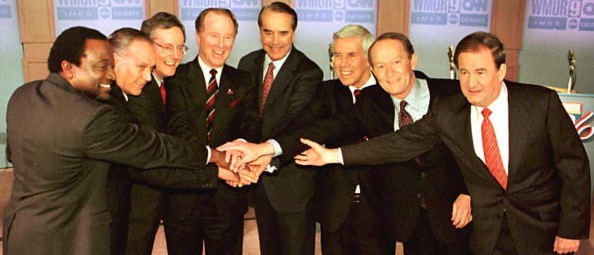
Republican leaders in 1996, including Bob Dole (center), Jack Kemp (to Dole’s right), and Patrick Buchanan (far right).

After spending several weeks in deep hugger-mugger at the Republican Party platform committee this summer, the leaders of the Right wing of the GOP emerged triumphant. Their deeply beloved and totally useless Human Life Amendment was reaffirmed. The obnoxious statement of “tolerance” for the opinions of those who disagree with the amendment was excised. Language about immigration, fair trade, the Second Amendment, and other issues important to the Right, religious and otherwise, was approved. The Washington Post, reporting on the adoption of the platform the next day, seemed ready to be taken off to a nice quiet place in the country to recuperate from its neurotic angst over the American Right and its victory. “The Republican platform committee today approved a statement of party principles closer in tone and emphasis to the nationalism and domestic conservatism of Patrick J. Buchanan than the party’s presumptive nominee Robert J. Dole,” trembled The Post‘s Thomas Edsall. And, for once, the general staff of the legions of the Right was in agreement. “This is very Buchanan,” beamed Bay Buchanan, Mr. Buchanan’s sister and campaign chairman. “We could not be more pleased. This is much more of a populist, conservative Buchananesque platform than we ever dreamed, to be honest.” Other leaders of the right like Phyllis Schlafly, Gary Bauer, and Ralph Reed concurred.


Well, since we’re being honest, the truth is that the conservatives got suckered, as some of them began to glimpse in the next few days when speaker after speaker ascended the podium at the Republican convention to avoid, contradict, or simply ignore the platform that had just been adopted. By the time Mr. Dole was officially chosen as the party’s leader, The New York Timesreported, some foes of abortion were mystified. “A lot of pro-life people are saying, ‘What’s going on here?'” whimpered one anti-abortion delegate, Mrs. Elaine Hawkins of San Antonio. “It’s like they’ve squished the issue out of existence. We know it’s there in print, but I don’t hear anybody talking about it.”

Nor was it only abortion that nobody talked about. “I haven’t read the platform and I’m not bound by it anyway,” Mr. Dole proudly announced to the press. The Post‘s David Broder reported the next week that “Dole, Speaker Newt Gingrich and party chairman Haley Barbour were comically eager to affirm that they paid the document so little heed they hadn’t even read it.” As for the central feature of the platform’s immigration plank, a resolution calling for a constitutional amendment or constitutionally valid legislation to end automatic U.S. citizenship for the children of illegal aliens born on American soil, former Rep. Vin Weber, a close adviser to Mr. Dole, let it be known that Mr. Dole simply didn’t support it. The Wall Street Journal‘s Al Hunt gleefully reported the next week that the party’s vice presidential nominee, Jack Kemp, was “horrified by the platform’s call to deny citizenship to children born in America of illegal immigrants.” By the end of the convention it was clear to everyone save those who wrap themselves in illusion that the conservative efforts to craft the party platform meant nothing. Inevitably, the lines of poet John Dryden crept into the mind: “All, all of a piece throughout: Thy chase had a beast in view; Thy wars brought nothing about; Thy lovers were all untrue.”

But actually something had been brought about. By engaging in the conflict over the meaningless platform, the conservatives allowed Mr. Dole to quell the incipient rebellion from the Right and to unify the party under his leadership. The convention began with Mr. Dole and the party establishment uncertain whether Pat Buchanan would endorse the final ticket or quit the GOP and run with Howard Phillips’ Taxpayers Party and thereby deny any possibility of victory in November to a party establishment that had ignored, insulted, and abused him and his 3 million supporters ever since he announced his candidacy. By the time the platform had been adopted, with considerable input from the Buchananites, that option was no longer possible, even if it had been desirable. By working with the platform committee, by writing a platform with which “we could not be more pleased,” the Buchananites and the Republican Right in general signed their own political death warrants, binding themselves to the party and the ticket, consigning themselves to political irrelevance, and ensuring that any walkout or rebellion they mounted thereafter would be universally regarded as simply one further confirmation of the fanaticism and sourness that their enemies habitually attribute to them.

If there was any doubt of the irrelevance of the Right to its own party, the selection of Mr. Kemp removed it. No other neo-conservative leader in the country commands as much of a political following (which is not to say that he necessarily commands much of a following), and no other major Republican leader is as much in thrall to neo-conservatism as a body of ideas and as an organized faction, as Mr. Kemp. Unable or unwilling to mount a campaign in the primaries, Mr. Kemp stayed out of the contest for the nomination and was widely regarded as politically defunct. His support for affirmative action in the face of the growing Republican and conservative consensus to abolish it; his support for NAFTA, the World Trade Organization, unlimited “free trade” in general; his foreign policy of global democratism; his enthusiastic and fiscally catastrophic attachment to Big Government, as evidenced by his enlargement of the Housing and Urban Development Department in the Bush administration; his bottomless zeal for supporting the full measure of civil rights laws and policies; and his fierce hostility to any suggestion of immigration control in the face of growing popular and intellectual disenchantment with immigration all placed him on the Left of the Republican Party and in bitter opposition to its Buchananite, America First, culture war, nativist, protectionist, populist, and new nationalist Right that actually entered the primaries and seemed for a while to be on the eve of victory. The choice of Mr. Kemp as Bob Dole’s running mate and the resurrection of the representative leader of a political persuasion and faction that has no tangible popular support outside the Beltway was a calculated kick in the groin to the Right by the party’s leadership, a kick to which the right, after its platform triumph, was unable to respond with the only weapon it had left, the threat of secession from the party; and if this ticket wins the race against President Clinton, its victory will almost certainly mean the political extinction of the kind of conservatism the Buchananite Right represents.

If the ticket wins, Mr. Kemp as Vice President will be positioned for his own race for the White House in 2000 and, barring a disaster in the Dole administration, will have the inside track to the nomination. Even if the ticket loses, it is not difficult to anticipate what the neo-conservative and even the liberal line will be — that Mr. Buchanan and the Right stuck the ticket with an “extremist” platform that simply frightened away mainstream voters, that the decrepit Mr. Dole was not supportive of Mr. Kemp’s pollygoggle policy-wonkism and refused to unleash his running mate’s bottomless genius, that Mr. Kemp was the unsung hero of the 1996 ticket and ought to be given another opportunity to crush the narrow-minded Mr. Buchanan and to redefine the American Right in his own generous Lincolnesque image. Win or lose, then, the real victor to emerge from the byzantine backstairs politics of San Diego this summer will be Mr. Kemp and his Beltway cabal, who will proceed to re-define the American Right in their own terms and to back up their re-definition with political power.

For the Buchananite Right, the Christian Right, the Old Right, the Hard Right, the paleo-conservatives, and the paleo-libertarians, that will mean political oblivion, the final disappearance of any serious hope of influencing American politics in a direction away from the gargantuan state and the state’s alliance with both overclass and underclass against the middle class, or in a direction toward dismantling the warfare-welfare state, controlling immigration, reversing the erosion of national sovereignty, withdrawing from the pursuit of a globalist-imperialist foreign policy, and restoring a Eurocentric cultural order. It is one thing to lose an election, but as long as the losers are able to define the opposition, they retain the possibility of eventual victory. It is another thing to lose the opposition itself, to allow not only the victors but the losers themselves to define the terms of debate and the rules of the game. That is what the election, and maybe even the defeat, of the Dole-Kemp ticket this year would mean — that it is not the real Right that defines the opposition and sets the framework of the political discourse but the fake Right the Dole-Kemp ticket represents.

Of course, the rank and file Republican and the average citizen who votes for this ticket against Mr. Clinton cannot be blamed for his choice. Supporting the re-election of an administration led by one of the most repulsive men in American political history, mottled with the gangrene of corruption and sexual license and emitting the stench of tyranny, is not a choice most decent Americans should welcome, regardless of their political beliefs. But the fact is that the re-election of Bill Clinton might just be better for the nation and the only political forces able to salvage it than the victory of Mr. Dole and his running mate. The evils of the Clinton era should not be the trump card by which a rival party, today almost indistinguishable from the Democrats in their basic worldview and policies, is allowed to win a rigged deal.

At least since the nomination of Dwight Eisenhower in 1952, the real Right in the United States has voted for the Republican ticket on the grounds that it was choosing the lesser of two evils, and every four years we hear the same refrain from the ticket’s apologists — that the country just can’t survive Adlai Stevenson, John Kennedy, Lyndon Johnson, Hubert Humphrey, George McGovern, Jimmy Carter, Walter Mondale, Michael Dukakis, or Bill Clinton. But the truth is that of course it does survive and that the victories of the centrist Republicans who are these villains’ foes never make any difference anyway. Conservatives, having worked themselves into a dither over the iniquity of the Democrats, fall for this argument in every election, and then, within a few years or a few weeks, are amazed to find that the centrist Republican candidates whom they have put in power have betrayed and ignored them once again. The argument that we just have to support the lesser of two evils to avoid destruction is merely a formula by which evil is perpetuated in power and men and measures that are not evil are driven into perpetual exile; if the real Right listens to the formula yet again this year, it may be the last time it will enjoy the opportunity to hear it.

Yet it may be that I exaggerate. Neither Mr. Dole nor Mr. Kemp is able to represent the social forces that are beginning to rally around the real Right that they managed to snooker at their convention this year, and it remains questionable if Mr. Dole’s endless rehearsals of his adventures in a war that ended more than fifty years ago and Mr. Kemp’s childish bubble-chatter about utopias of high technology, unlimited growth, and everybody getting rich will speak to the people whom Whittaker Chambers called “the plain men and women of the nation,” who see their material wealth, their communities, their nation, their people, and their civilization vanishing before their eyes. Even if they are still unwilling to embrace what the real Right offers and even if no such alternative is available to them, they may yet find alternatives in Ross Perot, the Libertarian Party, the Taxpayers Party, and other vehicles that are reasonable facsimiles and which come a lot closer than what the two “major parties” offer.

It may be, then, that what we saw in San Diego this summer and what we are seeing now in the race between Huey, Dewey, and Louie is simply the last gasp of a dying political system that is designed to ensure that no alternative and no challenge to the interests it protects can emerge. Unable to attract a mass political following on their own merits, those interests must advance candidates like Mr. Dole, Mr. Kemp, and Mr. Clinton, who offer the best counterfeits of the real Right they can concoct, and Middle Americans are increasingly biting hard on the currency they peddle to test its real value. It may be that the present two-party domination of national politics is now so exhausted that Middle Americans will soon emerge in their own party with their own agenda and consciousness unencumbered by the trivia and distractions of the major parties. But what ought to have become clear this summer is that that agenda and consciousness cannot be advanced by either the established leadership of the Republican Party or even by the party’s Right wing that allows itself to be swindled for a meaningless platform that the leadership despises.

This article was originally published in Chronicles Magazine in November 1996.

Thursday, August 9, 2018

Nationalism, True & False

                         By Samuel Francis


William Kristol, guardian of neo-conservatism.

Ruling classes exercise power through combinations of coercion and manipulation — what Machiavelli called force and fraud, or the habits of the lion and the fox that he recommended to princes who wish to stay in power. Like most princes, most ruling classes tend to be better at one than the other, and depending on their talents, interests, and psychologies, they will habitually rely on one style of domination more than on its complement. In the twentieth century, authoritarian and totalitarian regimes have rested their power on the use of force — to the point of what the Germans came to call Schrecklichkeit, or Terror pure and simple — but they did not fail to attend to the arts of manipulation as well. Communist brainwashing and the high science of propaganda that Joseph Goebbels perfected were perhaps as useful to their respective regimes and the ruling classes they served as the Cheka and the Gestapo.


Unlike European totalitarians, their American counterpart in this century has tended to rely on manipulation, which involves not only massive and constant indoctrination through the mass media but also the whole battery of techniques by which the population is managed to think and act the way the managerial ruling class wants it to think and act. Those techniques include the bread and circuses of mass consumerism and the entertainment industry as well as the blunter ideological disciplining delivered every night on television and in most Hollywood films. Of the two styles of power, reliance on manipulation is probably more effective, and certainly more economical than reliance on force. Every shepherd knows it’s more expedient to train a sheep dog to keep the sheep in line than to run after every beast that strays from the fold himself, and every ruler or ruling class understands that the means of force are always finite while the means of manipulation are virtually inexhaustible. You might sooner or later run out of bullets, but there is no bottom to the pit of delusion to which a populace eager to be enslaved will consign itself.

The reliance of the American managerial class on manipulation rather than force explains why dissidents are not simply rounded up and imprisoned or shot as they were in the sister regimes in Europe, as well as why the victory of the new elite in the middle of the century was so peaceful and virtually invisible to all but keen observers like James Burnham, C. Wright Mills, Garrett Garet, and a few others. Instead of being repressed, opponents of the revolution were either ignored and marginalized or in some cases rewarded and thereby digested within the belly of the beast. Even the hare-brained bomb-throwers of the New Left were not for the most part seriously subjected to coercive repression, except perhaps by local and state police agencies that had not yet been “sensitized” by the regime’s federal law enforcement apparatus, but rather were coddled, rebuked, and generally ignored until they grew up. Within a decade of their prediction of the storm of revolution that was about to descend on the ruling class, most of the more grotesque spokesmen of the Weather Underground had become dentists, insurance salesmen, and big-city lawyers, and the intelligence, security, and law enforcement branches of the regime never paid as much attention to the Weathermen, the Black Panthers, or the various Maoists, Guevarists, Trotskyites, and anarchists of the period as they are today paying to perfectly law-abiding and patriotic militias and grassroots activists of the Right.

Today, the regime is paying as much attention to the militant Right as it is for a simple reason — the means of manipulation is beginning to crumble as the official ideology of the regime is discredited and rejected, and as alternative means of communication become available that the ruling class is unable to control. Computers, faxes, the Internet, and other technologies allow dissident groups to flourish and communicate with each other in ways that were not available to dissidents of an earlier day, and all of these technologies are (so far) virtually independent of both the police power and the manipulative reach of the regime. Hence, incidents like Waco, Ruby Ridge, and similar acts of coercive repression become necessary to discipline the opposition, our very own form of Schrecklichkeit, and the emerging federal police state, with the help of semi-private intelligence-gathering arms like the Anti-Defamation League and the Southern Poverty Law Center, can be expected to offer at least as thorough use of coercion as the secret police of the European dictators.

Nevertheless, the ruling class is not stupid, and it knows very well that it cannot sit on bayonets forever. Therefore, it is rather clumsily trying to patch together new means of manipulation before the whole society spins out of its control. President Clinton and the “New Democrats” are the left side of this effort, while on the Right what is generally known (at least among paleo-conservatives) as “neo-conservatism” is its right side. Both are essential to preserve the illusion of political and ideological alternatives and the shadow of freedom, but any close examination will show that there is about as much real difference between them as there was between the Dole-Kemp ticket last year and its rival.

The Clintonian effort at keeping the sheep of the Left within the herd seems to have been successful, at least for now, but on the Right there are problems. Unlike the Left, the Right has actually produced a real and politically significant alternative to neo-conservatism in the Buchanan movement and in paleo-conservatism, or what may be called the “Hard Right” in general — ranging from this magazine to groups like the John Randolph Club and a variety of grassroots activists over to the militias and their constituencies. The problem for neo-conservatism is that most Americans on the Right don’t buy what it’s selling, don’t look to it for political or ideological leadership, and won’t swallow the managerial conservatism that it has formulated and made the dominant expression of the Right over the last twenty years or so.

Well, what is to be done? If at first you don’t succeed, try again. In the last few months, the current crop of neo-conservatives has been trying to sprout a new ideological line, one that might reasonably be expected to capture the Populist Right, assimilate it within the digestive tract of the regime, and thereby ensure that it does not eventually produce a movement or a leader that can seriously challenge its power.

The new form into which neo-conservatism is trying to cast itself is “nationalism,” and its guiding spirit is William Kristol of the Weekly Standard. Nationalism, of course, also happens to be the theme of most of the Populist Right, whether it is directed against immigration, which threatens to extinguish the actual people of the nation, or free trade and globalism, which threaten both the economic interests and sovereignty of the nation, or the multiculturalism and multiracialism that neither the mainstream (i.e., dominant) Left and Right now question seriously. Hence, it makes sense that the high priests of the dominant Right would seek to reinvent nationalism and redefine it in terms that will offer no serious challenge to the anti-national forces they really represent.

Mr. Kristol’s main formulation of neo-con nationalism appeared in an article in the Wall Street Journal (September 15), of which he and his colleague at the Weekly Standard, David Brooks, were the co-authors, and Mr. Brooks himself has busily been pounding the pseudo-nationalist drum for some time. In the last few months he has published articles in the Standard praising Teddy Roosevelt as a hero for conservatives and the architecture of the Library of Congress as the expression of what he takes to be high nationalism. One can quibble with either or both, but the kind of nationalism he and Mr. Kristol are trying to sell would have little appeal to Roosevelt, and seems not to have penetrated very far into any library at all.

Their proposed models for the new neo-con nationalism include not only TR but also Hamilton and Henry Clay. “American nationalism,” Kristol and Brooks write, “– the nationalism of Alexander Hamilton and Henry Clay and Teddy Roosevelt — has never been European blood-and-soil nationalism. It’s true that in the absence of a real appeal to national greatness, some conservatives are tempted à la Pat Buchanan, to turn to this European tradition. But this can’t and shouldn’t work in America. Our nationalism is that of an exceptional nation founded on a universal principle, on what Lincoln called ‘an abstract truth, applicable to all men and all times.'” It is no accident that these also happen to be among the very figures that Pat Buchanan has cited as exponents of the economic nationalism that has been the norm throughout most of American history.

This pretty much tells us all we need to know about the Kristol-Brooks school of nationalism. It’s a nationalism that takes the main advocates of a centralized state as its heroes but leaves out of its picture of “national greatness” any reference to the real nation — its people (blood), its land (soil), its interests, or its contemporary manifestations (in Buchanan and his following, which happens to be rather larger than that of the Weekly Standard). What is objectively wrong with the Kristol-Brooks version of nationalism is what I argued some years ago was wrong with the Hamilton-Clay-Lincoln version of it. Designed essentially to represent the material interests of a particular section (the commercial and industrial Northeast), it always remained merely an instrumental nationalism, designed simply as an instrument or tool to unify the real nation under the dominance of that section and its interests by masking them as “nationalism.” It failed — neither Hamilton nor Clay was able to make it prevail, and Lincoln and his party succeeded only because of the power vacuum generated by the Civil War — because it ignored the interests of the real nation. It is one thing to endorse the economic and trade policies of these leaders, as Buchanan does (and which Kristol and Brookes don’t), but those policies can be and are justified apart from the general vision of the state and nation that Hamilton, Clay, Lincoln, and Roosevelt I entertained.

The content of the phony nationalism formulated by Kristol and Brooks is enough to tell us how it differs from the kind of organic nationalism that is actually emerging in the Populist Right, the kind they seek to smother in its cradle. “Our pride in settling the frontier, welcoming immigrants and advancing the cause of freedom around the world is related to our dedication to our principles” — the universalist nationalism of Lincoln.

That’s why American nationalism isn’t narrow or parochial. It doesn’t believe in closing our borders or fearing the global economy. It does believe in resisting group rights and multiculturalism and other tendencies that weaken our attachment to our common principles. It embraces a neo-Reaganite foreign policy of national strength and moral assertiveness abroad. It would use federal power to preserve and enhance our national patrimony — the parks, buildings, and monuments that are the physical manifestations of our common heritage. And it insists that while government should be limited, it should also be energetic.

So, neo-con universalist nationalism is to support continued swallowing of the real nation through mass immigration and continued extinction of the national economic interest through immersion into the “global economy” and to reject multiculturalism, not because it threatens the destruction of the cultural nucleus of the real nation, but because it weakens attachment to “our common principles” — i.e., multiculturalism asserts the particular cultural identities of the groups that espouse it against the universalist principle that informs neo-con nationalism. Like the Hamiltonian instrumental nationalism, it also envisions an “energetic” national state (so does any nationalism that ignores the real nation; since it refuses to affirm the real people or the nation and their real interests, it has no other base of support than the state), at least to become a kind of super-janitor for public buildings and public parks. What is conspicuous by its absence in the Kristol-Brooks vision of nationalism is any reference whatsoever to the Constitution as both the limiting and energizing framework of the national state.

Nor is it an accident that only a few weeks before the Kristol-Brooks discovery of the strong-state nationalism of Hamilton and his heirs, George Will also dropped a column in which he told us, “The challenge is for conservatism to find a place in its pantheon for three great nationalists — Alexander Hamilton, Henry Clay and Theodore Roosevelt.” For Mr. Soulcraft, the invocation of these three as heroes is not surprising, though the occasion and the timing of his column are of interest. The occasion was the Weekly Standard‘s symposium in August on the “Conservative Crack-Up,” and both the Will column and the subsequent Kristol-Brooks piece in the Journal were first shots in the new effort to formulate an ideology for the Right that can manipulate, seize control of, and eventually castrate the radical nationalism of the Populist Right today and at the same time preserve the managerial state constructed in this century by claiming that it is the natural legacy of the pseudo-nationalism of Hamilton, Clay, and the first Roosevelt.

It’s doubtful that the nationalist Right will be deluded by the Kristol-Brooks-Will counterfeit. Populist nationalism, if not quite of the blood-and-soil variety, at least proceeds from a more authentic grasp of the organic life and people of the real nation than theirs, and most of the more serious exponents of the nationalism of the Populist Right have long since come to reject the unmitigated statism and globalism that lie at the heart of the neo-conservative agenda. The Right wing of the managerial class will have to come up with a means of ideological manipulation that is a bit more subtle and a lot more persuasive than either the defunct neo-conservatism of their parents or the stillborn neo-nationalism that the Weekly Standard has invented. Until it does the regime on which the American ruling class rests will continue to crumble.

This article was originally published in Chronicles Magazine in December 1997.

Wednesday, August 8, 2018

What Did the Founders Mean By "Liberty"?

                           By C. B. Robertson


If there is a singular, inarguable principle that lies at the heart of America, it is liberty. The “Statue of Liberty” is perhaps our most iconic landmark, and the “Liberty Bell” in Philadelphia is one of our oldest national symbols. There are more High Schools called “Liberty High School” than seems reasonable. And of course, it is acknowledged in our founding document, which lists securing the “Blessings of Liberty” as the final intended goal of the new government.

But like many words, “liberty” suffers from a plethora of definitions. It can be either an absence of something—i.e., the state of freedom from oppression, restrictions, or rules—or it can be the presence of something—i.e., the possession of “liberties,” often in the form of rights. The former is inherently subjective, while the latter is highly contextual, making the use of the word “liberty” a slippery business, particularly when it pertains to law and government.

As perhaps could have been expected, the term has been seized by Libertarians and Liberals, who emphasize that liberty means nothing if not freedom for the individual. While intuitive to the modern ear, this understanding is neither the only possible understanding of “liberty,” nor is it what the Founding Fathers meant by the word.

Consider, by way of explanation, one of the most favored quotes among American Patriots. Benjamin Franklin famously said that “[t]hose who would give up essential Liberty, to purchase a little temporary Safety, deserve neither Liberty nor Safety.” This assertion is interpreted as an embodiment of the American attitude which puts liberty (presumably of the individual) above safety (presumably of the collective) in nearly absolute terms.

The only problem is that in context, this famous quote means almost the exact opposite.

The quote comes from a letter written in 1755 by Franklin as a representative of the Pennsylvania Assembly. The letter was addressed to the Governor, whose loyalty seemed torn between the people of Pennsylvania and the proprietary family (the descendants of William Penn), who in fact lived outside of the province but owned a great deal of land there. Recent conflicts with Natives during the French and Indian War required more military supplies and protection along the border regions, which in turn required raising taxes to fund these common defenses. The only problem was that the proposed method of raising these taxes would have taxed the Penn family’s lands. This is what is alluded to earlier in the letter when Franklin writes:

Indeed all Bills for raising Money for Publick Use, are so far of the same Kind; but this differs greatly from every former Bill that has been offered him, and all the Amendments (of any Consequence) which he proposed to the Bill he last refused, are in this Bill admitted, save that for totally exempting the Proprietary Estate.

The famous quote itself is preceded by an explanatory statement of the predicament the Pennsylvanians faced what they had done so far to protect themselves, and the limitations they would face in preceding further without the land-taxes they are requesting:

In fine, we have the most sensible Concern for the poor distressed Inhabitants of the Frontiers. We have taken every Step in our Power, consistent with the just Rights of the Freemen of Pennsylvania, for their Relief, and we have Reason to believe, that in the Midst of their Distresses they themselves do not wish us to go farther. Those who would give up essential Liberty, to purchase a little temporary Safety, deserve neither Liberty nor Safety.

“Liberty” in this context refers to the freedom of the citizens to govern themselves and to pass laws as a collective. It is the freedom of the group, and not of the individual, which Franklin is appealing to. In fact, it appears that the freedom of the individual—the governor, that is—was the problem, as Benjamin Wittes of Lawfare and the Brookings Institute explains:

What’s more the “purchase [of] a little temporary safety” of which Franklin complains was not the ceding of power to a government Leviathan in exchange for some promise of protection from external threat; for in Franklin’s letter, the word “purchase” does not appear to have been a metaphor. The governor was accusing the Assembly of stalling on appropriating money for frontier defense by insisting on including the Penn lands in its taxes–and thus triggering his intervention. And the Penn family later offered cash to fund defense of the frontier–as long as the Assembly would acknowledge that it lacked the power to tax the family’s lands. Franklin was thus complaining of the choice facing the legislature between being able to make funds available for frontier defense and maintaining its right of self-governance–and he was criticizing the governor for suggesting it should be willing to give up the latter to ensure the former.

To summarize, the Pennsylvanians sought the “liberty” of self-governance through raising taxes on everyone via the provincial government. This conflicted with the “safety” of the proprietary family and the provincial governor representing the proprietary family’s interests.

Of course, we can reach this conclusion about intended meaning of “liberty” through the Declaration of Independence itself, which cites as its very first complaints how the King of England has “refused his assent to laws, the most wholesome and necessary for the public good,” and has variously prevented the Colonists from being able to govern themselves. It would not be overstating things to say that the colonists were not complaining about an excess of government so much as they were complaining of a lack of effective government. This absence of government, not its oppressive presence, was the impediment to liberty and prosperity which our Founding Father fought a war to do away with.

The Founding Fathers were not libertarian individualists. We know this from the fasces they adorned their buildings with, and we know this from their acknowledgment of differences between groups—something which leftists hold as evidence of racism at the very beginning of American history, but which also applies to distinctions between white groups. Benjamin Franklin himself, incidentally, held reservations about the Germans in particular:

Why should Pennsylvania, founded by the English, become a Colony of Aliens, who will shortly be so numerous as to Germanize us instead of our Anglifying them, and will never adopt our Language or Customs, any more than they can acquire our Complexion.

But most importantly, we know this from their statements about Liberty in our founding documents. Loving liberty does not require one to be an individualist, as an American or in general. To the contrary, the Founding Fathers understood that organizing around the collective interests of the group, rather than those of the individual, is the best way to achieve the most liberty.

Conservatives are the Real Anti-Whites: Dinesh D'Souza's Death of a Nation

                         By James Dunphy


Going to the movie theater is a religious ritual of sorts for me. My soda is my wine, and the dehydrated corn kernels accented with sludge are my wafers. They are a debauched communion. The largely Jewish-controlled entertainment industry is my church, and on this occasion, D’Souza was my minister. I received a typical sermon telling me that Jews died for my sins of ethnic identity. Like a good goy, I gave my offering to the teenager in the ticket booth beforehand, and she provided me with a program. Fortunately, I didn’t have to sing or follow along like I would with a church hymnal. I simply plopped down in the seat to which it directed me. I simply had to be a receptive, dumb audience member.

Okay, enough of that overdrawn analogy.

Neoconservative Dinesh D’Souza’s new film, Death of a Nation, is another crazy, illogical propaganda piece. However, it got me to think a bit, and I hope the following review will get the reader to think as well.

Summary

The film begins with an overview of Trump’s 2016 victory, where we see many Leftists accusing Trump of being a fascist. D’Souza has a new task: to prove that Trump isn’t a fascist and that the Democrats are the real fascists.

For D’Souza, the Democrat Party today is 100% responsible for everything that people in the party did from its inception, including supporting slavery. We might call this permanent institutional culpability. No matter how much the institution’s ideals, practices, and people change, it is always fundamentally the same thing, in D’Souza’s mind. The Republican Lincoln prevented the Democrat Party from enslaving blacks. The Republicans also created the Freedman’s Bureau to help the blacks. While this institution did many things that LBJ’s Great Society and Roosevelt’s New Deal also did, it wasn’t bad because, for D’Souza, only the Democrat Party can be bad. When the Democrat Party doles out aid, it is enslaving people and making them dependent on the government. When the Republican Party does it, it’s helping them to escape slavery. This is D’Souza’s crazy logic.

According to D’Souza, the Democrat Party then substituted progressive ideology for slavery so it could control people on a society-wide level rather than only on plantations. D’Souza’s contention that the slaveowners conspired to become progressives is laughable. He cites no evidence for it whatsoever.

Many progressives admired Hitler, a fact which D’Souza emphasizes. The actor who plays Hitler in the film, Pavel Kříž, is a Jew and looks like a Jew, having a leptorrhine nose, a half-circle skin fold on each side of his mouth, and bulging eyes. He and other National Socialist characters angrily shout all their lines and generally behave like thugs. Indeed, the Old Right was very mafia-like in some ways, and D’Souza is all too happy to show us this. He shows footage of antifa violence and claims it’s “just like the Nazis,” as further proof that the two are somehow the same.

Progressives were eugenicists. Eugenics, for D’Souza, is inhumane and evil. He doesn’t give a reasoned explanation for why this is the case, but rather shows us a horror-film caricature of it, conflating it with Mengele’s experiments.

It’s popular in Conservatism, Inc. to ridicule George Soros, a current Leftist supervillain, for having pretended to be a Christian and worked on behalf of the Nazis to assess the value of properties that were confiscated from Jews in Hungary during the Second World War. For D’Souza, this was a shameful act. However, it’s interesting that Soros’ father paid someone to take him in so that he could survive in secret. Jews have no problem with offering bribes and using crypsis when they feel threatened. It also reminds me of how Greg Johnson has quoted the Bible passage where an ancient Hebrew reduces the odds of his family being wiped out by sending some of his kin as hostages to a clan that is threatening to invade so that, if and when the clan attacks, at least some of them will survive. Maybe Soros’ father was following this idea.

D’Souza links fascism with socialism. The young Mussolini indeed believed in socialism, but recognized that workers would never unite across the world in the way Marx believed they would because of their ethnic and national allegiances, so he created the concept of Fascism, which combined nationalism with socialism. D’Souza claims that fascism is bad because of its alleged socialistic inspiration. He also claims that adherence to one’s ethnic identity causes nations to collapse from within. Hence the title, Death of a Nation, which is a play on the title of D. W. Griffith’s Birth of a Nation, which was instrumental in getting the 1924 laws restricting immigration into America passed. Speaking of immigration, he admits that nations can collapse from external forces as well, but glosses over that bit, for obvious reasons.

D’Souza attempts to debunk the notion that Nixon developed a Southern strategy to get the votes of segregationist whites in the South, but I dozed off during that part. (I mean, it was a boring film.) To make up for it, I watched a few videos of D’Souza talking about the subject. He claims that most blacks switched from the party of Lincoln to Roosevelt’s New Deal party for the welfare benefits, but he never explains why Southern whites switched to the Republican Party following the introduction of LBJ’s Great Society. Regardless, to prove that Democrats are the real fascists, he feels he must deal with the issue.

I perked up when the film mentioned the Alt Right. He interviewed Richard Spencer. Spencer tried to answer his questions honestly, but D’Souza was not interested in an honest discussion. It’s clear D’Souza was simply trying to entice soundbites out of Spencer to make him look like a cookie-cutter economic Leftist. This would make it easier for the audience to write him off. He followed this with a clip of Spencer saying he supports national healthcare. D’Souza’s message is thus that Spencer, Hitler, progressives, Democrats of all eras, and modern-day Leftists are all the same because they want to enslave humanity in various ways. The film was brusque in its treatment of the Alt Right but correct in asserting that Trump is not like Spencer and the Alt Right. Indeed, Trump is a civic nationalist, who simply happens to be better from an Alt Right perspective than any of his opponents were.

D’Souza then tries to cast pro-whites as anti-Christian, citing how Hitler allegedly secretly believed that the religion undermined the German people. D’Souza offers we goyim a Christian role model: Sophie Scholl, who distributed pamphlets calling for resistance against the Nazis in the Third Reich, citing Bible verses as support. The Nazis executed her for her dissent. D’Souza’s message is thus that pro-white advocates are out to get Christians in a similar manner.

Apart from this, there is a lot of emotional music in the film and several lyrical performances, one of them by black gospel singer Angela Primm, who sings in a church as the camera cuts to various scenes of iconic American cities and landmarks. Her singing consisted of nothing more than low-IQ clichés, but the Americana scenes were nice.

The overall message was that Democrats are the real fascists, and thus we goyim have nothing to regret in supporting Trump. Indeed, we’re as kosher as can be.

My Take

Let’s analyze D’Souza’s claim that Democrats are still slaveowners. One could see how a modern Catholic apologist like D’Souza would ascribe institutional continuity to Democrats because the Catholic Church, as recently as a century ago, taught that all non-Catholics went to Hell and that even a lot of Catholics were going to Hell. Nowadays, they teach that everyone goes to Heaven. This is a fundamental change, yet the Catholic Church sees itself as being the same institution. D’Souza strains to find similarities between the Democrats of yore and modern ones. I must say that despite all its changes, the Catholic Church has changed less since the early twentieth century than the Democrat Party has since the mid-nineteenth century. Believing in the Catholic Church’s continuity is thus not as much of a stretch as believing in the Democrat Party’s.

Regarding D’Souza’s claim that the Alt Right has a lot in common with twentieth-century fascism, I’m probably the wrong person to consult on the matter. Plenty of Counter-Currents writers can offer great commentary on that. I will say that one thing modern White Nationalists have in common with the progressives of yore is in the notion that society is broken. Just as progressives believed that government needed to intervene to make the world a better place, today White Nationalists believe that governments have a role to play in stopping immigration, as well as the white fertility rate from continuing its frightful decline toward extinction. They also believe that governments can be useful in stopping miscegenation and establishing white homelands. White survival is more important than – to paraphrase Greg Johnson – the freedom and livelihoods of the brown people who will replace us.

Most White Nationalists believe that a nation shouldn’t have dysgenic fertility, or a situation where less intelligent and criminally-inclined people outbreed smart, law-abiding people. To stop this, we can simply engage in positive eugenics where we incentivize smart, stable people to have more kids while not resorting to the sterilization of anyone. But only government can make this happen.

White Nationalists aren’t scary people who want to hurt others, nor do they scream and shout all the time like the Nazis in the film. Stupid people tend to be loud. Thus, African-Americans, 85% of whom have an IQ below the white average of 100, tend to be very loud. Whites aren’t nearly as loud on average, and doubtless the National Socialists weren’t, either.

D’Souza acknowledges that George Soros, a Jew from Hungary, and Tom Steyer, who is a Northeast WASP/Jewish hybrid, fund many Leftist groups. Nevertheless, Jews as a group are beyond reproach for him.

Concerning D’Souza claim that a nation which adheres to a particular ethnic identity collapses from within, this is certainly not true of racially homogeneous nations. It is only a problem in multiethnic ones, where several ethnic groups vie for power. And it’s especially a problem when one group dominates another. South Asians like D’Souza don’t dominate whites. I estimate that there are 6 to 7 million South Asians in the US. South Asians are therefore 2.2% of the American population. They are about 1.8% of US billionaires, or 11 out of 585. Whites are equally likely per capita to be billionaires. They are 60% of the US population but around 58% of all billionaires, or 339 out of 585.

Despite only being as numerous as South Asians, Jews are 35% of all US billionaires, or 204 out of 585, making them 16 times more likely to be billionaires than either South Asians or whites. Lest one think this is merely a quirky phenomenon pertaining to billionaires, according to a surname analysis of zip codes cross-referenced with the income levels of residents, Jews make up a quarter of the 1%, and a tenth of all US millionaires. That’s what D’Souza is arguing for in his film. He’s arguing for maintaining an oligarchy split between Jews and others, but which includes Jews as an incredibly privileged minority. That, for him, is freedom.

D’Souza neglects to mention that Jews were even more privileged in Weimar Germany. One pamphlet claims that in Berlin during the Weimar era, Jews were half of all doctors, lawyers, and medical teachers, a third of chemists, and a quarter of teachers in non-medical schools. They were similarly powerful in business, having made up 58% of those involved with commerce, and far more likely to own companies. Jews seem to inevitably reach a point in any white nation where they share power with whites in an oligarchy. They use this power to undermine and ridicule the culture of whites. When poor whites get tired this, they say to rich whites, “Jews are an alien group occupying positions of power that could be yours,” and then both rich and poor whites team up to expel the Jewish component of the oligarchy. Usually all they do is expel them, but unfortunately, as happened in Nazi Germany, sometimes they are killed. This trend of Jews cozying up to a white elite, wearing out their welcome, and eventually being expelled has been repeated countless times throughout history, dating back to the early medieval period. This is why Jews and whites should always live in separate nations, for the betterment of both.

D’Souza admits that nations also collapse due to external forces. However, he doesn’t admit the glaringly obvious fact that immigrants are causing white America to collapse. Since 2000, the Republican Party has remained 88% white, despite non-whites increasing by 45% during the same period. It is simple math to project that the more non-whites there are, the more the modern Democrat Party will gain power. This is what everybody who’s not selling snake oil believes. This is also why so many whites turned out for Trump. They know they’re on the edge of oblivion, and they want Trump to save them. D’Souza side-steps this question because he knows that non-white immigrants are on the rise, and he hopes that even they can be persuaded to vote Republican. Nevertheless, even non-white Republicans can breed whites out of existence.

D’Souza is not like most non-white immigrants. He is the reverse of Charles Stuart (1758-1828), a white officer in the British East India Company who adopted Hindu culture and earned the nickname “Hindoo Stuart.” Stuart bathed in the Ganges River in Calcutta every morning, amassed a collection of Hindu deities and icons of worship, wore Indian clothes, and praised the ways of Indian women, whom he regarded as more sensible, simple, and elegant than Western women. Most white people who sojourned in India during the British East India Company’s reign did not do as Stuart did, and most non-whites in America will not do as D’Souza has. They will not adopt white religion, political ideology, or societal conventions. They will follow their innate sensibilities, which differ strongly on average from the white average. They will not be “white D’Souza.”

At the beginning of the film, D’Souza admits that he came to America not because of its laws, but because of its people, who according to him are hardworking and individualistic, and yet affirming of their immediate family. I guess they were better than the population of India, where the average IQ is 82 and the population is completely non-white, lazy, and nepotistic.

The country D’Souza likes so much was 80% white when he arrived in 1978. Anthropologist Geert Hofstede devised an individualism index, where he scores Western European nations as the most individualistic. Sociobiologist Kevin MacDonald claims whites emphasize the nuclear family more and their extended family less than other groups, and that this inclination goes back to formative years in the Paleolithic. It’s time for D’Souza to admit that he came to America because of white people.

Regarding Christianity, it’s true that many whites are Christians, but they have more to fear from Jews than they do from White Nationalists. Jews were instrumental in getting prayer taken out of public schools. White Nationalists, meanwhile, are either indifferent to or supportive of it. Jews lobbied to get gay marriage passed and want to force Christians to bake gay wedding cakes. White Nationalists are in fact probably more tolerant of homosexuality than the average Republican, but they don’t seek to celebrate it for its own sake, and instead encourage homosexuals to become supporters of their race rather than fall for the Jewish agenda.

I identify as a Christian. The editors of Counter-Currents tolerate me and my beliefs. In fact, they have a Good Friday Special every year. I’m planning on writing an article for the next one, explaining how Jesus had a white personality in many respects, and how he deviated strongly from the Middle Eastern norm. I could never write that article for another publication, not even any “conservative” one, because the Jews would lobby to have me dismissed from the publication for writing it. So it’s clear that there is a place for Christians in a white movement and a white ethnostate.

America means something to D’Souza. It means something to me as well, but something different: it should be a place where whites can survive and flourish for generations to come. A white ethnostate is my America, wherever it happens to be, and I’m a little more frank about the race I like.