Thursday, January 10, 2019

Christopher Donovan On Heavy Metal

                    By Christopher Donovan


Implicit whiteness, with pyrotechnics: Or, the night white people took over Washington, DC

The other night I saw AC/DC at the Verizon Center in Washington, D.C.  For those out of the know, AC/DC is an aging Australian hard rock band (founded 1973) famous for thundering, simple-themed songs that revolve around alcohol, women, and rock.  Its guitarist, a pale, slight Scotsman named Angus Young, is known for performing while wearing a British schoolboy uniform (jacket, tie and shorts) which he sheds (except for the shorts) mid-concert and duck-walks the length of the stage with sweat and hair flying.

Of the thousands of human beings packed into the arena, I did not see a single non-white face.  They may have been there, but in numbers that can only be described as statistically insignificant.  They were working-class class whites, for the most part, spanning a range of ages, with the occasional obvious yuppie-with-a-black-T-shirt-for-the-occasion thrown in.

The swarms of whites did not go unnoticed by the smaller crowds of blacks orbiting the Verizon Center that night.  They seemed slightly alarmed by the rugged whites, many of whom sported Celtic cross tattoos, Germanic cross T-shirts, and other signs of what psychologist Kevin MacDonald calls “implicit whiteness.”  Some taunts were thrown in our direction by a group of black girls, and one black man was prompted, for reasons I could not discern, to bellow “suck my d***.  Suck my big black d***” for all to hear.

The only blacks who interacted with whites were ticket scalpers, whose activities were ignored by the all-black police force on the scene.

Inside, the concert was an electrifying spectacle of deafening anthemic rock that drove the crowd nuts.  Smoke, lights, a giant inflatable “Rosie” (you had to be there) and, for the finale song of “For Those About to Rock, We Salute You,” six full-sized battlefield canons were wheeled onto the stage and blasted at the appropriate moment.  Women wore flashing devil horns, which went nicely with songs like “Hell’s Bells” and “Highway to Hell.”

I had a blast.  But the pro-white observer in me could not help but play field anthropologist at the same time.  Here I was, in the thick of thousands of whites, all communing, if you will, around what was essentially a pagan convergence.  The same folks who heaped hatred on Sarah Palin could not have been much more comfortable with this panorama:  a sea of white males all thrusting their fists in the air and yelling “oi!”, and the occasional buxom white woman — probably a non-feminist — gyrating with glee.

I am sure that conservative Christian whites would not have approved of much of it.  But if we as whites are looking for what works, we should not overlook the “Viking” whites as an element of healthy, vigorous white life.  They like the beer, the fighting and the sex.  Properly directed, this is what a race on the survival track does.

In considering it further, I decided that the real function of AC/DC’s music is to whip up whites for war and male fertility.  Again, these aren’t bad things for a race declining in numbers and influence across the Western world.  And it all operates free from the scrutiny of the SPLC and other “hate hunters”, because it’s just too attenuated from anything explicitly pro-white (this explains why the criticism of “Lord of the Rings” as “racist” wasn’t taken seriously by anyone — though it was certainly accurate).

I have heard that at shows by another hard rock band, Pantera (with which I’m totally unfamiliar, except to know that they are not a skinhead or “white power” band), the implicit slips into explicit with occasional yelps of “white power”!  Good.  The more of this, the better.

There is a wonderful mystery to the dark forests of our European ancestors — the sprites, the gnomes, the elves, the swords, the axes, the knights, the maidens, the witches and warlocks, the war-party bonfires.  It’s a bottomless lake for the white imagination, and I am sure that an experience like an AC/DC show taps into it.

Whatever is going on, whites show up, in large numbers, ready to rock.  That’s about all we need, if you think about it.

Source: The Occidental Observer, November 18, 2008

Saturday, January 5, 2019

How Power Invented Individualism

                       By James Lawrence 


The recent online debates between Alt Righters and various classical liberal dissidents have resulted in a a string of victories for our side. In fact, the opposition has at times appeared too flimsy to be taken seriously. Carl Benjamin (Sargon of Akkad) has been ridiculed for nitpicking his way through his debate with Richard Spencer, then responding to criticism by placing the paper crown of the ‘liberalists’ upon his head; and even the more erudite Tarl Warwick (Styxhexenhammer666) could do little more than throw ‘what ifs’ at Greg Johnson’s case for an ethnostate. 

But the question underlying these verbal catfights could not be of greater importance. We and our debating opponents both know that the Left has worked itself into a toxic cultural revolution from which it can no longer back down, and that this is generating a massive public backlash against it. The question, then, is whether this backlash will give rise to a truly viable reaction against the forces destroying the West – or whether it will end up in a miserable and futile Ghost Dance of liberalism, the very ideology that brought us to this point in the first place. Sargon/Benjamin deserves serious attention not because he is a serious thinker, but because he is an archetype of the seriously deluded Westerner, who sees how the Left wields and justifies its tyranny and still concludes that the only remedy is a double dose of liberalism.

Indeed, for him and his fellows there can be no other remedy, least of all the resurgence of national identity offered by the Alt Right. Liberalism has sired different visions of society, but the single trunk of all its branches is individualism, which demands the primacy of the individual and his rights, interests and freedoms over all social collectives. In earlier days, this appeared to be quite compatible with national identity, and there are those in the Alt Right who would like to make it so again. However, as individualism has dispensed with initial compromises and progressed to its logical conclusion of denying all ‘collectivism’, such a reconciliation has become impossible.

Autonomous and self-interested individuals might coalesce into a voluntary club, a political faction like the ‘liberalists’, or a social-contract state garlanded with civic patriotism. But such a group is a mere cipher for individuals, or in other words, a collective means to individual ends – and is thus easily opened up to free entry by outsiders, defection by its members, and even dissolution in the event that the group outlives its usefulness. The Alt Right rejects any attempt to define the ‘true nation’, or ethnos, in this way. It conceives of this nation in fundamentally non-liberal terms: as an end in itself, defined by collective traits that are not subject to individual choice, and imposing obligations on individuals who neither founded it nor can ever dissolve it.

As the Alt Right takes the nation as its end, and our liberal opponents take the individual, both sides have spent most of the online debates talking past each other. Alt Righters are genuinely bemused at the mindset of these people, who obsess over individual rights while the barbarians are swarming through the gates. They argue that individualism is an unaffordable luxury in a society full of cohesive foreign tribes. But no such argument can disprove anything that is believed to be an end in itself – as the Alt Righters themselves go on to prove minutes later, when they are reminded of the many practical difficulties standing in the way of an ethnostate, and respond that they would move hell and high water to achieve it anyway.

As we shall see, things are not quite equal here. But we must try to step back from this awkward and unproductive duel of sacred cows, and try to take up a wider perspective. Such a perspective is furnished for us by Bertrand de Jouvenel’s work On Power, a ‘natural history’ of state expansion, which also has much to say about the origins of the liberty prized by the liberal individualists.

The thesis of de Jouvenel is that Power – a term that refers to central state authority regardless of its political form – expands itself to the detriment of the social order, by making alliances with the lowest classes against the intermediate social authorities that are capable of regulating Power. By ‘social order’, de Jouvenel means the capacity for a society’s members to regulate their own conduct through customs and traditions. Power, originally set up as a guardian of this order, breaks its leash by turning upon it and becoming a subversive force.

‘Intermediate social authorities’ refers to what de Jouvenel calls aristocracies – those groups or classes that hold social power outside the state, and thus have a vested interest in conserving social order and restraining the expansion of Power. This role was last played to significant effect in the West by the bourgeoisie; but this class, bound as it was to the socially-destructive forces of capitalism, was only ever a half-hearted and Janus-faced replacement for the traditional nobility.

The high-low alliance against the middle was represented in antiquity by the alliance of the tyrant and the mob, which culminated in Caesar’s overthrow of the Roman Republic in the teeth of aristocratic opposition. Long after the centralized Roman state had collapsed into a feudal social order overseen by a weak and regulated Power, the same dynamic reappeared at the twilight of the Middle Ages, as kings consolidated their power at the expense of the nobility with the help of plebeian clerks and jurists. And when the very presence of a king proved to be a restraint in itself, the democratic revolutions summarily dispensed with him, allowing Power to expand itself even further by conflating its will with that of the whole people.

In light of this, the support of Western elites for foreign immigrants against native citizens no longer confuses us. Power is simply up to its old game of subversion and expansion, conscripting the black and brown hordes into the role of the loyal plebeians, and treating the white nations of Europe as though they were defiant noble houses.

At first glance, all of this lends credence to the liberal obsession with individual rights and freedoms. The foreign immigrant invasion that so horrifies the Alt-Right is only one prong of the hostile pincer movement; the other is the expansion of Power, whose progress can be measured by the retreat of liberty, and which is taken just as seriously by those who choose to focus upon it. But having conceded the legitimacy of their concerns, we must ask the liberalists and libertarians why they assume liberty to be synonymous with individualism, and tyranny with collectivism.

De Jouvenel’s reasoning, based upon many facts and few ‘liberal principles’, poses serious challenges to such a view. First, a society must possess the capacity to regulate itself if it is to avoid regulation by Power – so an absolutised concept of individual freedom, which resists the bonds of social custom and state tyranny alike, can only lead in a roundabout way to the victory of Power.

Second, the earliest roots of liberty sprang from ancient aristocratic clans, and were nourished not only by inequality but also by collective structures and obligations. In de Jouvenel’s words: “whoever belongs to one of these families is free, because he has ‘brothers’ to defend him or avenge him”. It hardly bears repeating that the defense of liberty in later eras also depended on the solidarity of collectives, and that the nobility with its blood ties did a better job of this than the bourgeoisie with its ‘social contracts’.

Of course, there is a good reason why liberty and individualism are associated so strongly in Anglophone culture. As de Jouvenel points out, due to the strong customary law and long aristocratic domination of Power in England, the advent of liberal democracy in the Anglo-Saxon world initially took the form of an extension of the rights of the English nobility to all individuals. Having been granted these rights, apparently, on the basis of liberal theory (although historical realities had more to do with it), conservative Britons and Americans naturally defend them on an individualist basis. But even they should be able to see that this arrangement has not lasted anywhere outside the realm of theory: while one liberal YouTuber (Sargon) tells us that the British state exists to protect the rights of the individual, another faces imprisonment by that state for telling a joke about a protected group.

The question we must ask, then, is this: how could the extension of noble rights to individuals have ever been expected to last without the guarantee of any collective social entity that could preserve it against Power? It may have survived for a time on the ‘borrowed capital’ of pre-liberal social forms, like aristocracy and religion; and the transient coalescences of individuals may also have defended it. But liberal individualism is compelled by its own principles to burn up this borrowed capital, and undermine the solidity of even voluntary collectives, until nothing is left but the social atom who stands against Power as chaff before the wind.

If all of this has sounded like a broadside, rest assured that we have not even brought up the heavy guns yet. The contradictions between liberalism and restraint of Power, between individualism and the social order, should arouse our suspicion and motivate closer investigation. What if this elaborate theoretical formula for producing liberty, in which so many hopes have been vested by those who fear the creeping approach of tyranny, was never designed to work in the first place? 

Inventing the Individual, Or, How Power Invented Individualism

Few aspects of Western civilization appear to be more genuinely unique to it than individualism. For conservatives and libertarians, this is a good reason to be a Western chauvinist, and perhaps complain that the Muslims invading Europe are too gosh-darned collectivist and should be banned from wearing long dresses or something. But for those who recognize a more sinister ‘Western uniqueness’ in the internal crisis of our civilization and its submissiveness to external invasion, it is also a good reason to regard individualism with suspicion.

In Alt-Right circles and beyond them, one comes across many explanations for the unique individualism of the West. There is the theory of John Hajnal, which states that the marriage patterns of Western Europe diverged from the regions beyond it as a result of developments in the Middle Ages, giving rise to several ‘modern’ behavior patterns including high individualism. Alan MacFarlane’s study of the English argues that this people, at least, displayed individualist and proto-capitalist social patterns as far back into the Middle Ages as one cares to look, with the roots of this behavior presumably lying in the obscurity of the Saxon and Viking freebooter cultures. Kevin MacDonald traces the origins of our individualist tendencies all the way back to the Ice Age.

All of these theories suggest that Western Europeans may be predisposed – or, should we say, susceptible – to individualism. But they cannot explain the origins of individualism, because they approach the question from the wrong end of society, and fail to recognize the crucial role of Power in social change. Explaining individualism in terms of a racial-cultural stress on individuality is like explaining feminism in terms of female nature – such a theory might tell us why feminism is able to mobilize half of the human race against the other, but it cannot explain why that human race did not succumb to feminism throughout thousands of years of history, until Power gained the resources to supplant the social role of husbands.

In the same way, explanations from culture and biology cannot tell us how Europeans contrived to spend the vast majority of their history in ‘collectivist’ societies. (And not only does this arrow miss the target, it also shoots the Alt-Right in the foot, by enshrining individualism in our biological heritage and thus turning the collectivist defense of this heritage into a contradiction in terms).

So let us make a distinction. Individuality, understood as personal egoism and differentiation from others, is a neutral social phenomenon: all nationalists have individuality, just as all individualists have nationality. Individualism is a theory of social order and political legitimacy, and is apparently unique to the modern West. Only the origins and nature of this theory need concern us here.

In order to find them, we must introduce a brilliant and important work: Larry Siedentop’s Inventing the Individual: The Origins of Western Liberalism. The many twists and turns of its detailed historical narrative cannot be done full justice here; to grasp these fully, you simply must read the book. What follows is a stripped-down retelling of the book’s conclusions in the light of de Jouvenel, intended to highlight their implications for the question of Power and the social order. These conclusions, properly understood, dissolve the basis of the link between individualism and liberty – and they stand all the stronger for the fact that the liberal philosopher Siedentop had no intention of discrediting his subject.

Siedentop notes that most Western liberals are deceived as to the heritage of their ideals: they believe that the West invented individual liberty in antiquity, ‘lost’ it for no less than a thousand years of medieval religious tyranny, and happily ‘found’ it again when the Renaissance restored the light of antiquity to Europe. In order to replace this myth with a true understanding of the genesis of individualism during the Middle Ages, Siedentop begins his narrative in early antiquity, and makes it clear that the founding principles of Greek and Roman civilization were completely alien to modern liberalism.

The basic building-block of ancient society was not the individual but the family. This took the form of a self-contained religious cult, a church in itself, in which the paterfamilias had power of life and death over his subjects. These families required either blood ties or common worship to agglomerate into larger tribes; and when these in turn agglomerated into the ancient city, the result was a federation of cults and not an association of individuals. The life of the individual was consumed by the city, which penetrated every aspect of his life with its rules, and could summarily dispose of him by ostracism. Liberty simply meant a share in this omnipresent public power, and to seek a life outside it was to be an ‘idiot’.

Ancient reason or logos conceived of an hierarchical model of the world, a great chain of being, in which there was no hint of the moral equality underpinning individualism. But as the expansion of Roman imperial authority flattened the social landscape, and this rationalistic structure withered along with the role of the citizen class, there began a new religious search for a mystical and supra-rational Absolute. What it eventually found was the early Christian movement, which displaced the ancient governing role of reason in favor of a Judaic emphasis on the will, and would later go on to fuse this with the abstract universalism of late Hellenistic philosophy.

The teachings of Christ, refracted through Paul, displaced collective piety as the road to immortality in favor of individual spiritual transformation. Jesus had preached to all regardless of station, and his followers went even further in flouting social roles: early monks in Egypt and Syria withdrew into the desert to become ‘fools for Christ’s sake’, and the martyrs persecuted by Rome changed ‘heroism’ from the pursuit of civic fame into the defiant rejection of society. Monasticism offered a group identity that rested on voluntary acts of association, and rejected social roles and the wider community. One important theological development was Augustine’s emphasis on human weakness of will and reliance on grace, which inaugurated a sort of negative moral equality, and this was conserved against heresies like Pelagianism that tried to return to aristocratic conceptions.

Much of Siedentop’s account focuses on these Christian moral and theological innovations, which permeated the teaching and actions of the Catholic church in medieval Europe, as well as having wider effects on the feudal society created by the Germanic barbarians (such as preventing the return of ancient slavery). But we must remember that social and political individualism, and by extension modern liberalism, could not have come into being from a spiritual doctrine alone. The Eastern Orthodox regions of Europe share the early Christian tradition with Western Europe, yet did not create individualism; Islam stresses the personal ideal of the Prophet, and has produced anti-social ‘holy fools’, yet did not create individualism. Buddhism and Sikhism were spiritually egalitarian religions that abolished caste distinctions – yet did not create individualism.

What created individualism was a struggle for supremacy by Power in the West. 

Let us return to Siedentop’s narrative. After the Germanic barbarians carved up the Roman provinces and the imperial administration disintegrated, the clergy ended up wielding considerable power and influence as the sole educated class. A ‘schizophrenic’ marriage of Germanic customs and Christian morality was created under Charlemagne, who briefly restored political unity to Western Europe, and strengthened the clerical elite under his personal rule. But when Charlemagne’s empire fragmented into local feudalism after his death, the clergy reacted by developing its own political will to unity and self-defense, expressed as an insistence on the universal moral law and the equal submission of souls to the church. Against the hereditary principle of local lordships and the Roman imperium revived by Otto the Great in the German lands, the clergy in Francia promoted a monastically-inspired idea of government, in which the unit of subjection was not the fief or family but the individual ‘soul’.

Once the papacy had been rescued from the morass of Italian aristocratic intrigues by Otto the Great, it was ready to begin taking control of this formidable power network and new subversive idea of political legitimacy. After this was accomplished in the mid-eleventh century, a ‘papal revolution’ across Europe followed, as the papacy asserted its supremacy over the Empire and Christian kingdoms by appealing directly to individuals.

In Pope Gregory VII’s Dictatus Papae, which asserted a papal sovereignty extending to the right to “depose emperors” and “absolve subjects of unjust men of their fealty”, the concept of Roman imperium was merged with the ‘care of souls’ proper to the church. Significantly, this defined the individual as the basic unit of subjection to legal order. The power of this universal message was on display when Pope Urban II initiated the crusades: the feudal structure of command was perfectly inverted as first commoners, then nobles, then kings, and finally emperors set out for the Holy Land.

Originally justified as an attempt to free the church from secular abuses, this revolution soon degenerated into a typical expansion of Power for its own sake. The papacy claimed not just independence but also moral authority over secular affairs, and turned itself into an Europe-wide court of appeal that treated even quite petty cases. An army of canonist lawyers were raised up to create a new unified and positive legal system with reference to Roman law, and their writings foreshadowed many absolutist and liberal concepts such as Bodinian sovereignty, the social contract, and the natural rights of the individual. Such ideas always went hand-in-hand with the expansion of papal power: for example, no sooner had Pope Innocent IV extended human rights to the non-Christian populations of the world (“lordship, possession and jurisdiction can belong to infidels”) than he also claimed the right of the papacy to rule over them (“the pope, who is the vicar of Jesus Christ, has power not only after Christians but also over all infidels”).

Kings, nobles and independent communes had reason to be disturbed at this, but so did saints, as it represented a descent of the papacy from its spiritual calling. The famous ascetic monk, Bernard of Clairvaux, wrote: “What slavery can be more degrading and more unworthy of the Sovereign Pontiff than to be kept thus busily employed . . . in furthering the sordid designs of greed and ambition?”

The only reason why liberalism, and not theocracy, eventually emerged from the papal invention of individualism was that secular kings learned how to play the new game. They, too, started to assert direct rule over individual subjects, raising up lawyers to assert royal sovereignty and allying with insurrectionary burghers against the nobility. The result was the genesis of the ‘nation-state’:

Applying the papal model to secular government . . . gave kingship a more territorial basis. At the risk of oversimplifying, the ‘king of the Franks’ became the ‘king of France’. In the past, kings had been related only indirectly to their peoples. They had governed through a series of lordships and status differences, that is, through intermediaries . . . But applying the papal model broke the chain. “The king was no longer chief warrior of the clan (or federation of clans) and chief baron in the feudal hierarchy.” [Tierney 1964.] He became a sovereign over a well-defined territory inhabited by his subjects, individuals.

And thus began the process narrated by de Jouvenel’s On Power: the centralization and expansion of feudal kingship into absolute monarchy, which eventually fell in turn to democratic revolution, resulting in even further expansion and centralization of the state under the legitimizing banner of ‘the people’. By now, we have located the root of individualism, and know where the stem leads. So we need only continue with Siedentop as far as the fourteenth century, where we witness the fate of the papacy under the forces it unleashed. Assailed to the point of schism by the power-hungry French crown on one hand, and harassed by the rise of Pietists, Lollards and Hussites out of popular anticlericalism on the other, it had begun to reap the whirlwind that would destroy its claim to rule a spiritually united Europe in the sixteenth century.

Incidentally, Siedentop’s narrative ends at the point of the Renaissance – along with, it seems, much of his approval for the development of individualism. To his credit, he deplores the tendency of modern liberals deluded by the anticlerical tradition to hack at the Christian stem from which their own ideals flower; and he names the ‘cult of individuality’, beginning in the Renaissance, as a ‘liberal heresy’ that threatens freedom by undermining social cooperation. But like the liberalism of de Jouvenel, this is an incongruous footnote to an otherwise disinterested account of how one idea led to another and so on. And if liberalism is, as it would appear, a Christian heresy, then it has no more claim to legitimacy over a liberal heresy than one bastard has over another.

The real conclusion of Siedentop’s work, in the wider context of de Jouvenel, is this: one cannot honestly speak of individualism except in the same breath as one speaks of Power. Indeed, according to Siedentop, the use of the word individual became current at the same time (the fifteenth century) as the use of the word state in its modern sense.

The notion that the individual can be liberated from all collective structures, or preserved from tyranny under a state that calls itself ‘representative’ and stuffs a ballot and a list of promises into his hand, is thus a fantasy. All that the ‘liberation’ of individuals can accomplish is the destruction of intermediate authorities – the liberty-preserving ‘aristocracies’ – to the advantage of the highest governing authority. And once this Power has won its struggle, and the rights of its subjects have come to depend solely upon it, they can be taken away as quickly as they had been bestowed.

Conclusion: The False Opposition of Individualism and Collectivism

Let us zoom up from the depths of Siedentop’s historical narrative, armed with the insights we have gained, back to the shallows of our current debate with the libertarians and liberalists. They are, of course, still raving about the virtues of individualism and the vices of collectivism. Having perceived that the movement of the Left from individualism to collectivism is a step towards tyranny, they assume that the Alt Right is just another variant of that tyranny, because our movement places a collective entity – the nation – above and before the individual.

But would it not be more accurate for us to place them in the tyrant’s camp? At the beginning of this piece, drawing on de Jouvenel’s work, we made the point that the atomized individual cannot stand against Power. Later, investigating things further, we saw that individualism was created precisely as a means for Power to fulfill the ‘high-low alliance against the middle’, which allows it to grow at the expense of the social order. In light of this, the form of collectivism plaguing the West in the present day – that is to say, the state-suckled and socially-destructive Leftist form – appears not as the antithesis of liberal individualism but as its inevitable conclusion.

When subversive Power confronts an intermediate social authority, its first priority is to undermine that intermediary, by stirring up the individuals under its control and breaking them out of their social fetters. This is Stage 1: individualism. After the intermediary has collapsed as a result, and Power – either the state itself or the partisans of its expansion – is ready to mobilize the liberated individuals to its further advantage, it does so by quelling their desire for liberty and fastening new state fetters upon them. This is Stage 2: collectivism.

This movement from one stage of subversion to another explains how the meaning of the word liberal in the English language changed from ‘individualist capitalist’ in the nineteenth century to ‘collectivist socialist’ in the present day. As Mencius Moldbug observed (scroll down to the bottom of his rambling article), economic freedom in the nineteenth century meant the destruction of aristocratic paternalism; once this had been accomplished, and the ‘liberals’ were in power, they could set up their own form of state paternalism and throw economic freedom out of the window.

Another example can be found in the successive ‘waves’ of feminism, which in reality can be reduced to only two: the ‘first wave’ that proceeded intermittently from the Enlightenment to the early twentieth century, and the ‘second wave’ that started in the 1960s and has continued ever since. The subjection of women to the patriarchal family was an affront to individualist sentiment, so they had to be liberated from its closed domain and given the same civic rights as men; or, in other words, subjected directly to Power without any intermediate authority. When the forces of subversive Power were ready to mobilize these women into a collective battering ram against the social order, feminism swiftly transmogrified into a toxic and hysterical hate cult.

Liberal conservatives always support the individualist stage of subversion, and are always flabbergasted at the transition to the collectivist stage – no matter how many times it takes place before their eyes, and no matter how impossible it proves to argue the collectivists back to individualism. However – and this point cannot be made often enough – how can Power be prevented from mobilizing individuals in this way unless it is restrained by intermediate social forces, which require the strong collective identities dissolved by individualism? Once you have demolished the roof over your head to bask in the summer sun, what remains to prevent you from being rained and snowed upon in winter?

Instead of drawing a line between individualism and collectivism, a wiser rule of thumb would be to distinguish between autonomous social forces on the one hand and forces controlled by or allied to Power on the other. But liberals are, if anything, more wary of social forces than they are of Power’s legions – and this has much to do with the ingenuity of individualism. Not only does it subsume the protectors and destroyers of the social order under the single category of ‘collectivists’; it also induces its adherents to sympathize with the very forms of collectivism promoted by Power, for these always bear the stamp of their Stage 1 individualist origins.

An individualist contempt for social roles underpins Marx’s vision of a society in which everyone can “hunt in the morning, fish in the afternoon, rear cattle in the evening, criticize after dinner . . . without ever becoming hunter, fisherman, herdsman or critic”. Non-white racial collectivism may tolerate a fair bit of Afrocentrist ethno-mythologizing, but it justifies itself as a movement of individuals (‘Persons of Color’) who happen to suffer the consequences of non-white appearance and culture. Feminism is not a female supremacist matriarchy, but a movement of individuals rebelling against female biology and social roles – which is why it must defer to the transgender movement, which is even more radically individualist, and more useful to Power as a solvent of the social order.

Nationalism, in contrast, tends to offend liberal sensibilities by flatly denying individualism. But as individualism is an invention of Power, this tendency alone should hint at the presence of a component in nationalism that is fully independent of Power. That component is the ethnos, or ‘true nation’ based on blood, heritage and culture – which is the foundation of the Alt-Right, and an object of unparallelled fear and hatred for the modern globalist form of Power.

To be sure, Power and the nation have not always been at loggerheads, and some would argue that the nation is no less an invention of Power than the individual. This misconception comes about because the nation has so often been subsumed by, and conflated with, patriotism – a cult of loyalty to a territorial king or state, which easily segues into imperial expansion, and which according to Siedentop had a strong individualist colouring in the centralising kingdoms of the West. Certainly, absolutist and democratist Power made a subversive use of the nation during its struggle against the old nobility, just as globalist Power presently employs non-white nations to subvert European ones. But Power did not create the nation, which stems from the same roots as the patriarchal family and blood nobility, and existed long before Power used it for a time and discarded it.

Today, in the wake of the near-total collapse of traditional social structures in the West, the nation alone can serve as a rallying point against the expansion of Power into the sinister form desired by its court intellectuals: a global, unmediated mega-tyranny, which shall inevitably seek to break down the social order of all peoples, and thus complete the process that began with the initial corruption of spiritual authority in the West. By preventing the consummation of this tyranny, and defeating its modern high-low alliance with non-white invaders, a movement of nationalist reaction can defend Western liberty and individuality. But liberal individualism is an illusion that cannot defend the world, the West, the nation, or even itself.

Source: https://affirmativeright.blogspot.com/2018/01/how-power-invented-individualism.html

Libertarianism, Cosmopolitanism, & Indo-European Tradition, Part II

By Gregoire Canlorbe 

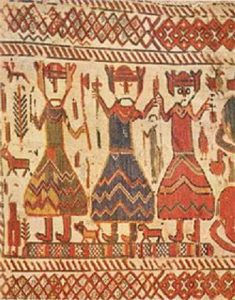
A Swedish tapestry from the twelfth century showing Odin, Thor with his war hammer, and Freyr with stalks of wheat. Scholars believe this reflects the traditional tripartite division of Indo-European societies.


The national-liberalism of 1789 in the face of the Indo-European tradition

The Indo-European tradition, which some people present as Tradition tout court, is the tradition of a tripartite and hierarchical organization of society, where the sovereign function (which relates to the spiritual sovereignty of the priesthood and to the political sovereignty of the sovereign) takes precedence over the military function, which in turn takes precedence over the productive and reproductive function. The authority to decide on “spiritual” and otherworldly issues is up to the priesthood (who compose the sacerdotal aristocracy); and it is always with the priesthood that this authority lies. As for political power – which includes the power to issue commands and make decisions, as well as the authority to decide on secular issues – it always lies with the sovereign and with a warlike aristocracy; warriors sometimes share the political power with the priesthood, but the supreme authority (on a political and potentially spiritual level) is always with the sovereign alone, by reason of his presumed connection to the deity and his wisdom. For their part, merchants and workers find themselves subservient, due to their inferior rank, to the warlike and sacerdotal aristocracy; it is worth mentioning that, depending on the society envisaged (within the Indo-European world), the castes prove to be more or less combined. Thus, Renaissance Italy saw noble-bankers and priest-soldiers emerging.

The juridico-political enfeoffment of the economic caste to the priest and the warrior is traditionally accompanied by a twin primacy of sacerdotal and warlike values (or functions). The national liberalism of 1789 set up a reversal of the Indo-European tradition by placing the productive function at the top: The enfeoffment of the warrior and the priest to the bourgeois thus follows, as does marginalization of the sense of honor (in favor of a sacrificial conception of heroism) and the advent of a materialistic way of life, which denatures the human being. The overthrow of the Indo-European triad in favor of economic values means, not the decrease of self-sacrifice, but the replacement of the Indo-European warlike ethos (i.e., identifying with and fulfilling oneself through war) with the sacrificial ethos of the bourgeois nations (i.e., anonymizing oneself within the mass of soldiers who die for their mother country). Besides, far from encouraging the global outburst of healthy instincts of territorialism, identity, and the will toward dominance and adventure, the hegemony of economics thwarts these basic instincts, the hypertrophy of the economic instinct leads us to focus entirely on trade and production. Such hypertrophy goes against the instinctive behavior of man, for whom the factors we have already named matter more than mere material enjoyment.

Nowadays, the defense of warlike heroism is most often accompanied by a sacrificial conception of the heroic ideal: the “hero” is perceived as the one who is ready to die for society (the nation, the fatherland, the Republic); and who forgets and denies his individuality, standing aloof from any selfishness in his conduct. That conception, stemming from Christianity and celebrated in bourgeois democracies (as well as in totalitarian regimes), diverges completely from the idea that the “pagans” had of heroism in the ancient world. Far from sacrificing himself for society, the hero and the warrior comprised the ruling and dominant class; it was rather society that sacrificed itself for the hero, and not the other way around, in the sense that the social order was designed for the benefit of the warlike and sacerdotal aristocracy. Besides, war was valued and perceived not as a means of self-denial, but quite the contrary, as the way of supernatural fulfillment for the individual: a way for him to divinize himself in the eyes of other men and to see his exploits sung in eternal glory. The esotericism of the priests were regarded as another modality of supernatural fulfillment: another mode of the deification of the individual. Bourgeois materialism – by which one must understand a state of mind mocking and refusing the warlike spirit (or warlike ethos), and denying the reality of magic and that of one’s intuition of the transcendental realms –won over the spirit as bourgeois nationalism was extending its grip over the Western world.

Not content with rejecting (intermediate) inequalities of law, and advocating for inequalities in income and occupation (under the aegis of the state), the national-liberalism of 1789 indeed advocates a materialist and sacrificial conception of existence, according to which the individual must renounce an honorable life – i.e., his heroic accomplishment – and devote himself solely to enrichment, both his own and that of the nation. Besides, the individual is allowed, and even encouraged, to satisfy his “personal interest” on an economic level, with the economic interests of individuals understood as being synonymous with “the interest of the nation” – but he must also be in a position to put his life at stake on a military level. While war in a traditional society is either the work of the warlike nobility and its mercenaries, or else that of a conscript army that respects and incorporates divisions of rank, conscription is an inevitable trait of the bourgeois nation. As the bourgeoisie dethrones the sacerdotal and warlike aristocracy, and inequalities of rank dissipate (in favor of economic inequalities), war becomes everybody’s business. By the same token, the heroic ideal, the supernatural self-affirmation through war or clairvoyance, is devalued; and it is expected from war that it will henceforth be a path of self-denial, the path of sacrifice “in the interest of the nation.”

The mediocrity of classical liberalism, as seen above, consists in its pacifism: the mediocrity of the national-liberalism of 1789, which has nothing to do with pacifism, stems from its sacrificial conception of heroism. The transition from a warlike and sacerdotal order, such as in France of the Old Regime, to a bourgeois order does not mean that bellicosity dissipates, but that the warrior is now subordinated politically and morally to the bourgeois, even in the specific case where the sovereign authority lies with an individual who arises from the military; and where the warlike function is devalued in favor of the productive and reproductive function. In other words, warlike heroism henceforth means sacrificial heroism; the sense of honor, the chivalrous spirit, of the warlike aristocracy is abandoned in favor of the materialistic moralism of the bourgeoisie. The Napoleonic Wars, far from giving rise to a resurgence of the warlike culture of traditional France, precisely enshrined the bourgeois order and the abandonment of a warlike ethos (in favor of the cult of self-sacrifice for the nation). Let us remember what Carl Schmitt wrote on this subject in The Nomos of the Earth: the Jacobins “decried the classic interstate war, purely military, of the 18th century as a cabinet war of the Old Regime and . . . rejected as a matter of tyrants and despots the liquidation of the civil war and the limitation of the external war accomplished by the state. They replaced the purely state war with the people’s war and the democratic mass uprising.”

The national-liberalism of 1789 is therefore a nationalism which breaks with the Indo-European tradition, and subverts the traditional hierarchy of functions and ranks. It combines the ideal of free enterprise and of an extended division of labor with the ideal of a bourgeois nation: in other words, a nation where inequalities in law and income take such a form that the so-called bourgeois class (i.e., the “merchants” in the broad sense: entrepreneurs, capitalists, executives, consultants, bankers, etc.) is now the dominant class; and where the moralism (Vilfredo Pareto proposed the phrase “virtuism”) and materialism associated with the bourgeois class serve as reference values. Italian Futurism, which culminated in Fascism, was certainly in revolt against bourgeois society and its moralism: “We want to demolish museums and libraries, fight moralism, feminism, and all opportunist and utilitarian cowardice,” wrote Filippo Tommaso Marinetti. To the extent that Soviet nationalism and Hitlerian nationalism – but also Fascist nationalism in its definitive form – in turn subordinated the warlike function to the productive and reproductive function, those nationalist socialisms lie in the lineage of the nationalist liberalism of 1789. They combine the ideal of the collective ownership of the means of production, and of central planning, with the ideal of a proletarian nation: it is no longer the bourgeois, but the proletarian, who subdues the warrior (at least on a symbolic and moral level).

National Socialism is certainly a socialism, but it is a socialism where class consciousness is dissolved in favor of race consciousness; and where the mystique of the proletariat blends into a larger mystique surrounding work. The moral (if not juridico-political) allegiance of the warrior to the proletarian remains incontestable, and shows how the socialism of Nazi Germany was a socialism that broke with the Indo-European tradition. In Hitlerian imperialism, the subordination of the warlike function to the productive and reproductive function was announced and described in these terms by Ernst Jünger, in The Worker:

The armed defense of the country is no longer the obligation and the privilege of the sole professional soldiers, it becomes the task of all those who are likely to bear arms. . . . On the same token, the image of the war, which represents it as an armed action, is blurred more and more in favor of the much broader representation which conceives of it as a gigantic process of work. In addition to the armies fighting on the battlefield, new kinds of armies are emerging: the army in charge of communications, the one responsible for the supply, the one that supports the equipment industry – the army of labor in general.

Further precisions on heroism and bourgeois society

With regard to the precise symptoms of the hegemony of the productive function in contemporary Western society, it has been commonly argued that this hegemony implies the predominance of the “utilitarian” lifestyle associated with the merchant, and the dissipation of the “heroic” way of life associated with the warrior. To begin, the distinction between the hero (seen as the one who is ready to die for others) and the merchant (seen as selfish and calculating) developed by Werner Sombart does not stand up to scrutiny. The traditional hero is the one who performs exploits, i.e., exceptional deeds singling him out, and who exhibits a territorial, adventurous, and domineering will, asserting his identity, such that he proves able to achieve. Only the hero in the modern sense – the hero as defined in bourgeois nations – is the one who dies for others: Achilles is ready to die, but for the sake of his own distinction and the immortality of his name. Whether in fiction or in history, many heroes have been merchants, the emblematic example remaining to this day Cosmo de Medici: the noble who rose to rule Florence by virtue of his skill in finance, and who founded a dynasty of Tuscan rulers. Thus, it goes without saying that in defending heroism in the traditional and pagan sense, we do not intend to discredit acts of generosity in society, including the devotion of the saint and that of the mother to her children.

At first sight, it may seem paradoxical to denounce the virtuism of the bourgeoisie while celebrating the warlike spirit of the great captains of industry. In fact, the “bourgeois” who applies a chivalrous code is bourgeois only on an economic level; morally and psychologically, he is a warrior, a kshatriya. The soap opera The Young and The Restless, which is very popular in France, features a businessman, Victor Newman, cultivating a warlike (or Nietzschean) morality in the puritanical and sententious environment of Protestant America. It cannot be denied that the “will to power,” understood as the simple act of aspiring to hegemony in society, is common to both the bourgeoisie and the warriors; on the other hand, the “will to power,” understood as the will and capacity to set up an assertive and fighting character, and to exhibit a conquering and virtuous intelligence – virtuous in the sense of the Machiavellian virtù – is proper to warriors (and to those of the “bourgeois” who have a warlike soul). The hegemony of merchants in contemporary Western society means the hegemony of a class whose will to power cannot be denied if taken in its first sense, but who lack manliness and the sense of honor: in other words, the will to power taken in its second sense.

In bourgeois society, the primacy of the economy over sovereignty and war does not mean that a strictly utilitarian way of life (i.e., unconcerned with the idea of dying for someone or something) predominates; nor does it mean that the natural instincts are unleashed, and that man regresses to the animal stage. As economics takes over, a way of life impervious to the warlike ethos (i.e., the ethos consisting of achievement and distinguishing oneself in war) becomes predominant, which does not mean that this mode of life becomes utilitarian or that war disappears accordingly. Besides, the economic instinct (i.e., the instinct that leads us to seize opportunities in trade and production) is indeed ascendant when economics becomes hegemonic, but it is pitted against the aggressive instincts, so much so that it is a counter-instinctive way of life which is finally manifested. Those are the true symptoms of the hegemony which is realized by the productive function in the contemporary Western world.

It is to the anthropologist and philosopher Robert Ardrey that we owe the remarkable elucidation of man’s priorities: territory and domination, but also identity (i.e., knowing and proving who we are, and experimenting and seeking recognition for the uniqueness of our personalities) and adventure (i.e., leading an exhilarating and meaningful life). It is true that those aggressive instincts very largely dictate our choices in consumption for the reason that, in the enjoyment of material goods, aggression matters more than material comfort (i.e., the comfort of a roof over one’s head and of a steady supply of food and clothes). It is also true that Promethean growth (i.e., based on the domestication of nature through the coal and nuclear industries) and modern capitalism (i.e., entrepreneurial, financialized, and globalized) have allowed consumer goods to satisfy the aggressiveness of the masses as never before: think of the social status afforded by the only possession of an iPhone or of a luxury watch, or the adventure offered by a videogame saga such as The Legend of Zelda. The fact still remains that economic life – and a fortiori consumption – can only satisfy the aggressive instincts of man in an indirect and incomplete manner; and that those instincts are repressed and left unsatisfied as economics ascends in the scale of values.

Besides, the attitude of the economic hegemony towards war does not only mean that on the battlefield, the warlike ethos (which can still be found among soldiers) is scorned; rather, it means that it is despised in warfare, but also in economics – and in these softened and derivative forms of war that are entrepreneurial and financial competition. A society that has become completely hostile to heroism does not praise the kshatriya any more than it admires and protects the soldier who lives according to a warlike ethos: it expects that the soldier should be ready to die for the homeland (instead of distinguishing himself and seeking the thrill of blood and adventure); and that the entrepreneur should make profits (instead of “dreaming” himself to be the heir of Alexander the Great). The contempt for military and economic heroism characterizes economic hegemony; and that contempt culminates in the importance assigned to university diplomas in contemporary Western society, the assumption being that the culture of the diploma ensures devirilized individuals’ access to key positions in companies, governments, and state armies. It can be argued that the culture of the diploma has enshrined the spiritual and moral hegemony of the vaishya over the kshatriya.

Some people welcome the decline of violence that (apart from the Reign of Terror and the Great War) accompanied the rise of the bourgeoisie and the break with the Indo-European tradition: this pacification of Western society was a gift of the bourgeoisie to the world. Nevertheless, the consubstantial violence of the traditional Indo-European societies was a sign of their vitality: a sign that the circulation of elites was ongoing, and that the struggle for life (of which the struggle for preeminence is only a derivative form) was doing well. The gradual pacification of the white world after emerging from the Renaissance should not be interpreted as progress in every respect. To a large extent, the decline of intra-Western violence means the decline of the white world’s elites, for it means the decline of those traditional ways of ascent that include war and the Florentine virtù; it means the prioritization of the diploma and of entrepreneurship among the processes through which the elites are selected. As the circulation of elites is pacified, the chosen elites emerge more and more emasculated and less and less heroic – leading to our greatest misfortune today before the invaders from Africa and the Middle East. When it is not simply humanitarian cowardice that motivates the elites of the Western nations to allow terrorists and colonists prosper with impunity on European and American soil, they behave as emissaries of the world’s superclass, for whom the “great replacement” of the white man (i.e., the European or American Caucasoid) is a clearly established goal.

Towards a new national-liberalism: Territorial-aristocratic liberalism

Can one conceive of a nationalism that combines the ideal of free enterprise and an extended division of labor with the warlike and sacerdotal order on which Tradition is built? We will try to show that yes, such a nationalism is conceivable; and we will outline the contours of this radically new doctrine. Beforehand, however, we must specify that we accept the distinction made by Julius Evola between an aristocratic nationalism (based on the warlike-sacerdotal aristocracy and a heroic and supernatural conception of existence) and a plebeian nationalism (based on equality and materialism). Within national-liberalism, we believe that the same distinction applies between a national-liberalism of the plebeian kind (that of the French Revolution) and that of the aristocratic kind: namely, the one we defend and which is biding its time. If both are defined as national socialism, Soviet and Maoist nationalism can both be subsumed in this category along with Hitlerian nationalism, and national socialism itself is only a modality of plebeian nationalism.

In its new and aristocratic version, national-liberalism approves of the prosperity and “recognition” of the merchants, while rejecting their juridico-political and moral hegemony: likewise, it rejects the enfeoffment of the warlike function to the productive and reproductive function and intends to restore the primacy of warlike and sacerdotal values in society, as well as the juridico-political hegemony of the priests and warriors. Additionally, it defends property rights and modern capitalism of an entrepreneurial, globalized, financialized, and “digitized” kind: it intends to preserve the forms of Tradition in the context of modern capitalism. Such nationalism rejects any form of egalitarianism, including the universality of law (which serves, let us recall, as the fundamental value of liberalism); to the extent that this nationalism affirms its attachment to free enterprise and to the extended division of labor, and recognizes the true value of the coordinating role of the entrepreneur (who adjusts the division of labor in an optimal direction), it is all the same allowed to consider that doctrine as a liberalism – a borderline case of liberalism. Since that liberalism defends the nation, and thus the territorial instinct, and defends the inequalities of rank which constitute Tradition, and therefore the warrior-sacerdotal aristocracy and the instinct towards domination, it is possible to baptize this doctrine: territorial-aristocratic liberalism.

While the national-liberalism of 1789 combines the ideal of free enterprise with the rejection of castes (being the intermediary between the state and the individual), and with a materialistic and egalitarian conception of human life (which rejects supernatural ends and devalues the priest and the warrior for the benefit of the merchant), territorial-aristocratic liberalism simultaneously preaches free enterprise and the return to castes as well as a “traditional” system of values. Far from denying race, the national-liberalism of 1789 recognizes the bonds of blood on which the nation is built; more precisely, it rejects the distinctions of rank within the nation, and thus rejects caste consciousness in favor of mere race consciousness. This state of mind culminates into the “racism” of 1789 towards the warlike nobility, which sees itself conveniently likened to a foreign race. For its part, territorial-aristocratic liberalism advocates race consciousness, but also caste consciousness and the restoration of a sacerdotal and warlike nobility; nevertheless, it remains attached – like the national-liberalism of 1789 – to free enterprise and the extended division of labor. Besides, it denounces deep ecology and promotes Promethean growth: that which does not rest only on the extension of the division of labor, but on the emancipation of human productive powers towards the cycles of nature – an emancipation which is the work of the exploitation of fossil and nuclear energies.

Man, as territorial-aristocratic liberalism envisions him, is not this puppet of Hume or Hayek’s theories, who pursues his “private interest” (an expression which, in their theoretical framework, insidiously designates the pursuit of material well-being) while deliberately and calmly cooperating with others in the framework of universal rules of law. Rather, in this view, he is fundamentally aggressive: First and foremost, he is territorial and domineering, adventurous and identity-minded, and not concerned with his material well-being. Besides, that new liberalism sees man not as a calculating agent whose conduct is deliberate and peaceful at every moment, but as an agent most often making decisions under the influence of emotional impulse, thus only giving an appearance of rationality to his actions through non-logico-experimental derivations. In accordance with this anthropology, territorial-aristocratic liberalism cannot contain the society of this famous “spontaneous order,” which is dear to the heart of Friedrich von Hayek: in fact, that muddy expression refers to a juridically egalitarian order, where the struggle for status is eclipsed in favor of economic competition alone.

Society, as envisaged by the new liberalism, is necessarily organized around a pecking order, a hierarchy of castes, regardless of whether it is a hierarchy which ignores the intermediate ranks; and never around universal rules of law. But while rejecting formal egalitarianism and the universality of law, territorial-aristocratic liberalism does not accept castes without social mobility: that is, without a system of free competition for status. Besides this, it intends to preserve the identity peoples, not forgetting that a relative genetic and cultural homogeneity, as well as a common territory, are an integral part of a social link; and that one cannot boil everything down to the division of labor and commerce. If so many anarcho-capitalists indulge in “multiculturalism,” it seems that this is due to the fact that, conversely, they believe that the division of labor is the cement of society, and they consider that genetic and cultural proximity plays only a secondary, or even insignificant, role in socialization processes. Besides this, they deny the territorial instinct; they therefore imagine that all kinds of heterogeneous races and cultures can cohabit peacefully within the division of labor that has been established on a given space.

And now let’s talk about the state. Its vocation in territorial-aristocratic liberalism is not to guarantee an egalitarian right (i.e., universal freedom), nor is it to administer the economy or to redistribute incomes. The state, as territorial-aristocratic liberalism wants it, presents itself as the guardian and summit of a hierarchy of castes opened to social mobility; i.e., that subordinates (on a juridico-political level) merchants in relation to warriors and the priests in the hierarchy, while warriors and the sovereign (unless he himself stems from the sacerdotal caste) are “spiritually” subordinated to the priests. In this way, the state brings form and harmony, “a differentiated and hierarchical order of dignities” (according to the formula of Julius Evola), to a multitude which came before it; and that proves relatively homogeneous on a genetic and cultural level. In this way, too, the state puts into practice the two laws (dear to Robert Ardrey) that life in society renders necessary in all vertebrate species: the inequality of ranks (in favor of the juridico-political domination of the “alphas”: warriors, priests, and the sovereign); and free competition for status – instead of an automatically hereditary perpetuation of ranks.

Besides this, territorial-aristocratic liberalism is fully open to consumerism and to technological innovations. It envisions the cosmos as an active entity, striving relentlessly towards order and complexity, and the human being as a catalyst for cosmic creation; it believes that the cosmos mandates man to perpetuate and multiply the creative gesture of nature through the accumulation of capital and the provision of new goods and services for the masses. Territorial-aristocratic liberalism considers that a nation can prove to be both “consumerist” (in the sense that it pursues the enjoyment of consumer goods) and faithful to Tradition, a cultivator of virile and supernatural values, and anxious to maintain the connection with the spiritual realm. While defending traditional (or pagan) heroism against sacrificial heroism, it sees in heroism an attribute of the productive function, and not only of the warlike function: it believes that from it may, from time to time, emerge an entrepreneur who possesses the warrior spirit. Not content with praising the men who build a commercial or financial empire, it promotes the enthronement of the great samurais of finance and of the great captains of industry among the ranks of the warlike aristocracy.

Further precisions on territorial-aristocratic liberalism

In the end, our liberalism is archeofuturist in the sense that it reconciles warlike society with consumer society, and the hegemony of the priests with the prosperity of the merchants. With the overthrow of the Indo-European triad, the priest lost his spiritual authority for the benefit of the bourgeois; moral authority henceforth lies with the bourgeoisie, which seeks advice from the priest, soliciting his gifts of clairvoyance for the smooth running of business. Our liberalism, which reengages with the spiritual order and breaks with bourgeois materialism, is a liberalism of the Indo-European tradition: It intends to restore the traditional aristocracy, which consecrates the moral and juridico-political primacy of the priest and the warrior over the merchant. Our liberalism also prohibits itself from intervening in the choices of individuals with regard to pensions and healthcare, with the sole exception of emergency measures to be taken in the case of a serious pandemic. It also believes that education must take warlike and aristocratic values into consideration while leaving the bosom of the state, at least in terms of its funding.

Some additional clarifications need to be made regarding globalization. The inequalities inherent in the legal system of the pre-1789 societies amounted to exceptional laws for the benefit of the warlike and sacerdotal nobility, which existed within nations and yet sustained links of solidarity that extended beyond nations. The contemporary inequalities in law amount to exceptional laws for the benefit of the bourgeoisie (who has taken control of governments through the dissipation of intermediate inequalities in rank), but also for the benefit of a small number of companies and banks whose executives compose what has been judiciously called a world superclass: a class that sits above nations. It would be wrong, however, to conceive of those inequalities in law as consubstantial with the phenomenon of globalization: the grip of the world superclass is an accidental feature of globalization as we are living it; it does not necessarily have to be this way. Territorial-aristocratic liberalism intends to restore the traditional inequalities in law and couple them with globalization; it is not a question of restoring those inequalities in opposition to globalization.

Quite often, the denunciation of “globalism” and of the “reign of merchants” proceeds from the vilest petit-bourgeois resentment. Behind the moralizing speeches against Starbucks, KFC, Volkswagen, Sony, Amazon, or Apple, one can glimpse the second-tier entrepreneur who is jealous of the power of the multinationals. In reality, multinationals represent a danger to the nation so long as they behave as the agents of influence for cosmopolitanism; but they are by no means harmful in the cold pursuit of their economic interests. It is sound, and even imperative, to counter the cosmopolitan lobbying of multinationals; it is insane to denounce the strategy of multinationals to apportion activities on a global scale: specializing the regions of the world according to comparative advantages does not harm, but benefits, the prosperity of nations. Far from deploring the power of multinationals, territorial-aristocratic liberalism knows that the power of a nation implies a hegemony that is as much economic as it is military and cultural. It is not outraged that the firms which an ambitious nation gives birth to conquer an international market, implement subsidiaries around the world, or solicit favors from foreign governments.

Concerning protectionism, territorial-aristocratic liberalism recognizes that the facilitation of trade between nations, which amounts to facilitating the extension of the division of labor across borders, as well as the coordination of the division of labor via the entrepreneurial reallocation of capital across borders, necessarily benefits consumers. It recognizes that this advantaged situation of the consumer means the mutual enrichment of nations engaged in free trade; nevertheless, it knows that it is not true that this mutual enrichment implies that the gains of free trade are also mutual on a geopolitical level. If openness to free trade allows the enterprises of a foreign nation to gain the upper hand over the enterprises of a nation adopting free trade, or the foreign labor force to replace the labor force of this same nation, then there is actually a balance of power which is established. Free trade is always a positive-sum game from the point of view of consumer enrichment; it is very often a zero-sum game from the point of view of the nation’s hegemony. A wise government must seek the right balance between free trade and protectionism: it must ensure the enrichment of the consumer without losing sight of economic hegemony. It is quite legitimate to quote the wording of Voltaire: “To be a good patriot is to wish that one’s own community should enrich itself by trade and acquire power by arms; it is obvious that a country cannot profit but at the expense of another and that it cannot conquer without inflicting harm on other people.”

A word on currency. Applying the teachings of the Austrian School of Economics, territorial-aristocratic liberalism does not entrust the monopoly of issuing money to a single organ such as the central bank in its present sense. It ensures the free competition and circulation of currencies out of a strict concern for respecting property rights; it can nonetheless entitle the state to ban such currencies which are disrespectful of private property, namely which weaken purchasing power, distort the means of production, and generate dysgenic behaviors. It can also entitle the state to determine those currencies which are allowed to circulate, without the state having to intervene in the process of production, exchange, and circulation. For this reason, territorial-aristocratic liberalism favors any currency such as gold or silver (without introducing a bimetallic system) in order to clarify that money – due to its character as a means of exchange and representation of value, must be of a very particular and ethical nature because it coordinates production, exchange, and the temporal preferences of individuals; for this reason, it must obey a principle of relative rarity and very high quality. The practice of the fractional reserve by the banking institutions will be prohibited; banking regulations will be abolished in favor of returning to commercial and private law in the strictest respect for private property; counterfeiting will be severely punished.

Conclusion

The enterprise of subversion in the form of the city, which began with the overthrow of the Indo-European tradition in favor of the advent of commercial society, finds its apogee in contemporary cosmopolitanism. Classical liberalism has strongly encouraged that cosmopolitanism, while the bourgeois takeover has accompanied the implementation of the ideals of 1789. Saving the identity of the West, and of France in particular, can take place by reifying a new national-liberalism: a national-liberalism which is not limited to defending the nation against cosmopolitanism; but that also reconciles free enterprise and the extended division of labor, as well as “Promethean growth,” with the defense of the traditional nation and its warlike and sacerdotal order against both bourgeois society and the modern nation.

Grégoire Canlorbe is an independent scholar who has conducted numerous interviews with economists and social scientists for academic journals such as Man and the Economy, which was founded by the Nobel Prizewinning economist Ronald Coase. His subjects have included a wide range of renowned personalities such as Yves-Saint Laurent’s co-founder and former President Pierre Bergé, Greenpeace’s co-founder and former President Patrick Moore, and former Czech head of state Václav Klaus. Canlorbe is at work on a book of interviews with the sociologist and philosopher Howard Bloom about mass behavior in the universe, from quarks to humans. Besides his intellectual and journalistic activities, he is the Vice President of the emerging French party, Parti National-Libéral.

Tuesday, November 20, 2018

Libertarianism, Cosmopolitanism, & Indo-European Tradition, Part 1

                       By Gregoire Canlorbe


Warning: This article lies on a metapolitical and ideal level, and not on a programmatic and political level.


The obsession of liberals (libertarians, either “classical liberals” or “anarcho-capitalists”) with condemning economic or Cultural Marxism is a dead end. Saving Western civilization requires the wisdom to identify, and the courage to name, the true contemporary enemy of the West: cosmopolitanism. Cultural Marxism is a sluggish expression, which may at best designate Gramsci’s doctrine that Marxists must, before attempting the Revolution, achieve cultural hegemony; as for economic Marxism, which is only a way of designating Communism and planning, it subsists at the margins. Cosmopolitanism is the ideology promoted by the “global superclass,” according to the expression popularized (if not initiated) by Samuel Huntington: the world superclass consists of a transnational network of uprooted and denationalized people, whose gestation dates back at least to the beginning of the twentieth century and whose constitution accelerated with the fall of the Soviet bloc. This article aims to elucidate the conceptual relations between liberalism (libertarianism) and cosmopolitanism, and will outline the contours of a new variety of liberalism: a liberalism simultaneously directed against bourgeois nationalism and against cosmopolitanism.

Definition of cosmopolitism

By cosmopolitan ideology, one must understand the ideology that rejects humanity divided into nations. As such, cosmopolitanism condemns the particular mode of organization that characterizes a nation, which confers on a group of individuals the identity and unity of a nation. That mode of organization is the following: a relative genetic homogeneity, as well as cultural; a chain of social and juridical ranks that goes back to a sovereign political authority (i.e., the supreme authority within the government); and a territory that is covered by, and which limits, this hierarchical and homogeneous organization. Cosmopolitanism attacks the sense of territory, and therefore borders, by forbidding governments to defend nations against indiscriminate free trade or free immigration. It also attacks the juridico-political hierarchy of a nation in advocating the sole income and occupation inequalities, or in defending a world government. Finally, cosmopolitanism condemns the genetic and cultural differences between nations: not content with advocating the relativism of values within each nation – i.e., the abolition of moral boundaries enacted within them – it praises the leveling of races and cultures.

It is a mistake to believe that the cosmopolitan elite cultivates the ideal of a humanity reduced to its animality. The ideology of the world superclass abhors, very precisely, these fundamental instincts of human nature that are territorialism the will to domination, identity and adventure, which are so many distinct expressions of the aggressiveness coded in our genome. The ideal that cosmopolitanism cultivates is actually that of a humanity in which the instincts of territory and identity, and thus the attachment to frontiers, are no longer expressed; and of a humanity in which the instincts of adventure and domination, and thus the taste for competition and war, are no longer expressed. A humanity deprived of its national and cultural rooting – but also, more fundamentally, of its biological rooting – is the horizon of cosmopolitan ideology. In the field of values and moral boundaries, let us point out that the cosmopolitanism of the world superclass diverges from the pur et durcosmopolitanism, in that the ideology of the world superclass counterbalances the call to ignore moral boundaries (on behalf of individual emancipation) with the concern for preserving and establishing typically bourgeois values.

Although the concept of “cosmopolitanism” was brandished for the first time by the Cynic philosopher Diogenes of Sinope, it is far from being evident that Diogenes (and in his wake, the Stoic philosophers) understood cosmopolitanism in its current sense of an ideology preaching the relativism of values and the leveling of races and nations. It may well be that cosmopolitanism in its Classical sense was only the philosophy that everyone belongs – on a moral and bio-cultural level – to a given nation, and in a “spiritual” sense belongs to all of humanity as well: such a conception does not mean the rejection of nations. Be that as it may, what will concern us here will be cosmopolitanism as it is understood (and set up) by the world superclass; and it will be liberalism envisaged in its relation to the cosmopolitanism of the world superclass: a cosmopolitanism that advocates bio-cultural leveling and a certain moral relativism, but which remains attached to these properly bourgeois values that are the hegemony of economy, contempt for virility, the materialist approach to reality, and puritanical or feminist moralism.

The three faces of the equalitarian utopia

For the overwhelming majority of liberals, they (be they academics or simply followers of the liberal philosophy) refrain from denouncing cosmopolitanism and envision Marxism as the only enemy to fight. What is more, they indulge in cosmopolitanism at various levels, whether or not they use the term cosmopolitanism; and whether that ideological stance is conscious on their part or is so natural that it goes unnoticed in their own eyes. Is that situation the sign that liberalism is culminating as cosmopolitanism: in other words, that cosmopolitanism constitutes the logical outcome of liberalism; and that the endorsement of cosmopolitanism among liberals is, therefore, neither accidental nor contingent (but responds to a conceptual necessity)?

Before we answer, it is not useless to highlight the kinship of liberalism, socialism, and cosmopolitanism. Those three ideologies (or philosophies) are ultimately the three distinct manifestations of the same egalitarian ideal. Indeed, liberals, socialists, and cosmopolitans are enemy brothers, animated by a common passion for equality; even though it is a faith, an ideal, that they embody in three distinct ways: universality of law for liberals, equality of income for socialists, and the leveling of races and nations for cosmopolitans. Let us add that liberalism, socialism, and cosmopolitanism – as they have unfolded since the French Revolution – also converge in their common adherence to the hegemony of economy in the scale of values. Such hegemony is not a wishful vow on the part of egalitarian ideals: as rank inequalities were dissipating (in accordance with the liberal ideal of equality in law), economics has gradually lifted itself (since the Revolution of 1789) to the summit of Western values. By the same token, the welfare state has gained ground (in accordance with the socialist ideal of economic equality), and cosmopolitanism itself has finally contaminated the intra-national mores and relations between nations.

Let us be clear about what makes the singularity of each of the three heads of the equalitarian hydra. The universality of law – or the equality of human beings with regard to the rules of law that must apply to them – serves as the fundamental value of liberalism. The essential propositions of that philosophy always boil down to some justification or affirmation of the value of equality, understood in its legal sense as equal freedom for all equal escape from all coercion (in their lives and in terms of the goods they can acquire). For socialism, it is equality in an economic sense – income equality and central planning – which serves as a fundamental value; and for cosmopolitanism, it is equality taken in a biological, cultural, and “communitarian” sense: the equality of men in the sense of their biological and cultural lack of differentiation, and in the sense of their not belonging to any other collective than humanity. That everyone should be culturally and racially identical, that no one should be a member of a nation within humanity, that everyone should be a member of humanity considered as a collective in its own right (and that one should be a member of that collective only), that the individual should be released from the values and moral boundaries that his affiliation to one or another nation assigns to him, and that he should everything which “thwarts” and separates individuals should be removed: this is the egalitarian creed of cosmopolitanism.

From classical liberalism to anarcho-capitalist cosmopolitanism

In its chemically pure form, so to speak, liberalism merges with an anarchism that respects private property – and, in particular, the private ownership of the means of production. Knowing whether the “truth” of a doctrine lies in the extremist, radical branch of that doctrine or in its moderate, “pragmatic” branch is an insoluble problem: it is a matter of arbitrary consideration, of “subjective preference,” rather than a means to identify the authentic meaning of a doctrine with what its radical or moderate branches affirm. Therefore, it would be futile that we ask whether anarcho-capitalist liberalism is “truer” or more “authentic” than so-called classical liberalism. But it is not vain to determine whether integral liberalism, in addition of being anarchist, is also a cosmopolitanism (out of logical and conceptual necessity). We will see that anarcho-capitalism only serves to exacerbate the cosmopolitanism already present in classical liberalism.

The classical liberalism of John Locke, Adam Smith, Jean-Baptiste Say, the Mill father and son, Robert Torrens, Frederic Bastiat, Yves Guyot, Ludwig von Mises, or Friedrich August von Hayek, not only affirm its attachment to equality in law, or universality in the rules of law, but promotes an extended division of labor, and praises the entrepreneur as the one who coordinates the division of labor (on the basis of his anticipation of the fluctuations in demand), spurring the allocation of factors in anticipation and in the direction of long-term equilibrium (where capital is allocated in such a way that entrepreneurial decisions have correctly anticipated the priorities now displayed by the demand for consumption or investment). Anarcho-capitalism lies in the vein of classical liberalism, except that it rejects the “minimal state” promoted by classical liberals; and calls for privatizing (and opening up to competition) the regal functions, to put an end to the state’s legal monopoly on the use of force to sanction the rule of law.

The greatness of classical liberalism (that culminates in anarcho-capitalism) lies in its double demonstration of the superior productivity of the extended division of labor, and of the need for the free market – and a fortiori the free market for capital goods, in the absence of which there can be no anticipation and no calculation of the profitability of allocation decisions – to coordinate the division of labor in the direction and in anticipation of the optimal satisfaction of the demands for consumption and investment. The mediocrity of classical liberalism lies in its contempt for the warlike spirit, and in its pacifist ideal, which degrades human nature, given that it is the case – as Hegel knew so well – that “the movement of the winds preserves the waters of the lakes from the danger of putrefaction, which would plunge them into a lasting calm, as would do for the peoples a lasting peace and a fortiori a perpetual peace.” Let us note that the pacifism of classical liberalism has remained wishful thinking to this day; and that the West after the Revolution of 1789 did not see the end of war, but only of the warrior spirit: we will return to this subject later.

Anarcho-capitalists, as much as classical liberals, by the very necessity of their doctrine indulge in cosmopolitanism. While classical liberalism merges with a relative cosmopolitanism, anarcho-capitalism merges with a more pronounced cosmopolitanism. While classical liberalism affirms the existence of nations, and nonetheless promotes the indiscriminate opening of borders to goods and migrants (in the name of the ideal of a division of labor whose scope transcends political boundaries), anarcho-capitalism denies or condemns the existence of nations themselves. The reason for that animosity lies in the fact that anarcho-capitalism draws all the implications of equality in law, which is tantamount to saying that it aspires to an equality in law that is perfect, “die-hard.”

Classical liberalism, as it accepts the state, accepts a first infringement of equality in law: officials and taxpayers, indeed, do not see themselves judged by the same rules of law (in the sense that the former are exceptionally empowered to live on coercion and to enjoy privileges such as, for example, the more extended right to strike, very advantageous pensions and health care mutuals, or guaranteed employment). However, classical liberalism does not only accept the state, it accepts the state within a national framework: it accepts the state as it covers the territory of a given nation, federated by a relative cultural and genetic homogeneity; in spite of notable exceptions, including that of Mises, classical liberalism does not promote the disappearance of national states in favor of a world state. As such, in addition of accepting the inequality in law between civil servants and taxpayers, classical liberalism accepts the inequality in law between domestic residents and foreigners. Anarcho-capitalism does not even want those two infringements of equality in law: the only inequalities that it considers legitimate are the inequalities of income and profession, any inequality in law becoming ipso facto guilty in his eyes – including the distinction between the official and the taxpayer, and that between the national citizen and the foreigner.

Concerning the relative cosmopolitanism that characterizes classical liberalism, and the adherence to a world government that makes the originality of Ludwig von Mises within classical liberalism, this passage from his treatise Liberalism is quite clear:

The metaphysical theory of the state declares – approaching, in this respect, the vanity and presumption of the absolute monarchs – that each individual state is sovereign, i.e., that it represents the last and highest court of appeals. But, for the liberal, the world does not end at the borders of the state. In his eyes, whatever significance national boundaries have is only incidental and subordinate. His political thinking encompasses the whole of mankind. The starting-point of his entire political philosophy is the conviction that the division of labor is international and not merely national. He realizes from the very first that it is not sufficient to establish peace within each country, that it is much more important that all nations live at peace with one another. The liberal therefore demands that the political organization of society be extended until it reaches its culmination in a world state that unites all nations on an equal basis. For this reason he sees the law of each nation as subordinate to international law, and that is why he demands supranational tribunals and administrative authorities to assure peace among nations in the same way that the judicial and executive organs of each country are charged with the maintenance of peace within its own territory.

Anarcho-capitalism condemns the distinction between the official and the taxpayer, as well as the distinction between the national citizen and the foreigner. Without being integrally cosmopolitan (and favorable to moral relativism or bio-cultural leveling), anarcho-capitalist cosmopolitanism is therefore a much more assertive, much more radical cosmopolitanism than is classical-liberal cosmopolitanism. In practice, one cannot but notice that there exists – in addition to those cosmopolitan tendencies that flow from a conceptual necessity – a very strong propensity of anarcho-capitalists to deny the existence of aggressive instincts, as well as that of races and cultures; and to condone, or even encourage, cultural leveling and miscegenation. This is accomplished on the grounds that only “individuals” would thus exist – i.e., individuals who are not only born tabula rasa and undifferentiated, but who have no other social link than the division of labor and trade. National genetic and cultural links are particularly denied. Such an approach deserves, in our opinion, the qualifier of “liberal Lysenkoism” [“libertarian Lysenkoism]; it is found among anarcho-capitalist, but also hybrid liberals: those who rally to the minimal state (or minarchy) of classical liberalism are nevertheless seduced – like anarcho-capitalists – by the ideal of racial and cultural leveling.

From the national-liberalism of 1789 to pseudo-nationalist anarcho-capitalism

One can conceive of “chemically pure,” radical liberalism as an egalitarianism which recognizes as legitimate only economic inequalities: income and occupation inequalities. Some anarcho-capitalists, however, claim to be defending the nation and developing a system that reconciles the preservation of nations with the universality of law: such is the case with Murray Rothbard, Hans-Hermann Hoppe, or Bertrand Lemennicier. We will see that these claims are invalid, and that such a version of anarcho-capitalism is only pseudo-nationalism. Nevertheless, there is indeed a liberalism that reconciles the ideal of the nation and the rejection of all forms of cosmopolitanism with equality before the law, or the universality of the law; and that liberalism is none other than that which inspired the Revolution of 1789 and the posterior European nationalisms.

We have seen that classical liberalism affirms the existence of nations and advocates that they cultivate pacifism and free trade, rejecting warmongering for the benefit not only of peace, but for an unlimited division of labor that extends beyond the frontiers; where men and capital circulate without the slightest restriction. The national-liberalism (or nationalist liberalism) of 1789, which served as the matrix for the various European nationalisms of the nineteenth century, differs from classical liberalism on the question of free trade and free immigration: it does not intend – unlike classical liberalism – to open borders to goods and people without discrimination. It is also distinguishable from classical liberalism on the question of pacifism: Napoleonic imperialism and the conflict of 1914-1918 constitute the purple epiphany of the warmongering inherent in bourgeois nationalism.

The national liberalism of 1789 combined the ideal of free enterprise with that of a perfectly unified nation, i.e., deprived of its intermediary bodies and of its rank inequalities. It intends to exacerbate the national sentiment so that the feeling of belonging to a nation henceforth arouses greater pride than that of belonging to some caste or class within that nation; it also attempts to erode the traditional status inequalities so that the nation will only know inequalities in terms of income and profession, and that individuals are reduced to mere cogs in the division of labor. Besides this, the national-liberalism of 1789 promotes a greater cultural homogenization: for example, in combating regional dialects and in imposing the use of a single “national language,” it can even promote the unification (into a single nation) of a geographical area that is composed of culturally and genetically related nations. Italy and Germany offer us two eminent examples of such unification.

On all those points, apart from forced unification and cultural homogenization, the national-liberalism of 1789 convergences perfectly with classical liberalism. Their model of the nation is rigorously the same: namely, that of a bourgeois nation. The disagreement comesover the questions of free trade, free immigration, and pacifism. As Vilfredo Pareto invites us to do, it is always worthwhile to distinguish between the “residue” and the “derivation,” the feelings that an ideology expresses and the supposedly logico-experimental varnish that covers them (often in disguising them). In fact, the national-liberalism of 1789, which claims to adhere to equality before the law, legitimizes a society that does not ignore inequality before the law, but only intermediate bodies (between the government and the individual); and where inequality before the law takes such a form that the dominant class, juridically and politically, becomes henceforth the bourgeoisie by virtue of the erasure of the intermediate inequalities in rank in favor of solely economic inequalities. The national-liberalism of 1789, like classical liberalism and even anarcho-capitalism, proposes to defend the bourgeois order and the commercial society under the guise of a mysticism of equality.

A version of anarcho-capitalism exists, which I have already referred to as pseudo-nationalist, which claims to be a liberalism that claims to preserve nations. Its adherents are, in truth, just as deluded on that question as those among the anarcho-capitalists who openly claim to reject the nation. The anarcho-capitalism à la Hoppe conceives, in more or less explicit terms, of the nation as an association based on property rights, and on the basis of property rights only. In other words, it envisions the nation as a vast ownership cooperative on which the state would be grafted ad hoc. The sympathies of those who adhere to the national-liberalism of 1789 for this variant of anarcho-capitalism stems from the condemnation of free immigration that has been formulated by the thinkers of Hoppe’s school. While they support free trade and the indiscriminate opening of national borders for the exchange of goods, they claim that the indiscriminate opening of those same borders to people violates property rights.

The inanity of such a conception of the nation cannot be overestimated. In the real world, national boundaries are not enshrined by property owners, but by governments. The nation is no more a fantasy exploited by governments to legitimize their authority over a given territory than it is an association of private owners. Once we get beyond the anarcho-capitalist chimeras, it is possible to apprehend the nation for what it is: a space federated by a given pecking order, and thus a certain juridico-political order; and by a territorial instinct which is expressed as much among the owners “at the bottom of the social ladder” as among those – bourgeois or aristocrats – who compose the ruling class and the state administration. It is also expressed in a relative genetic homogeneity, as well as that of culture: a common worldview, a certain canvas of memes. In fine, wanting to rebuild nations on the basis of property rights constitutes a modality of cosmopolitanism.

For an introduction to the theory of pecking orders, one may consult Howard Bloom’s interview with the Gatestone Institute:

Research on pecking orders – known technically as dominance hierarchies – has gone on now for roughly a hundred years. Schjelderup‑Ebbe, the naturalist who observed this “dominance hierarchy” in a Norwegian farmyard, called it the key to despotism. Schjelderup-Ebbe had discovered that in the world of chickens there is a social hierarchy, a division into aristocrats and commoners – a lower, middle and upper class. Pecking orders also exist among men, monkeys, lobsters, and lizards. And the struggle for position in a pecking order is not re­stricted to individuals. It also hits social groups.

Bloom’s interview is also interesting as an introduction to meme theory:

As genes are to the individual organism, so memes are to the social organism, or superorganism, pulling together millions of individu­als into a collective creature of awesome size. Memes stretch their tendrils through the fabric of each human brain, driving us to coagulate in the cooperative masses of family, tribe and nation. . . . In law, politics, and economics, individualism is a personal credo of great importance. I, for one, am a passionate believer in free speech, democracy, and capitalism. But to scientists, the obsession to place emphasis on the individual has been a chimera leading them down a dead‑end path. History, either natural or human, has never been the sole province of the selfish individual, essentially preoccupied with preserving his genes. For history is the playfield of the superorganism – and of its recent step-child, the meme.

Concerning the argument that a free immigration policy is incompatible with respect for property rights, and therefore incompatible with anarcho-capitalism, that argument is merely a rhetorical trick, a “derivation,” than a logico-experimental form of reasoning. Indeed, it implicitly assumes that the nation constitutes a club or cooperative ownership, where the decision to authorize (or refuse) the entry of migrants is made by the owners (or by a gathering of members of the club). Yet that is a manifestly false conception of the nation (which is no more a club than it is a cooperative); and on the basis of such a premise, one could just as easily argue that free trade violates property rights, and therefore anarcho-capitalism, on the grounds that a policy opening up the nation’s frontiers to goods denies the right of the owners to decide which goods are allowed to cross the boundaries of their properties.

Free immigration and free trade must be limited, not in the name of anarcho-capitalism, but in the name of rejecting the cosmopolitanism inherent in classical liberalism and in all forms of anarcho-capitalism. Liberalism must be counterbalanced, limited by “civilizational” and geopolitical considerations: in this respect, it should be reminded that the invasion of Western nations by cosmopolitanism is only the culmination of a process of subversion which began with the abandonment of the warrior-based and sacerdotal culture, and with the advent of the commercial (or bourgeois) society. Classical liberalism has been involved in the march of cosmopolitanism from the beginning, in the sense that it has accompanied free trade and free immigration; for its part, the national-liberalism of 1789 has been involved in the march of the commercial society (without either classical liberalism nor anarcho-capitalism coming to intellectually oppose bourgeois society, or to defend the Indo-European tradition).